
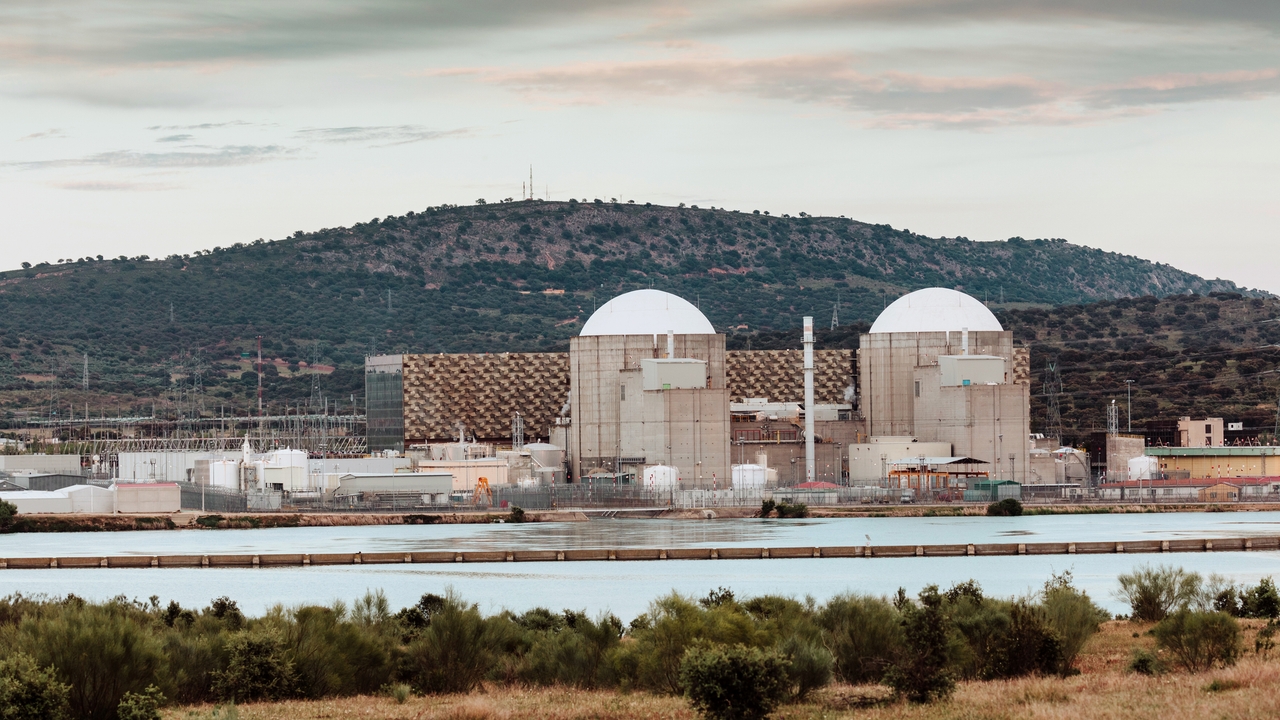
Some 7,000 people took to the street last Saturday to demonstrate against The Almaraz closure. The nuclear power plant is located in the Commonwealth of Spider’s Field (Cáceres) and has been operating since the end of 1983 generating some 2,000 direct jobs in the region. According to the closure of closures, agreed in 2019 between electricity companies and the government, this installation will be the first to stop producing. The first Almaraz reactor will close on November 1, 2027 (it has to begin shortly to cool to stop) and the II in October 2028. The rest of the reactors, which right now generate 20% of the electricity of the electricity of the electricity of the Mix, they will have to go out to 2035 according to what the National Integrated Energy and Climate (PNIEC) includes.
The closure of the Government of Spain with the nuclear blackout contrasts with the growing interest in this source of energy worldwide. The rebirth, as the International Energy Agency is called, is based on a “rhythm of construction of new atomic reactors that represent a capacity of 71 GW, something that has not been given for three decades. This year electric productiona of the more than 400 operational reactors in the world will reach 2,900 twh, The highest level so far, ”says the entity in a report published these days. There are 40 countries with development plans for these infrastructure and nuclear capacity is expected increase 50%, up to 650 GW in 2050.
More than half of the reactors are built in China, but interest in the United States is being reactivated (Trump has promised to boost this technology), France, the United Kingdom, Sweden, Switzerland, Holland or Belgium. Even Japan that, after the accident of Fukushima of 2011 It was proposed to dispense with this energy, it has two new reactors under construction and keeps a dozen of its more than 30 centrals into operation.
The situation when the closures in Spain were agreed in 2019 is not the same as at 2025. The Ukraine War or the European decision to become independent of Russian gas led the commission in 2022 to integrate nuclear and gas in European green taxonomy, That is, he integrated them into the group of “green” technologies in which it can be invested. In Europe there are very different situations. In Germany there is a lot of social response with this energy and the country, which also announced its intention to do without the nuclear after Fukushima, just turned off its last three reactors. In France, the EU country with greater presence of fission in its energy mix (up to 70% of the total) It is in a paradoxical situation. On the one hand, they have announced new investments in this technology but another is finding problems. These days, the country’s court of accounts published an audit report in which it highlights that the EPR2 program of the Electricité de France SA (EDF) company, through which two new reactors were going to be built, a 30 %. «France, is very dependent on nuclear energy but its reactors begin to be old and generate problems as we saw in 2022 when of the 47 reactors that stopped producing almost half of them. Spain had to supply a lot of energy to cover that electric hole, ”says Javier Andaluz, responsible for climate change of environmental environment, who also remembers some iconic investments cases in the old continent that have not gone well. “In Finland, the Olkiluoto 3 reactor was going to end in 2007 and has 18 delay and with an envelope of 8,000 million euros.” The position of the NGO is clear, first see how chimeric that the nuclear power in the world is doub Solar comes out more profitable. In fact, there is no interest, not even the proprietary companies, in betting on new centrals or lengthening the useful life of which there are already. “Any extension would imply enormous costs to implement additional security measures asks for Europe, including Almaraz’s,” says Andalus.
The possibility of lengthening Almaraz’s life until 2030, and the rest of the Spanish park, seems at the moment, remote. The employer who brings together the companies that own these facilities, Nuclear Forum, points to fiscal policy as a problem Added. The tax charge of the nuclear park has increased by 70%in the last five years, moving from € 16/MWh to 28, «discriminating the nuclear generation against other technologies and making its economic viability unsustainable. As we have denounced on numerous occasions several of these taxes are redundant, with duplicate objects and bases and mostly do not attend to their purpose ». It must be remembered that last summer the large electricity presented an appeal before the Supreme Court against the Enresa rate, which pay nuclear centrals to finance their dismantling and radioactive waste stores, in addition to a large nuclear cemetery.
SMR The Great Promise
Almaraz on its own represents 7% of the energy that occurs in Spain and together with Trillo they provide 50% of the energy to Madrid, alert the voices contrary to the closure of the Central Central. Nuclear in total, is almost 20% of electric production in Spain (Renewables exceed 53%). However, it is expected “a significant increase in electrical demand in the coming decades”, as a prediction among other agencies the College of Industrial Engineers of Madrid. AI and data centers are already large consumers of resources and promise to increase energy spending in Spain more. In fact, the Peninsula has already attracted investments of 34,100 million for the construction of new data centers in the last six months.
Technological giants look interesting small modular reactors or SMR. «Instead of GW reactors, they are smaller, 300 MW, such as old nuclear power plants. They have the advantage that they decrease the loss of energy in transport because they would be installed near the consumption centers. They are also more efficient when taking advantage of the fisible fuel, which, in general (although it depends on each project) could increase the reserve of combustible material by a factor 10. That also means that the recharge time is extended by passing from the Two years of now to about 10-1, ”explains José Díaz Medina, researcher at the Institute of Corpuscular Physics, Mixed Center of the Higher Council for Scientific Research (CSIC) and the University of Valencia (UV).
It is estimated that the first SMR could come into operation The next decade, So today they still pose unknowns such as safety or costs. «Construction projects take a minimum of seven years since they are approved. At that time the costs, both work and raw materials, increase. It is also necessary to analyze whether the fact that it is smaller, supposes that there will be less personnel taking measures, or less armed safety equipment in the installation or size of the radiological protection equipment. For example, if Cofrentes have 30 people working on this, the new SMR will also have those services and personnel? And in that case, the cost of production of the MWH will at the end will be profitable taking into account that they have less power? Medina asks »
The other great challenge of both children and large reactors is waste management. The spent radioactive fuel is active for 100,000 years And right now there is no definitive solution for them. In Europe, a second storage is being raised in great depth in Söderviken, 150 km from the Swedish capital, Stockholm. Is placed as a great cemetery 500 meters deep in a solid rock base of 1.9 billion years old where about 12,000 tons of nuclear waste will be stored. To dimension the issue, it is enough that the International Atomic Energy Agency (OIEA) states that In the world there are about 370,000 tons of exhausted nuclear fuel. «Another possibility is to take advantage of the isotopes for other uses such as medicine. French and Japanese recycle their fuel so that they can use it again to produce energy. The less “green” parts of nuclear are mining and transport, but if it was invested in recycling and investigating more, in part we would manimize these two less sustainable legs of this energy that does not emit CO2, ”concludes Medina.