
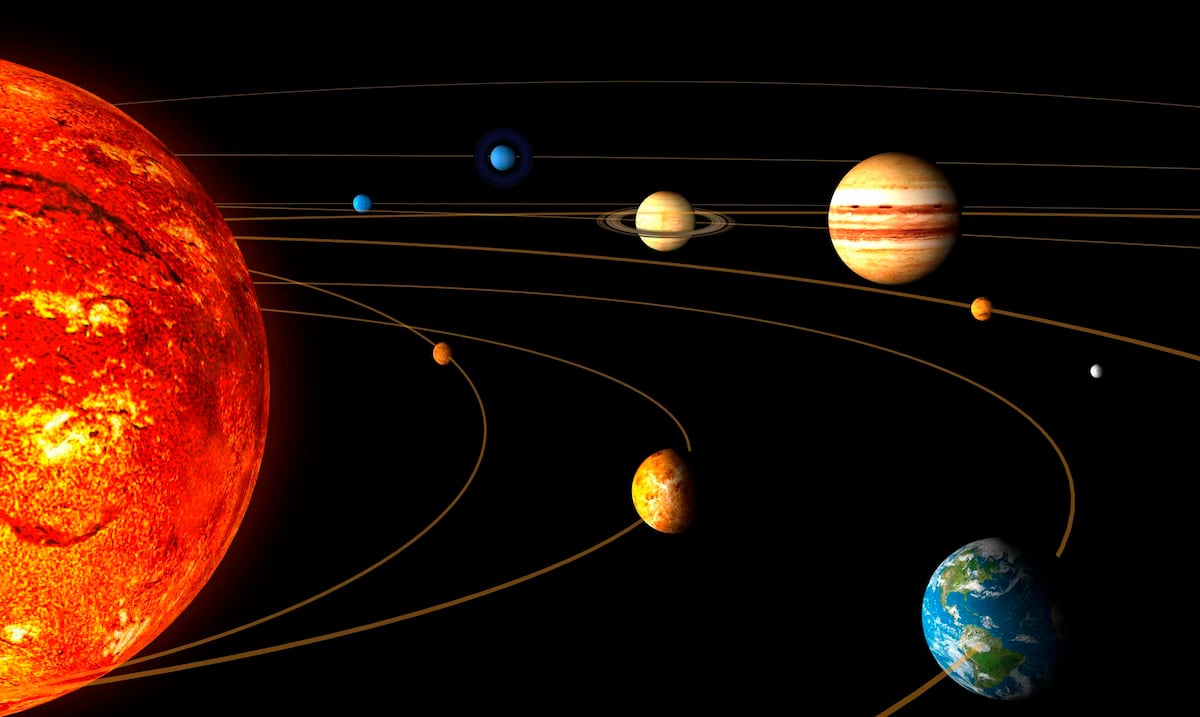
This January 21 will be the best day to observe a planetary conjunction.
Venus, Mars, Jupiter and Saturn will be the protagonists of this show that can be seen with the naked eye and from anywhere in the world, the magazine reported National Geographic.
The National Aeronautics and Space Administration (NASA, for its acronym in English) indicated that this alignment has been occurring throughout the month of January and that it is common for “planets always appear along a line in the sky”but ““It is less common to see four or five bright planets at once.”
Sky buffs will be able to see Venus, almost “paired” with Saturn, Jupiter and Mars, and two more if a telescope is used (Uranus and Neptune). There are seven of the eight planets (including Earth) of the Solar System in the same plane, although the imaginary line that would join them would trace a curved path, never straight.
The seven planets, plus the Earth, always travel along the same imaginary line in the sky, the so-called “ecliptic”, although periodically it is possible to see more planets with the naked eye at night on that line, which is what is happening these days. days, the Mexican astrophysicist and popularizer Mario De Leo-Winkler clarified on his networks, who was also blunt on the matter: “No; “There is no millennial alignment of planets.”
Recommendations to observe the phenomenon
NatGeo recommended contemplating the phenomenon away from light pollution. Also, use astronomy applications for mobile devices to identify each of the planets.
When will it look more spectacular?
In February, the astronomical event will become even more spectacular, since Mercury will join the planets, adding a total of seven stars visible from Earth, meaning that all the planets in the Solar System will be in that imaginary conjunction, a “parade ” of planets that can be considered unusual, due to the possibility of seeing up to five of these stars in the night sky with the naked eye.
According to National Geographic magazine, “this event will not happen again until the year 2492.”
Although the event can be seen for several days and from any point on the map, February 28 will be the ideal day to contemplate the seven planets on the horizon, NatGeo added.