
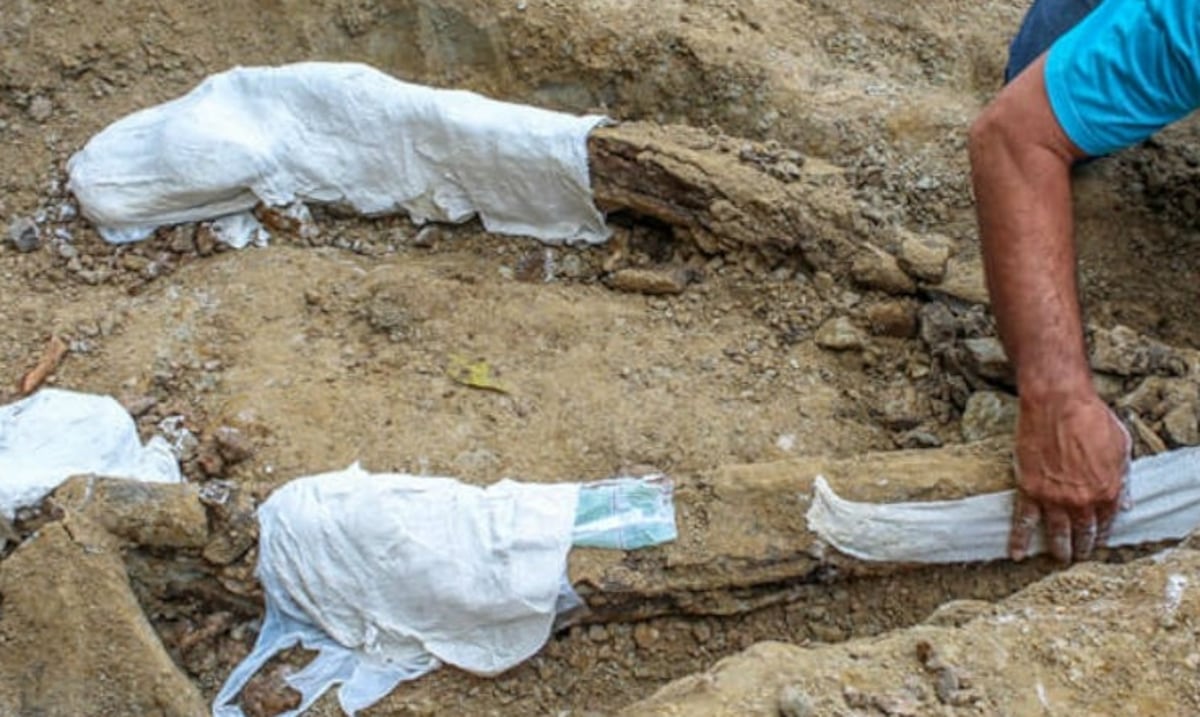
Paleontologists from Argentina found fossil remains of marine animals in the province of Neuquén, in the southwest of the country, including the skull of a marine crocodile in the colossal Vaca Muerta unconventional hydrocarbon formation.
As reported by the Government of Neuquén this Sunday in a statement, These findings corroborate the entry of the waters of the Pacific Ocean into this territory millions of years ago.separated from Chile and the sea by the Andes Mountains.
The discovery was made by professionals from the Cultural Heritage area of the province and the National Council for Scientific and Technical Research (CONICET) of Argentina.
As part of their work at the Pampa Tril site, experts found remains of a marine crocodile in rocks of the Vaca Muerta formation, today famous for oil activity.
According to the statement, at the scene “There are signs of a sudden marine ingression, about 150 million years ago, in outcrops with an important diversity of invertebrates and marine reptiles”.
In 2022, paleontologists had already managed to rescue fossil remains of an ichthyosaur column at this site.
Now, a few meters from that discovery, remains of other ichthyosaurs, fish, oysters, ammonites and the skull of a marine crocodile appeared.
“The skulls can give us anatomical information that allows us to have an overview of the diversity of these animals in the past”said Mateo Gutiérrez, one of the experts who leads the team of paleontologists.
The same group of researchers also managed to partially rescue the remains of a marine reptile from the ichthyosaur group in the Los Molles formation, near the Chacay Melehue stream, also in the north of Neuquén.
These organisms were completely adapted to life in the open sea and looked similar to current fish or dolphins.
“This is a significant finding, taking into account that there is not much record of marine reptiles in this geological unit and this would be the first record of ichthyosaurs for this locality.””Gutiérrez highlighted.
The paleontologist pointed out that between the towns of Chos Malal and Andacollo “we can observe rocks from the Los Molles formation that were deposited in a period of 165 to 180 million years and that reveal the first marine ingression from the Pacific Ocean into the Neuquén basin. leaving layers with fossils of marine origin.”
Given this discovery, rock samples were taken to perform micropaleontological analyzes that will help determine the age of the remains.
“It is not uncommon for ichthyosaur vertebrae and ribs to be found in some marine geological formations in the Neuquén basin, but the presence in this unit and the possibility of finding other elements of the skeleton justify the rescue of the rest of the animal that “It is still buried.”indicated Micaela Chaumeil Rodríguez, from the Research Institute in Paleobiology and Geology (IIPG) and who also leads this group of experts.