
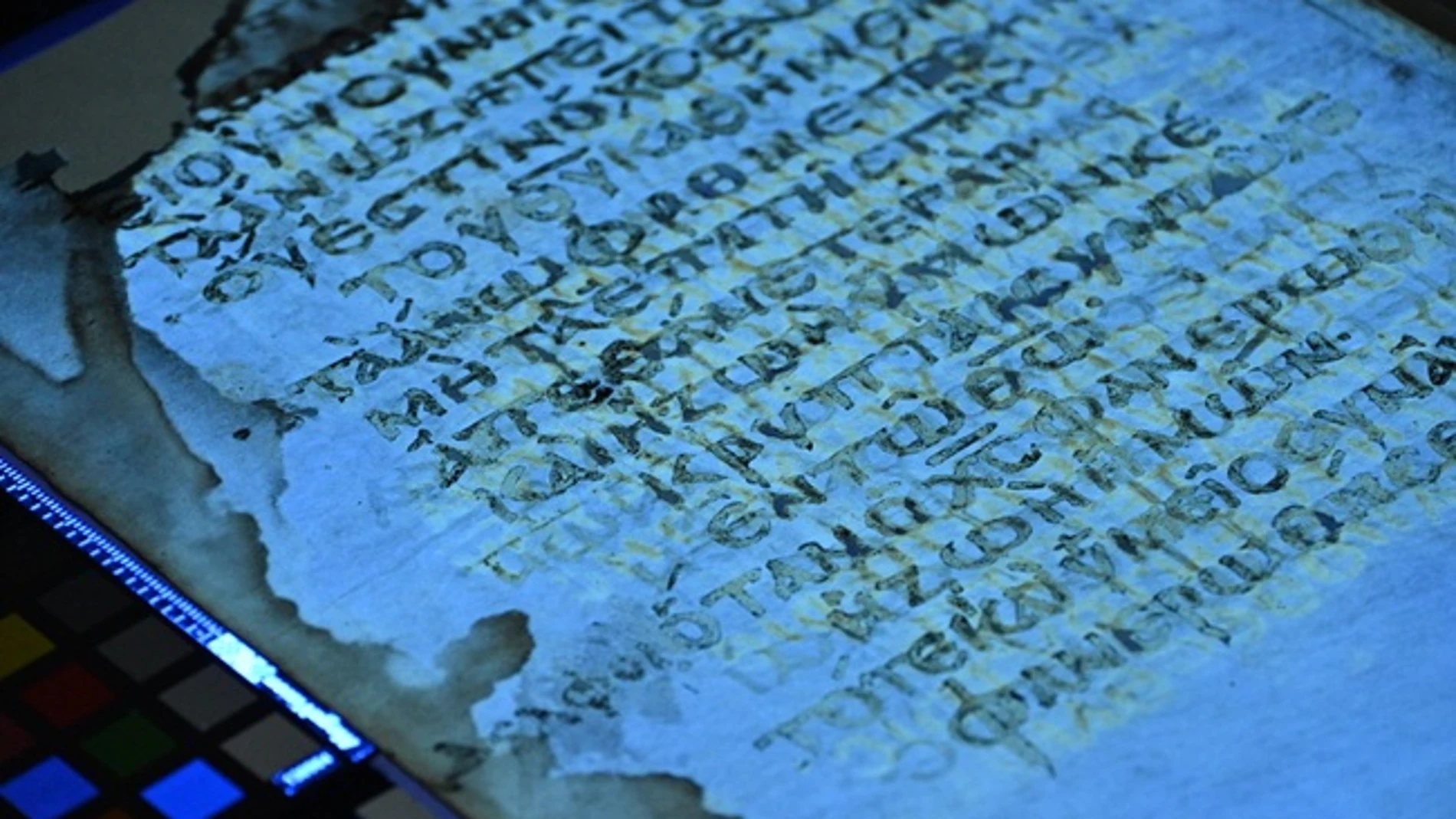
An international team of scientists, led by Garrick Allen of the University of Glasgow has managed to recover 42 lost pages from one of the oldest and most important manuscripts of the New Testament: the so-called Codex H.
This is a 6th century copy of the letters of Saint Paul which disappeared as a complete manuscript in the 13th century. At that time, in the monastery of the Great Lavra, on Mount Athos (Greece), its pages were disassembled and reused as binding material in other books. Over time, these fragments were scattered in libraries in various countries, including Italy, Greece, Russia, Ukraine and France.
The key to the discovery has been a combination of modern techniques applied to an ancient problem. “The advance started from an important fact: we knew that the manuscript had been reinked – explains Allen in a statement -. The chemicals in this new ink caused a ‘mirror effect’ on the facing pages, leaving traces of the original text that are not visible to the naked eye.but yes with current imaging techniques.”
To recover this content, the team worked together with the Early Manuscripts Electronic Library (an organization specialized in the conservation and study of ancient and medieval manuscripts), using multispectral imaging. This method allows the same document to be analyzed under different wavelengths of light, revealing traces of writing that no longer physically exist. In practice, each preserved page contained remains of several original pages, as if the manuscript had left a “shadow” of itself.
Additionally, Allen’s team collaborated with experts in Paris to perform radiocarbon dating, confirming that the parchment is from the 6th century. The recovered text does not reveal unknown content: These are passages already present in the Pauline letters, but they do provide relevant information about how these texts were organized, read and used in ancient times.. Among the findings, some of the oldest known lists of chapters stand out, which differ notably from the current division of these writings.
The fragments also allow us to observe how the scribes worked: corrections, annotations and marks that show an active interaction with the text. At the same time, The state of the manuscript itself offers evidence of a common practice in the Middle Ages: the reuse of materials, even in the case of texts considered sacred.
“Since Codex H is such an important testimony to understanding the Christian Scriptures, Discovering new evidence, and in this quantity, about its original form is something extraordinary”Allen concludes.
Beyond the content, the study shows how current tools can recover information that was thought to be lost. No new physical pages have been found, but new layers of information hidden in the existing ones have been found. A manuscript fragmented for centuries that, thanks to current technology, is beginning to be recomposed without the need to physically reunite all its parts. And there may be more. The Those responsible for the progress indicate that, as soon as they finish, the entire document will be available for free and online to study