
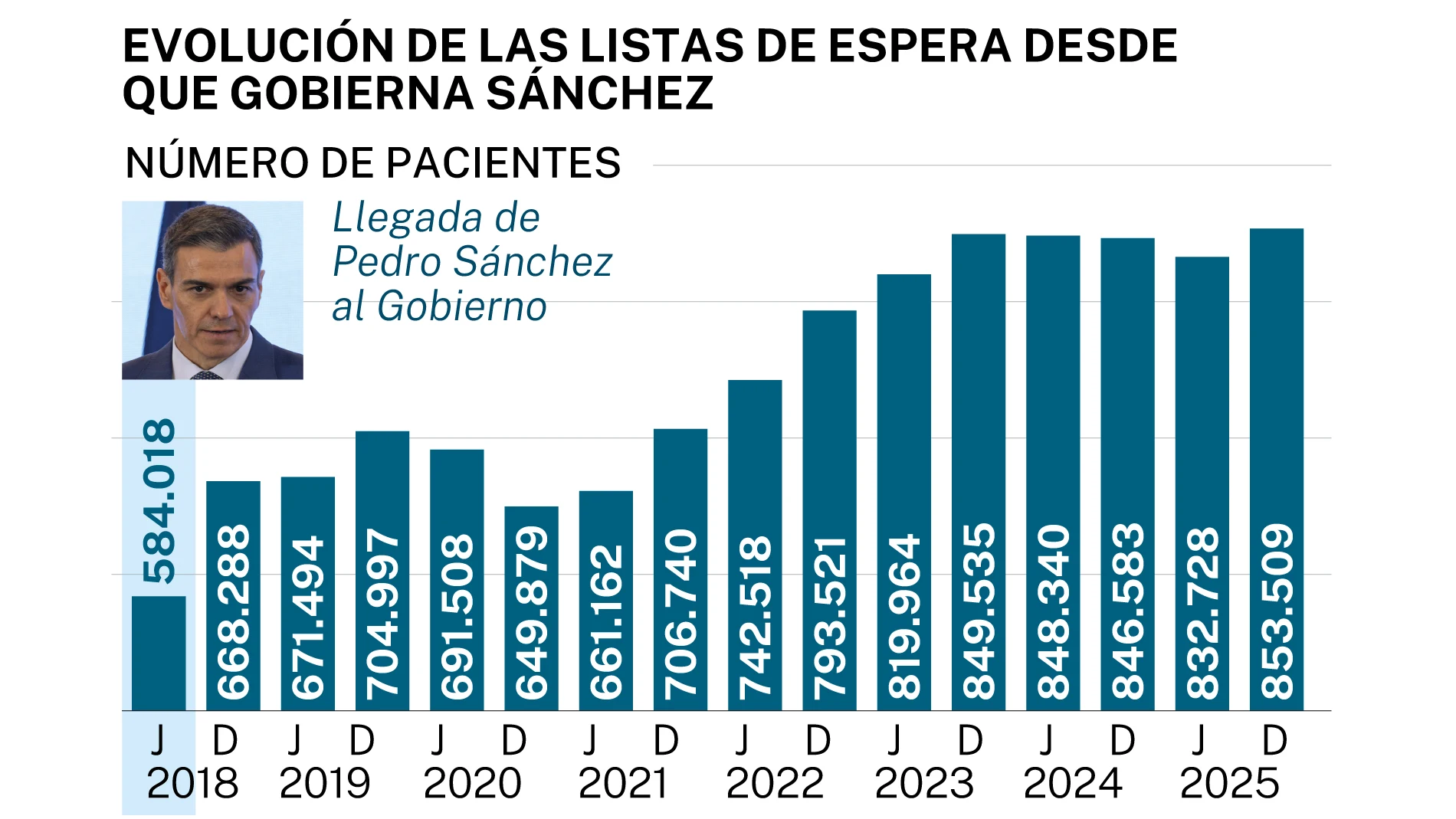
Since Pedro Sánchez arrived at Moncloa in June 2018, the surgical waiting lists of the National Health System (SNS) have not stopped growing until reaching their worst record in history. At the end of 2025, 853,509 patients were awaiting a non-urgent intervention, which represents 269,491 more than at the beginning of the stage of the self-proclaimed “progressive” government, when there were 584,018. In percentage terms, The increase exceeds 46%, according to the latest official data from the Ministry of Health.
The evolution of the series reflects how The healthcare jam has become chronic in these almost eight years. In December 2018, just six months after the change in Government, the figure had already climbed to 668,288 patients. After slight ups and downs in 2019 and 2020, this last year coinciding with the impact of the covid pandemic and the stoppage of scheduled health activity, the system has not managed to recover previous levels and Since 2022 the trend has been clearly upward.
Thus, in June of that year there were 742,518 people pending surgery. Six months later there were 793,521. In June 2023, the barrier of 800,000 patients was surpassed and in December of that same year, a then-unprecedented record was reached: 849,535 people. Far from being corrected, the situation has remained at a high during 2024 and 2025, until closing last year with 853,509 patients on the waiting list.
It is not only the volume of citizens caught in the surgical delay that is of concern. Also Waiting times are still much higher than existing ones when Pedro Sánchez came to power after evicting the popular Mariano Rajoy from the Government through a motion of censure. In June 2018, the average wait for an operation was 93 days. Today it stands at 121 days, that is, almost one more month. Although the worst moment was recorded in June 2020, with an average of 170 days, the reality is that the public health system has not returned to the levels prior to the health crisis.
More than six months in limbo
The other great indicator that shows the deterioration is the percentage of patients who have been waiting for surgery. In June 2018 they represented 12.2% of the total. Seven and a half years later it is 21.6%, practically one in every five patients registered on the list. The peak was also reached during the covid pandemic, when in June 2020 it reached 33.8%, but the subsequent recovery has been partial and insufficient, as data from the Ministry of Health itself shows.
The figures also portray strong territorial inequalities. Andalusia leads the worst waiting times, with 173 days on average, followed by Catalonia, with 142. At the opposite extreme are Madrid, with 50 days, the Basque Country, with 64, and Galicia, with 73. The Community of Madrid has now been the region with the lowest surgical delay in the country for four consecutive years.
By specialties, the greatest delays correspond to plastic surgery, with an average wait of 269 days; neurosurgery, with 172; and angiology and vascular surgery, with 151. In terms of number of patients, the largest lists are concentrated in traumatology, ophthalmology and general surgery, areas that are especially sensitive due to their high demand for care.
Health experts have long warned of several factors that explain the collapse: aging of the population, deficit of professionals, increased demand, underfinancing in certain areas and the still unresolved drag of the pandemic. They also question that the current statistics do not include other relevant delays, such as diagnostic tests or primary care, so the real pressure on the system could be even greater.
Still, the data is stubborn: Spain closed 2025 with the highest number of patients waiting for an operation since comparable records exist. And it did so after almost eight years of Pedro Sánchez’s mandate, with 269,491 more people in line than when he came to the Government and his response has so far been null. Sumar and the PSOE included in their legislative pact the promise of a law to set maximum waiting times and thus protect rapid patient care.As of today, this law does not exist. The Executive also tries to attack private healthcare despite its contribution to unloading public healthcare to which Hundreds of thousands of immigrants could be added with regularization.
The president’s other burden
Adding to the escalation of waiting lists is another bottleneck of the health system: access to therapeutic innovation. Spain now takes an average of 661 days to finance new medications since their European approval, 276 days more than in 2018, when Pedro Sánchez arrived at La Moncloa. The delay places our country among the slowest in Europe and it especially affects cancer patients, who wait up to 725 days to receive cutting-edge treatments. While other countries accelerate the incorporation of therapies. innovative, in Spain the bureaucracy and administrative filters are responsible for prolonging the wait of thousands of patients. The delay not only delays treatments, but, in many cases, reduces survival options and quality of life.