
It will be a space dedicated to the sea, but not in a vacuum. What happens on the coast and inland mountains has a direct impact on the sea, and that relationship will be the axis of the Interactive Center for Environmental, Marine and Coastal Education that the organization ISER Caribbean proposes to create in Red Cape.
The educational center will be the expansion of the work of scientific education and work with the communities that ISER Caribe already does with secondary level students, but which, until now, it cannot do with elementary level students, explained the executive director of the organization, the environmental scientist. Braulio A. Quintero Nazario.
“The interactive center is our proposal to expand the environmental education services and, specifically, marine restoration that we already do in our nurseries in La Parguera and ceiba. These nurseries have served as practice centers for students of different ages, from 13 or 14 years old to university students,” highlighted Quintero Nazario.
The non-profit organization operates two nurseries – in Lajas and Ceiba – to which they cannot take elementary students due to safety considerations.he explained. One of them is located on Magueyes Island, headquarters of the research station of the Department of Marine Sciences of the Mayagüez campus of the University of Puerto Rico (UPR), which cannot be visited by children 10 years old or younger. In Ceiba, they work from the former lands of the Roosevelt Roads naval base, in conjunction with the Roosevelt Roads Local Redevelopment Authority.
Given this, the interactive center they propose has the little ones in mind. To this end, they will convert a space they already have in the urban area of Cabo Rojo, which currently serves as a warehouse.
“We want to serve this population of children in elementary school to provide them with similar experiences (to those that the young people receive in their nurseries), begin to introduce the topic of the sea at an early age, so that they know that the sea is a space – just like the land – where you can do research, where you can do recreation, where you can do business entrepreneurship,” he said.
“This new space will also serve to start talking about the connectivity of ecosystems, especially to children at an early age, how what happens in the mountains has an impact on the sea, how this spatial gradient between ecosystems is interconnected,” he added.
The proposal for the interactive center is ready, it has been discussed with allies and now ISER Caribe enters the fundraising phase to make it a reality.
ISER Caribe leads the largest coral restoration project in Puerto Rico. They are the first to achieve sexual reproduction of the elkhorn species (Acropora palmata) in Puerto Rico, through in vitro fertilization techniques carried out between their two nurseries, in alliance with other entities and even volunteerspointed out Quintero Nazario.
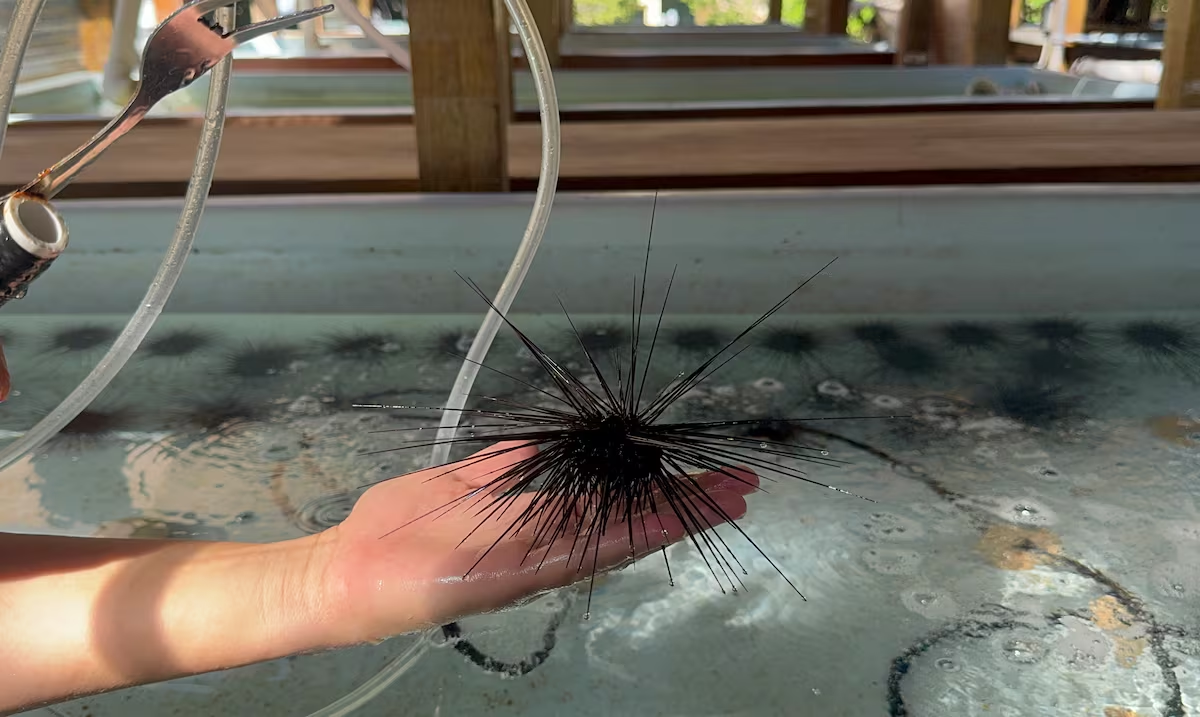
“The ‘Caribbean Reef Project’ is the most comprehensive coral reef restoration project in Puerto Rico, and we can say in the Caribbean. In this project, transplants of corals, urchins, and crabs are propagated in these nurseries that we manage (…) In addition, we have our mangrove nursery, from where we propagate mangrove seeds to restore mangrove forests throughout Puerto Rico,” he explained.
The Interactive Center for Environmental, Marine and Coastal Education will highlight the projects that ISER manages through what Quintero Nazario described as a “sequential experience” that will take visitors on a journey from the mountains to the sea.
“It will explain how events, human activities and natural activities that occur up on the mountain are transported through watersheds, through rivers”he indicated.
“(We will see) how humans and natural systems interact in those basins and, eventually, all of these events – which can be erosion, fires, use of pesticides in agriculture – are transported through these integrated and interconnected systems and everything reaches the coast, having an impact on the first line that we see, which are the mangroves, then the seagrass meadows and, eventually, the coral reefs,” he described.
To establish the center, ISER has set a goal to raise $25,000, so that they can have access to a match, through grants, which would bring the total investment to $50,000.
Those interested can make their donations through the website of ISER Caribbeanthrough digital transactions or checks. In addition, Quintero Nazario indicated that they can be done through the “donate” tab in the ATH Móvil application, under the “ISER” entity.
“Part of the goal of this center and what we do is to present that the sea that surrounds us is a space of opportunity, of learning, a space to undertake, to conserve,” he said.
“We live on an island and, sometimes, we forget that under the sea there are animals, there are marine plants, which also suffer the impact of climate change, of pollution. Many people forget that corals are animals, that reefs provide us with sustenance, recreation, protection of life and property on the coasts. So it is a way to start talking about the sea as a space that also belongs to you and you belong to the sea,” said Quintero Nazario.