
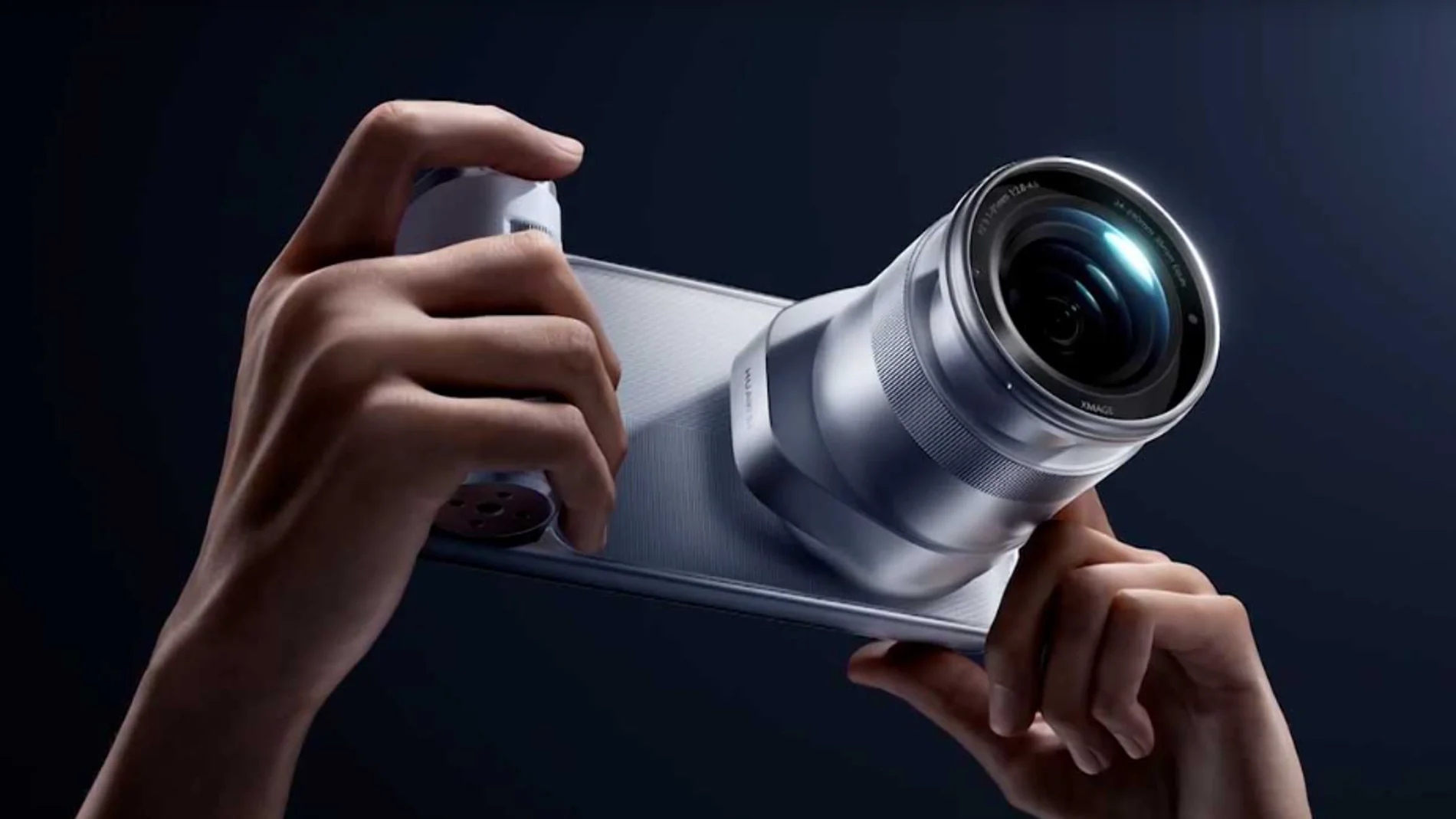
For years, mobile photography has advanced in a very specific direction: integrating more and more cameras and sensors into an increasingly smaller space. Huawei has decided to explore the opposite path. Their new proposal does not consist of slimming down a lens or multiplying the phone’s sensors, but rather adding a complete camera. The Ruiying Z10, presented in China along with the Mate 90 family, is a photographic module that attaches to the back of the smartphone and that, due to its characteristics, looks more like a compact camera than a conventional accessory.
The fundamental difference is inside. While other external telephoto lenses rely on the cameras that the mobile already includes to expand its optical possibilities, The Ruiying Z10 has its own one-inch, 50-megapixel sensor, type RYYB (a filter that Sony created precisely for the Huawei P30 camera). That is, it does not use the phone’s main sensor: it has its own image capture system. The smartphone provides the power, the screen, the software and the processing capacity.
The optics are another of its distinctive elements. The module offers an optical zoom equivalent to a range of 24 to 240 millimeters, with a variable aperture from f/2.0 to f/4.5. In practical terms, it allows you to go from an angular photograph to a powerful image without resorting to the jumps between fixed focal lengths that characterize many phone cameras. The objective is made up of 19 elements distributed in six optical groups. Huawei has incorporated optical image stabilization, an autofocus motor, a laser sensor to assist focusing and a multifunction ring. The set also includes a variable aperture and a motorized zoom system. The company thus proposes an experience that is close to that of a traditional camera, but without giving up the immediate connectivity of the phone.
In this photographic ecosystem, the size of the sensor is one of the keys. Although smartphones have achieved surprising results through computational photography (combining multiple captures, reducing noise and reconstructing details in software), a larger collection surface allows more light to be collected in certain conditions and offers more room to control the depth of field. It does not mean that the sensor alone guarantees better photographs: The result also depends on optics, processing, stabilization and lighting conditions. But it does represent a physical advantage that software cannot reproduce identically.
The module is secured using the HyperClick system, designed to connect directly to compatible models without the need for a special case. For now, the Ruiying Z10 works with Mate 90 Pro Max Collector’s Edition and Mate 90 RS Ultimate Designtwo versions that incorporate specific anchoring. Huawei has explained that the mounting system can be adapted using interchangeable rings, which opens the possibility of compatibility with future phones from the brand.
The proposal, however, has an obvious cost in mobility. The module weighs approximately 346 grams and measures about eight centimeters. Together with the smartphone, it transforms a device that fits in your pocket into a voluminous set, closer to a compact travel camera. Its price is around 850 euros. Huawei has not announced its international availability for now.