
If we talk about the greatest scientific projects in history, we quickly think about The Hubble Space Telescope, the James Webb, the CERN, but there is one that will soon exceed all of them. This is the iter, acronym for international experimental thermonuclear reactor, an international scientific collaboration focused on demonstrating the viability of merger energy.
The iter will be A large -scale experimental fusion reactor that is being built in southern France with the aim of demonstrating that merger reactions can produce more energy than necessary to start them. In fact, the iter is not designed to generate electricity, but to advance the science of fusion and test technologies for future electricity power plants.
Basically, seek to take advantage the same energy source that feeds the sun and stars through nuclear fusionwhere light atomic nuclei merges to form heavier nuclei, releasing huge amounts of energy.
“The idea is to merge two light atoms of the most fundamental element and in quantity in the universe, which is hydrogenor hydrogen isotopes, such as deuterium and tritium – explains us Augusto Pereira, responsible for the AI project in the National Fusion Laboratory of the CIEMAT, involved in the iter – . And to overcome the electrostatic forces of repulsion of hydrogen atoms, which only has a proton, we have to apply energy. How do we apply it? With temperature ”.
This is where what is called magic begins and today is known as science (a phrase by Arthur C. Clarke). While on the surface, The sun has a temperature of about 5,500 º C, in its nucleus the reality is very different. And extreme.
“In the sun you can reach 10 million degrees Celsius – confirms Pereira – and, at that temperature, it is possible to merge the hydrogen and that is transmitted to a heavier atom, which already has two elements and two protons, plus a fast neutron that escapes. A neutron close to the speed of light and that, by the Einstein equation, the famous energy equation equal to mass by mass by speed of light to the square to the square, Transmit that energy. A gram of tritium deuterium contains as much energy, as 8 tons of coal. ”
Another example would be that of the Ponferrada Central in El Bierzo, says Pereira. This had 1.3 gigawatts of annual power and for this it consumed about 3 million tons of coal per year. In the iter they want to do the same, only with 375 kilos of tritium deuterium.
Keep in mind that, despite myths around Fukushima or Chernobyl, Fusion radiation is clean, does not produce CO2, only energythere is no transmission to the environment. But that does not mean that everything is easy. In the first instance is the temperature: reaching 10 million Celsius degrees implies facing several challenges.
For this, Pereira’s team has extra help, a specialist named Watsonx, IBM AI, responsible for evaluating all the data obtained in the experiments. Currently, and until the construction of Iter ends, Most of those linked on fusion are carried out in the TJ-II.
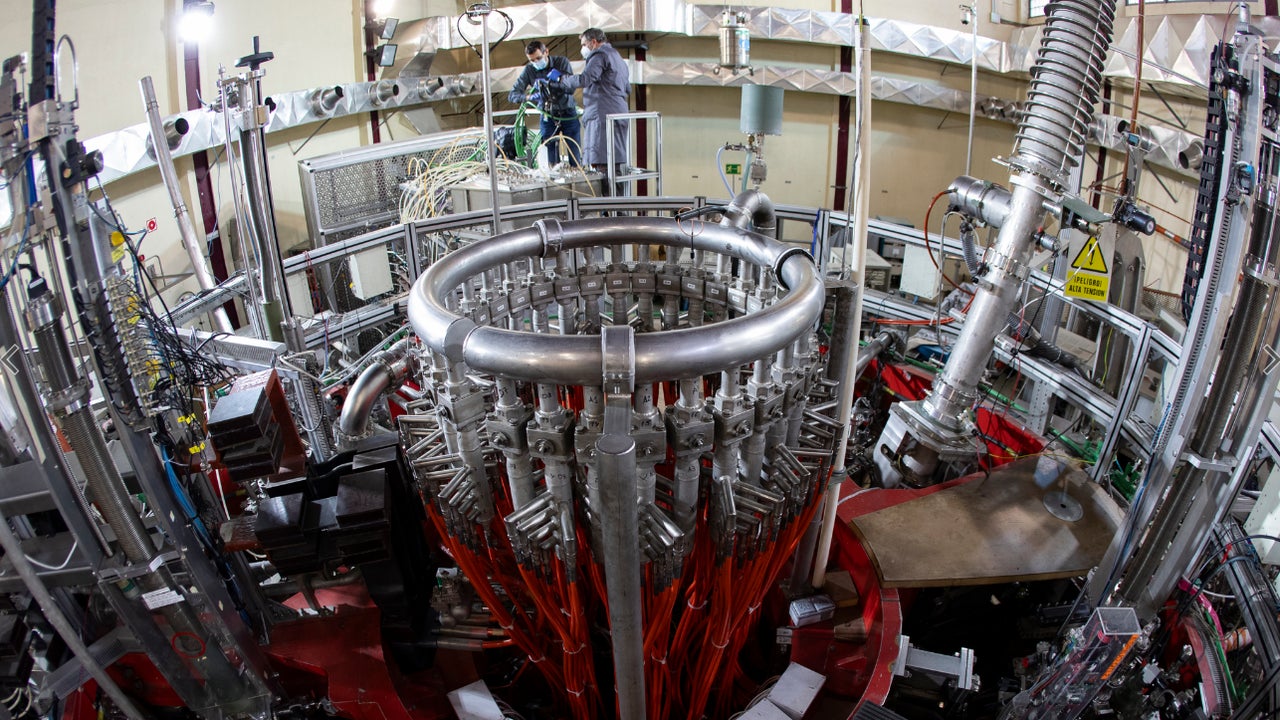
The TJ-II is a Stellarator experimental device (A kind of “solar jail” that is used to confine hot plasma and keep controlled nuclear fusion reactions), located in the National Fusion Laboratory of the CIEMAT in Madrid.
“Pereira I commented that Within the TJ-II, 10 million degrees Celsius are achieved. What does that mean? It means that we cannot open a window inside the device, touch the plasma and say, ah, yes: it is hot. -Explains the Technical Leader of IBM in Spain, Portugal, Greece and Israel, Manuel Villalba -.
All these data are signs, all are diagnoses, all are lasers that cross, they are many data. And what scientists do is to do those experiments to get the merger or get what is sought in the experiments in an optimal way. Artificial intelligence is helping to map all those data, to relate, to look for, even to find relationships that a scientist may not have found With its rationing, because artificial intelligence in the end is nothing more than data and relationship between that data. So, the fact that an experiment, goes well and being able to look for related experiments and look for related patterns to get the merger optimally, helps to see what is not seen with the naked eye. ”
In this sense, the iter generates about 18 TB of compressed signals and images information. And the challenge now is to use the IBM generative AI to connect all that information and prepare for what will come: once the iter works More than 100 petabytes will be generated a year. To give us an idea, a Petabyte could store more than 200 million photos of 5 MB, or approximately 13.3 years of HD video content.
How is so much information generated? Villalba explains it in a simple way: “One of the hottest points and is not the hottest on earth, is the interior of the merger devices, for example, the TJ-II and others. At the same timethe coldest sites of the entire universe are where are the chips of quantum computing and In both two quantum phenomena are generated. ”
“Iter is already being built, south of France and is the greatest technological and scientific challenge, I believe that the CERN in Geneva, because the iter started with 5,000 million dollars, I think I remember, and we are going, I think, for 30,000 million dollars”Pereira adds.
The future? As more information is generated, both in TJ-II and in the future iter and demonstrate their capabilities, it will be necessary to raise the level of the generative AI to cover the enormous amount of data that will be generated and made it available to scientists from around the world. Because, In essence, artificial intelligence and nuclear fusion share much more than the quantum world: They are part of a future with the potential to transform our civilization.