
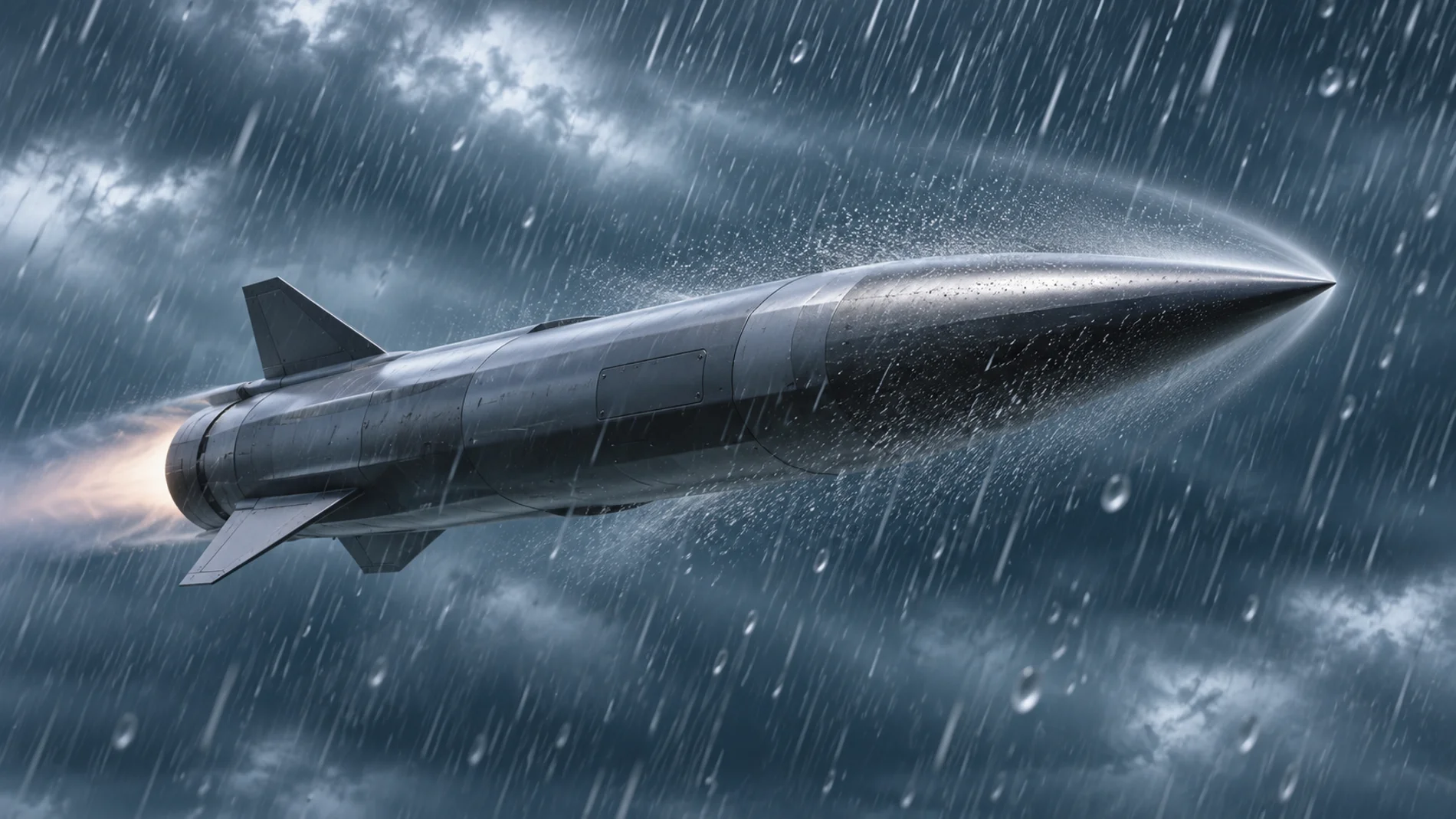
A raindrop may seem insignificant, but hitting it at extreme speed can damage the surface of a missile. For hypersonic weaponscapable of exceeding five times the speed of sound, starting at 6,125 km/h, going through the rain is a challenge that tests its materials and coatings.
The problem is in the violence of the impactwhich increases with the relative speed between the vehicle and the water. As explained Winnie Laifounder and CEO of Auriga Spacein an interview with Defense Blog, These collisions can cause erosion, cracks and separation of the layers of the material.
Furthermore, the droplets do not necessarily reach the missile in their original shape. ‘One of the things we have observed is that the shock wave preceding the object deforms the water droplets before impact’Lai notes, which changes how they hit the surface.
This wave is a disturbance of the air that forms in front of the object when it moves at supersonic speed. Its effect on the droplets complicates the reproduction of the phenomenon in a laboratorywhere some installations use small nylon spheres to simulate rain.
Although these spheres allow us to approximate an impact, They do not deform or fragment like real water. It also matters where the drops hitbecause the damage varies depending on the geometry of the piece and whether it reaches its front edge or another area. Besides, successive impacts can accumulate deterioration.
Auriga Space, founded in California in 2023, seeks to study these effects more precisely. The company was born to develop a system with which to launch satellites into space using an initial electromagnetic impulse instead of the first stage of a rocket, but found in hypersonic tests an application with which to generate short-term income and finance its original objective.
Your tool is Prometheusan accelerator that uses a linear electric motor to propel parts through magnetic levitation inside a sealed tube. Inside you can adjust air pressure to replicate different flight conditions and place real water droplets and particles at precise points along the trajectory.
Thus, engineers can compare the resistance of different materials and coatings against those impacts. The system also allows recover samples after a test to examine their damage and retest them, something especially useful for studying accumulated deterioration.
For now, Prometheus has reached supersonic speedsalthough the company does not specify the figure, and work to reach hypersonics. Your tube has about ten centimeters in diameter and, as they run on electricity, they can prepare another test in minutes and perform several a day.
Auriga affirms that it works with contracts from the Air Force American and the Missile Defense Agency. In addition to serving the military sector, in July it opened its trials with water drops and particles to the commercial market, with Axiom Materials as first client.
The next step will be thoran external accelerator designed with a tube of 2.44 meters in diameter to test subsystems and complete systems. It is in an early phase of development and must still overcome stages such as choosing the location and validating its highest-powered equipment.
These facilities seek alleviate the shortage of testing capacity, which Lai says is causing years-long waits in the United States. Being able to test frequently, recover parts and correct defects would allow problems to be detected on the ground that could appear much later during a much more expensive test flight.