
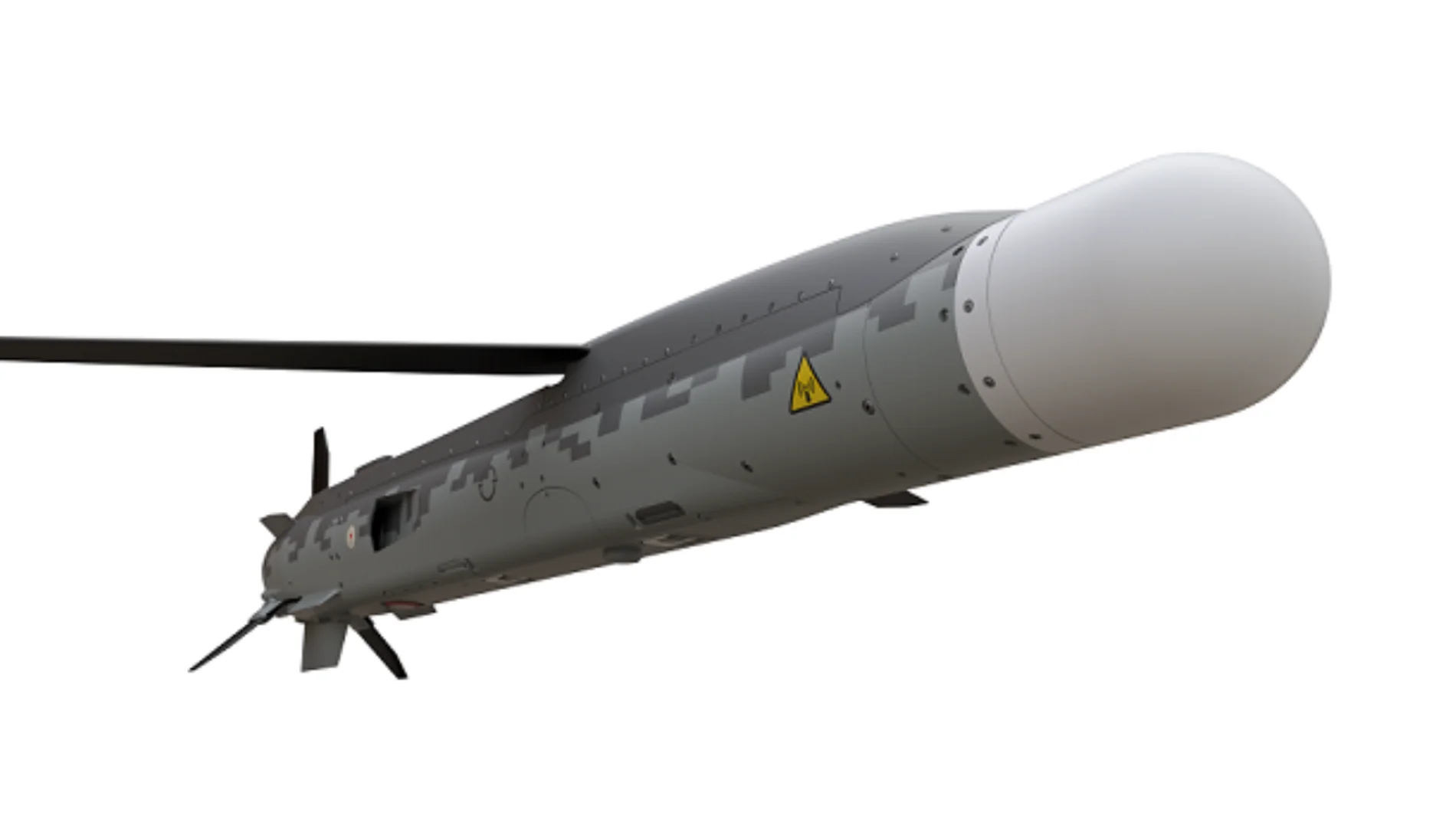
For decades, the evolution of missiles has followed an almost intuitive logic: bigger, faster, more destructive. But in recent years, that trend has begun to reverse. The future no longer seems to be in size, but in intelligence. AND The name is SPEAR-3 or Select Precision Effects At Range.
The British Ministry of Defense itself has gone so far as to describe SPEAR-3 as a “cruise missile of the future.” Not because it is the most powerful, but because it redefines what it means to attack a target. At first glance, SPEAR-3 shatters expectations. It measures just 1.8 meters and weighs about 90 kilos, dimensions closer to a light bomb than a long-range missile. However, this miniaturization is precisely its greatest advantage.
Thanks to a small turbojet engine, It can fly more than 140 kilometers and at speeds greater than 900 km/h, allowing aircraft to launch it from a safe distance, out of the range of many anti-aircraft defenses. Also, unlike traditional missiles, designed to destroy large areas, SPEAR-3 is committed to surgical precision. It is equipped with a multimode guidance system that combines GPS, inertial navigation, millimeter wave radar and laser guidance. This allows it to adapt to different scenarios: from attacking a moving vehicle to impacting specific infrastructure in adverse weather conditions.
In addition, it can be reprogrammed in mid-flight thanks to a bidirectional data link. That means you don’t just “fire and forget,” but you can also “shoot and decide later.” One of the greatest challenges in modern warfare is not to destroy the target, but to reach it. SPEAR-3 has been designed precisely to overcome that problem. Its range, combined with its maneuverability and advanced guidance, allows it to avoid defenses and adapt to complex environments.
According to its developers, the system offers an unprecedented combination of range, flexibility and load capacity to confront modern anti-aircraft systems. And here another of his keys appears: he does not act alone. One of the most innovative ideas behind SPEAR-3 is its ability to operate on a network. The system can be integrated into what is known as swarm attacks, where multiple missiles communicate with each other and coordinate their behavior. Some can act as decoys or jam radars (in their electronic variant), while others attack the main target. It is a paradigm shift: it is no longer an isolated projectile, but a cooperative system.
Its small size has another key consequence: it allows planes to carry more units. For example, fighters like the F-35 can carry up to 8 SPEAR-3 missiles, multiplying their offensive capacity without compromising their stealth. This makes each aircraft a much more versatile attack platform. At its core, SPEAR-3 is not just a new missile, but a new way of understanding air warfare. Rather than relying on brute force, it is based on three key ideas: precision, connectivity and adaptability.
It can attack multiple types of targets—from moving vehicles to defense systems or vessels—change targets in flight and coordinate with other systems. It is, in essence, a weapon that thinks while it acts. Despite its capabilities, SPEAR-3 is not yet fully operational and its entry into service has been delayed, with forecasts pointing to the next decade. But beyond the calendar, its importance is already evident. Because it represents a profound change: the move from individual weapons to intelligent, connected systems capable of making decisions in real time.