
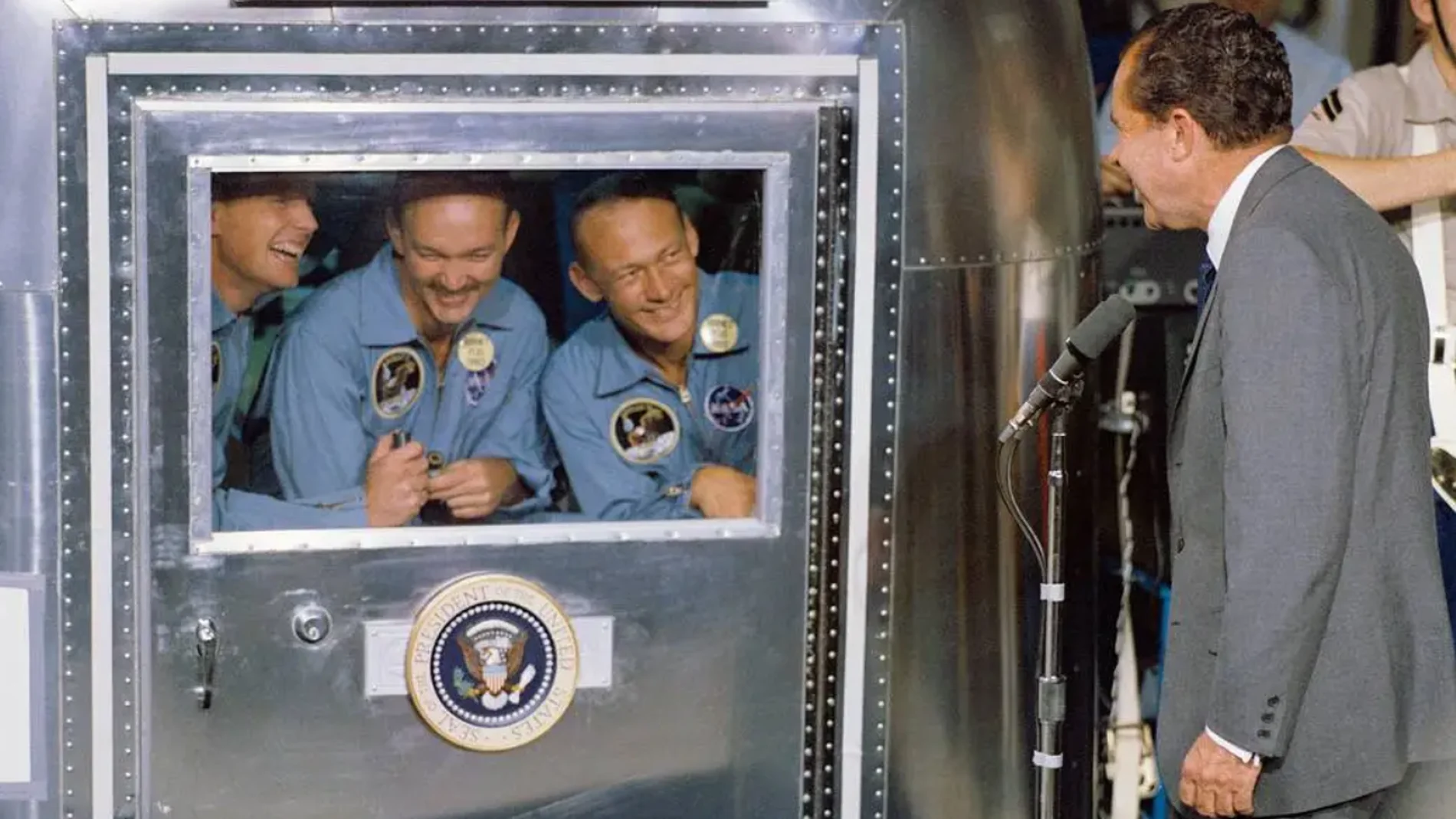
There is something paradoxical, almost contradictorily intuitive… or intuitively contradictory: 14 days before leaving Earth, the astronauts isolate themselves from the world, but upon returning from one of the most extreme environments imaginable, they return directly to it. No quarantine. Without barriers. As if the danger was down here… and not up there. And, in a sense, it is. The reason why space agencies like NASA force their crews to quarantine before launch It has less to do with space and more to do with something much more everyday: viruses, bacteria and that invisible fragility that we take for granted in daily life.
Before a mission, like the recent Artemis II, astronauts enter what is called a “health stabilization” program. For about two weeks they live in controlled isolation, avoiding public places, wearing masks and even limiting contact with their own families. In space, a simple flu is no longer something minor. There are no hospitals there, there are no specialists, there is no room to stop. A cold can prevent you from compensating the pressure in your ears during a cabin change; A mild infection can become serious in an environment where the immune system is weakened. And, above all, there are no substitutes.
A mission like Artemis II is a millimeter choreography in which each astronaut has an irreplaceable role. If you fall ill before launch, not only is your health at risk: a multi-billion euro mission may be delayed or cancelled. That’s why quarantine is, in reality, a way to protect something bigger than the human body itself: time, precision, the exact window in which everything must happen. It is, if you will, a quarantine against chance.
But then the inevitable question arises: why doesn’t the same thing happen when we return? The answer is because there is nothing to “bring back.” During the sixties and seventies, In the era of the Apollo missions, there was a very real fear of extraterrestrial contamination. Astronauts returning from the Moon were isolated, along with lunar samples, in case they had come into contact with unknown microorganisms. It was a logical precaution at a time when we knew very little about other worlds. But that uncertainty was dissipating.
Today we know that the Moon is an extremely hostile environment for life: no atmosphere, no stable liquid water, bombarded by radiation. The probability of an astronaut bringing with them a lunar pathogen is, in practice, zero. That is why post-mission quarantines disappeared after the first Apollo missions. In other words: the biohazard is not out there.
Furthermore, there is another less obvious and more human reason. Upon returning, astronauts do undergo exhaustive medical checks, but the goal is not to protect Earth from them, but them from Earth. Their body has changed: they have lost bone mass, their cardiovascular system has adapted to microgravityyour balance is no longer the same. What they need is not isolation, but readaptation. Walking again is challenging enough. So the logic is reversed. Before the trip, the mission of the human body is protected. The human body is then protected from return.
There is something deeply symbolic about this asymmetry. For centuries, we imagined space as a source of unknown, almost biological dangers, as if the universe were full of invisible threats waiting to cross the border. But the reality is different: the greatest risk continues to be here, in our own biosphere, in that microscopic ecosystem from which we cannot escape.
The last American lunar mission to return to Earth, Apollo 17, did not have to undergo quarantine upon his return in 1972. However, for missions to other planets, strict anti-pollution measures will be applied.