
As another political party of the system that it is, Vox is financed, to a large extent, by the public money it receives from the State. That is, subsidies.
Financial resources that it allocates for purposes as diverse as providing scholarships to its employees at Issep, the private teaching center that came to Madrid thanks to the niece of Marine Le Penwhich does not have its degrees approved – neither its programs nor its courses are part of the official university system of our country – and which is established as a Foundation (its patrons include Javier Tebas).
Although the Issep brand is patented by Tizona Comunicación, the company shared by the leading gurus of Santiago Abascalwhich are: Kiko Méndez-Monasterio and Gabriel Ariza –son of Julio Arizafounder of Intereconomía–. They are the ones who pull the strings of the party and, at the same time, their main suppliers.
Various former students who have passed through the center’s classrooms assure LA RAZÓN that the party sends almost all of its staff to study at Issep, which has its headquarters at number 9 Nicasio Gallego Street, where Vox was once located and today a few Ariza companies are domiciled. Case of Tizona itself, Infovaticana or Ivat SL, which, as published The Confidentialsays Abascal’s wife.
In practice, the link between Vox and Issep is total. But not in theory. Because Issep acts as a Vox institute when in reality it does not belong to Vox, but to the court advisors of its leader.
Furthermore, the vast majority of the students are made up of Vox staff, both those at Bambú’s national headquarters and those who work in institutions.
Various former students who have passed through Issep’s classrooms, and also regional leaders, reveal to this newspaper that “successive agreements have been signed” between the center and Vox groups in all legislative chambers: the Congress and the Senate, regional assemblies or local councils, to provide scholarships for officials and advisors.
The money that Vox receives from Congress
In the case of the Lower House, as stated in the Regime and aid, the Vox parliamentary group, like the rest of the parties, receives “a fixed subsidy” of 30,346.72 euros per month, and a variable subsidy of 1,746.16 euros for each deputy. Which is equivalent to a total of 57,623.28 euros per month.
Money that the parliamentary group can spend on scholarships for its employees to improve their training. And the sources consulted by LA RAZÓN insist that this is how it happens today.
On some occasions, the directive from the Vox leadership to its regional or local officials so that their parliamentary groups sign agreements with Issep has ended in discord. This is what happened with the defenestrated José Ángel Antelo in the Region of Murcia. «They called him to accept that rubbish about the courses and he refused. I found it very strange, because they were not official qualifications,” says a source who worked on his team.
An exception, because practically all those responsible for the party have given their approval to the agreements with Issep. In fact, the center designs “ad hoc” training programs for different positions.
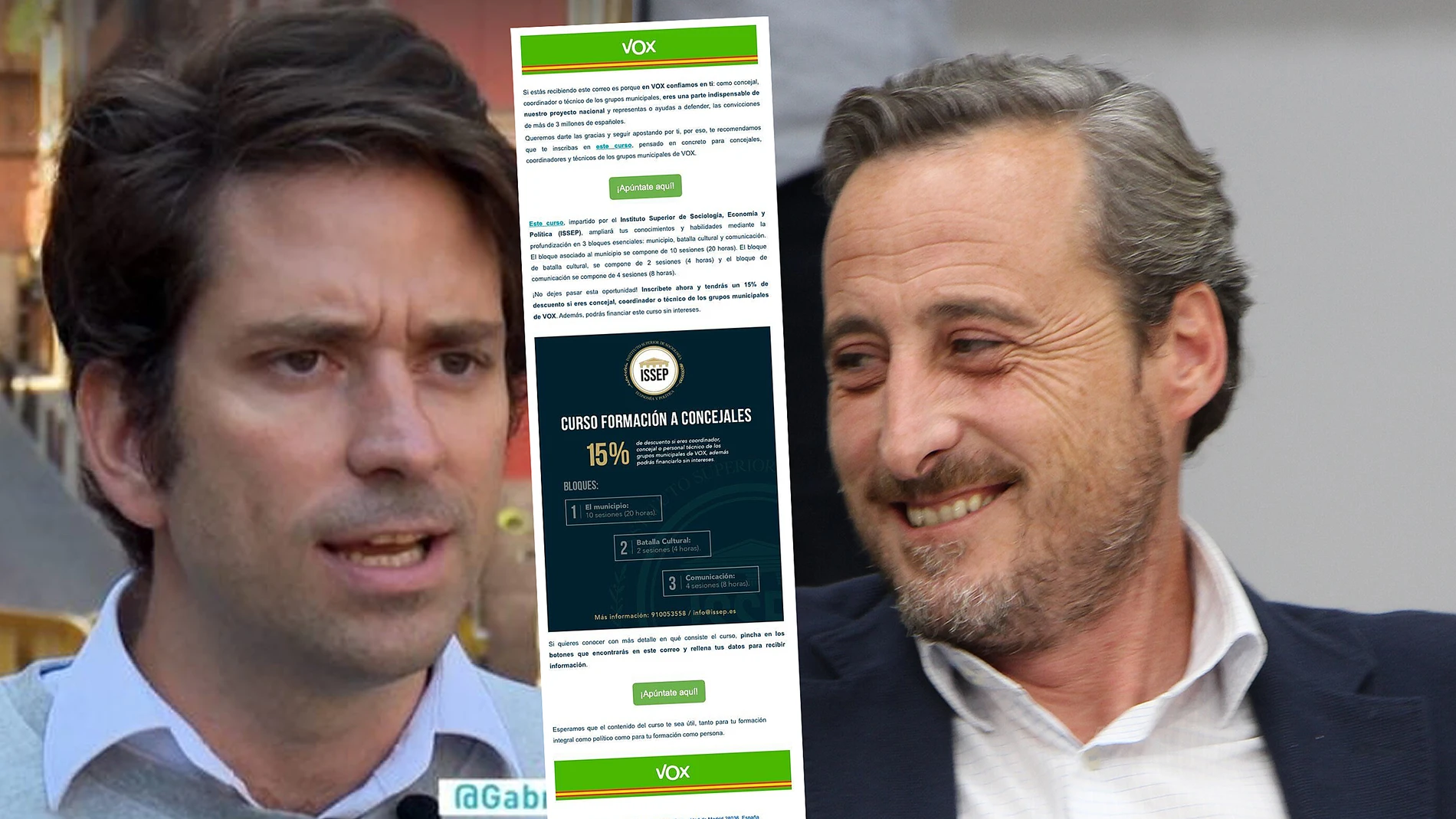
As “speech courses” for the deputies. Or a “councilmen’s course” which, as stated in a party promotion sent by email to its cadres, carries a 15% discount: “If you are a councilor, coordinator or technician of Vox municipal groups.” The price is 1,746.16 euros.
Some students end up in positions of responsibility. The greatest example: Carlos H. Quero, the current young promise who has won everyone in the ranks of the formation with his speech on housing. “They tell members that Issep is a platform to enter the party,” says a student who studied the “Leadership Program” with a scholarship from the party.
As for the faculty, if Issep does not have his titles approved, his cast includes, above all, Vox leaders. In total, there are five national deputies who teach classes: the aforementioned Quero, Meer Dew, Carlos Floreyes, Ignatius of Hocesy Manuel Mariscal. Other “professors” that stand out: Kiko Méndez-Monasterio himself, who is presented as “author of several literary works.”