
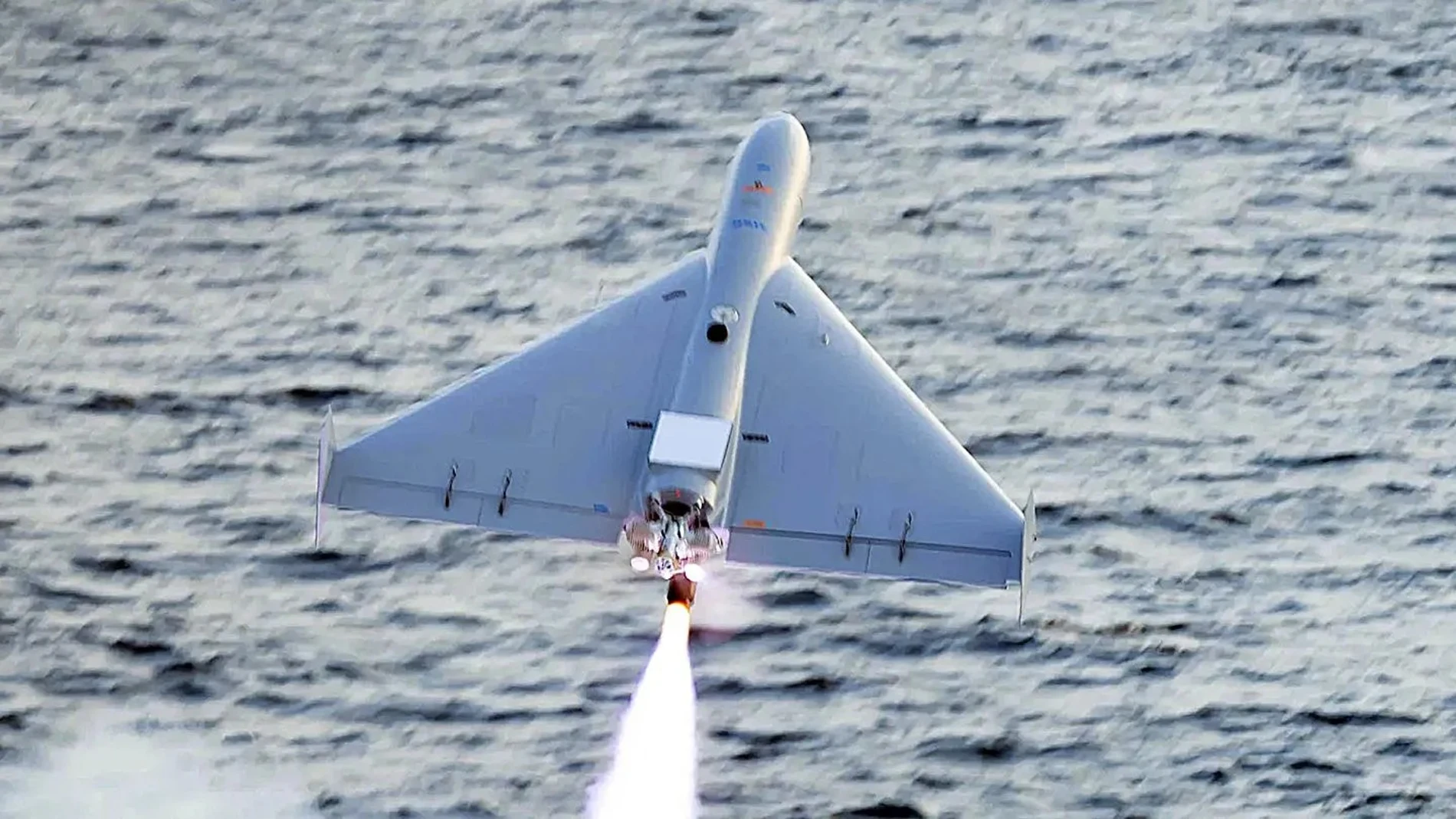
He United States Army he wants to use his kamikaze drones LUKE to knock out warships without needing to sink them. The idea is damage your radars, communications or other essential equipment to open a passage through which American planes and ships can later act.
Military commanders explained these plans during the annual meeting of the Association of the United States Armyheld last week in Washington. According to The War Zone, which attended the debate, they were responding to a question about how they were incorporating these long-range drones into their plans and training.
The general Bernard Harringtonresponsible for the command that coordinates different military capabilities of the Army in the Pacific, summarized the approach in that ‘maybe you don’t necessarily need to sink a ship’ and explained that disabling certain systems could allow an aircraft carrier with its escorts or a bomber force to advance.
What Harrington describes is known in military terms as ‘mission kill’prevent a weapon or vehicle from fulfilling its mission even if it is not destroyed. A ship can still float, but lose much of their ability to detect threats, communicate or defend themselves.
In a possible conflict with China, these attacks would serve to breach your access denial and area networks. These are sets of radars, missiles and other means intended to prevent enemy forces from entering an area or operating within it. The Army simulations contemplate coordinate LUCAS drones with unmanned vessels and other systems to weaken a portion of enemy defenses and take advantage of that opportunity.
What is the LUCAS drone
The LUCAS is the American copy of the Iranian Shahed-136developed through reverse engineering, that is, studying the original device to reproduce and adapt its technology. It is the same design as Russia uses against Ukraine under the name Geran-2with versions that it also manufactures in its territory.
The US version measures approximately three meters long, 2.4 meters wingspan and uses a combustion engine that drives a rear propeller. It is designed to fly autonomously and can take off using catapults or with the help of a small rocket, from land platforms or ships. According to The War Zone, its range is around 800 kilometers.
The decision to copy it responds to the interest in have relatively cheap long-range weapons that can be manufactured in large quantities. The US program seeks to distribute its production among different manufacturers in order to increase volume and speed up deliveries. This capability will allow the use of many inexpensive and reserve the most sophisticated missiles for other missions, forcing the enemy to spend more interceptors.
In Europethe US Army is studying using this type of drones to weaken an adversary’s defenses and destroy their missile launchers. The general Steve Carpenterresponsible for the equivalent command on that continent, mentioned at the meeting the Iskander-M and the oldest Tochkaboth carried and fired from mobile launchers that can travel on road.
The United States had already announced the initial deployment of the LUCAS in December 2025 and used them against Iran this year. He is now studying how to extend his employment while providing training in the maintenance, use and coordination of long-range and single-use attack drones at the Bayonet Academy in Washington state.
Plans for LUCAS include integrating the software hivemind of Shield AI for several drones to work in a swarm, coordinating tasks and maneuvers under human supervision.