
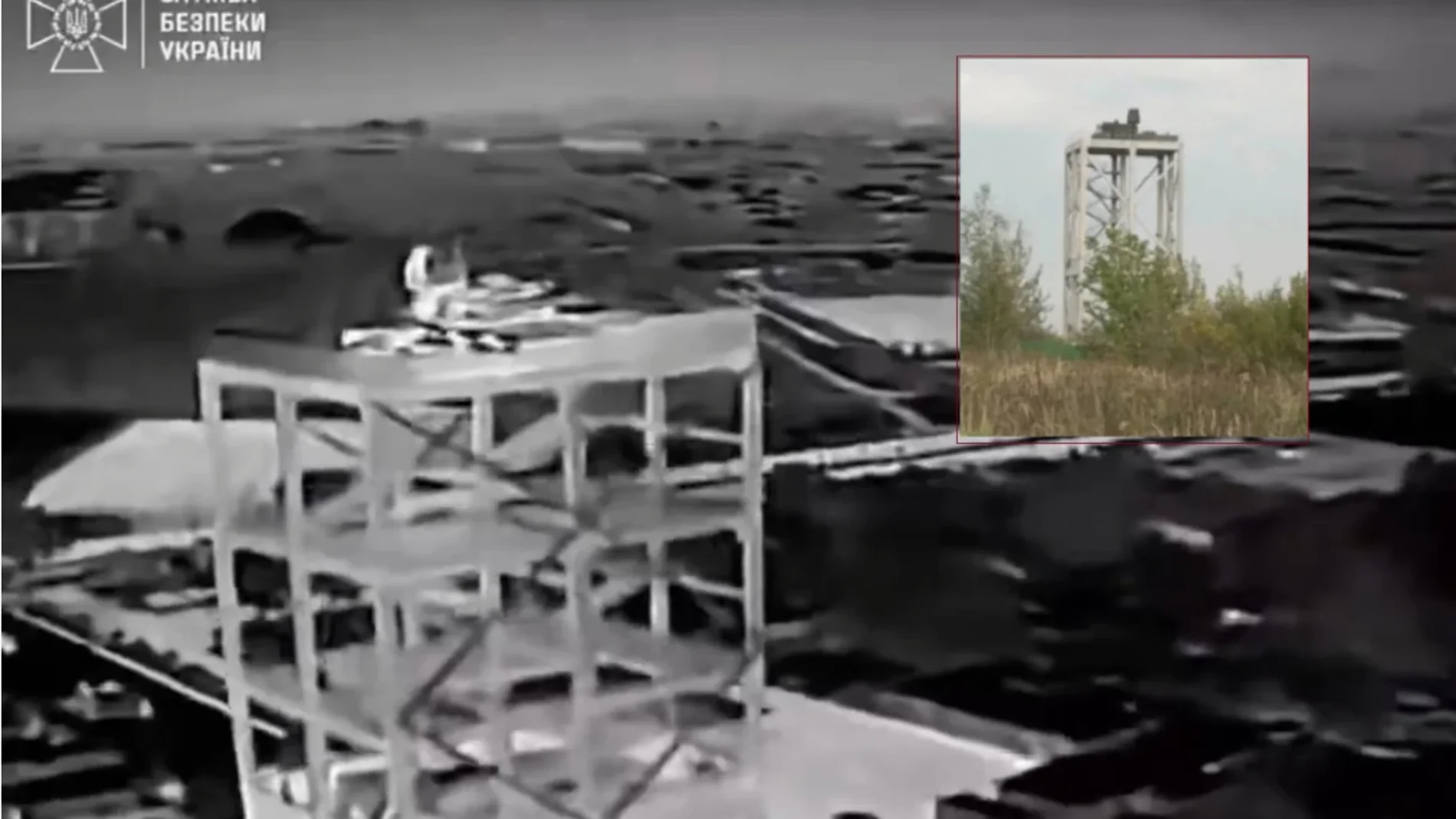
In drone warfare, gaining altitude can make the difference between detecting a threat in time or discovering it when it is too late. Russia knows this and has begun to install air defense systems on metal towers to expand its field of vision. But that advantage comes at a price: a fixed structure can also become an easy target. A video released by the Security Service of Ukraine (SBU) shows how a Ukrainian drone hits a Russian Pantsir system located at the top of one of these towers. The exact location of the attack, the date it occurred or the model of unmanned aircraft used have not been revealed. What the Ukrainian media does reveal is that it is a Pantsir-SMD-E, the latest model of this air defense. The images, released by the SBU’s Alpha special operations unit, show the attack against the anti-aircraft system installed on an elevated platform. At the moment, it is also not confirmed if the tower was damaged or if the impact destroyed only the Pantsir.
The informal name of these structures, Flakturmrefers to a much older episode in military history. During World War II, heNazi Germany built huge reinforced concrete towers equipped with anti-aircraft guns to defend cities such as Berlin, Hamburg and Vienna from Allied bombing. Current Russian structures are different, both in their design and dimensions, but they share the fundamental idea: to raise weapons to improve their ability to detect and attack air targets.
The presence of Pantsir installed on metal towers near Moscow became public in September 2023, when Russian state television showed these positions. The objective is to improve airspace surveillance against threats that, due to their small size and low-altitude flight, may be difficult to detect. The problem is the curvature of the Earth and the obstacles in the terrain. A radar located close to the ground may have difficulty locating a low-flying aircraft, especially if there are trees, buildings, or other elevations between them. By placing the system several meters higher, the line of sight is expanded and some of those blind spots are reduced. It does not mean that the radar can detect any drone at any distance, but it does mean that an elevated position can offer you better conditions to monitor certain approaches.
The Pantsir is designed precisely to deal with these types of threats. It is a short-range mobile anti-aircraft defense system that combines a detection and tracking radar with surface-to-air missiles and two 30-millimeter automatic cannons. Its task is to protect military installations and units against aircraft, cruise missiles and unmanned aerial vehicles.
That combination of sensors and weapons makes the Pantsir an important piece of Russian air defense. However, the system needs to locate and track the target in order to respondand its effectiveness also depends on the conditions of the confrontation. Small drones, low-altitude approaches, and strikes against known positions pose different challenges than conventional aircraft or missiles.
Here the paradox of the towers appears. Elevation can help a radar see further, but at the same time, it gives it greater visibility as a structure. To this we must add that, once identified, a fixed structure cannot be moved to avoid an attack. If the adversary manages to locate it and has means capable of reaching it, the same facility that improves surveillance can become a much more accessible target.
That doesn’t mean that placing an anti-aircraft system on a tower is necessarily a tactical mistake. Height offers real advantages and can make certain attacks more difficult. The point is that defense against drones does not depend solely on the power of the radar or the range of the missiles: it also requires protecting positions, hiding them when possible and preventing the enemy from easily attacking them.
The destruction of a Pantsir does not in itself mean that a region has been left unprotected: Coverage depends on the distribution of the systems, the available radars and the coordination between the different units. But each loss forces Russia to assess how it replenishes its teams and adapts its defenses in the face of a rapidly evolving threat.