
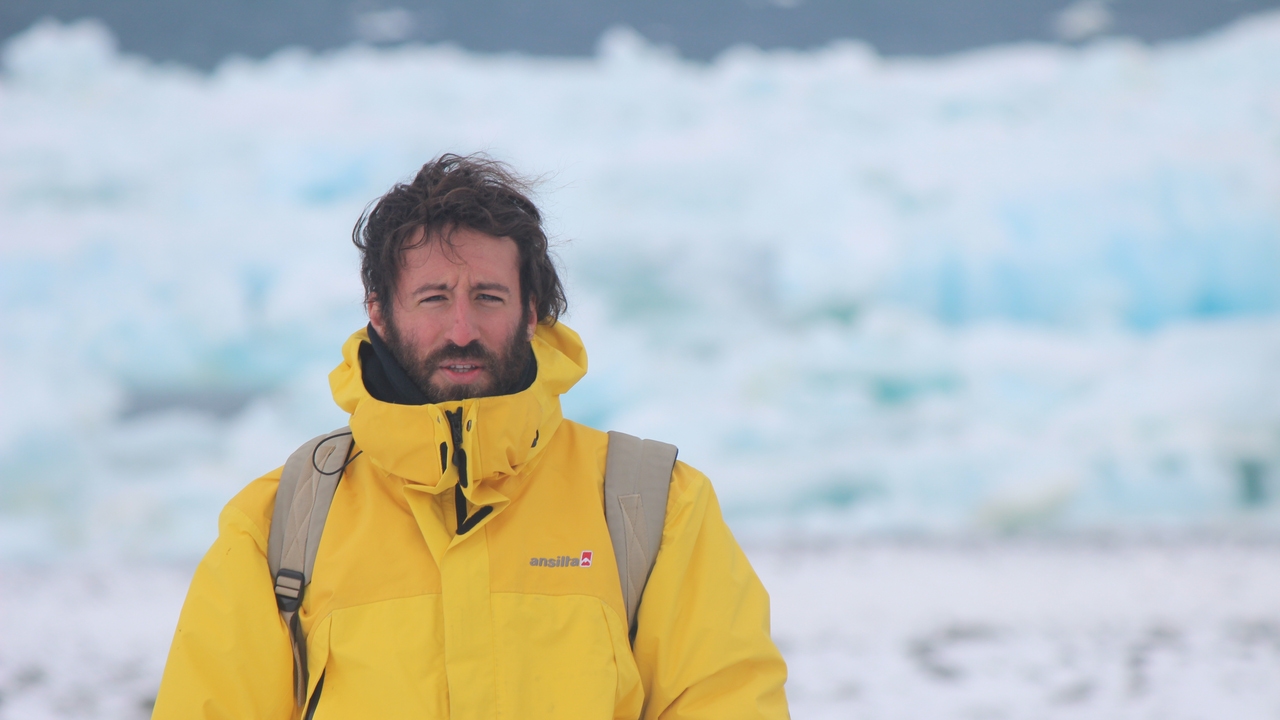
Antarctica. 25 Days Locked in Ice, by Federico Bianchini, ceased to be a report on science at the Carlini base when its author was trapped on the continent due to bad weather. Isolated for days, the long conversations with researchers in one of the most uncertain territories on the planet became the germ of a story that, beyond dissemination, interweaves science and personal chronicle, borrowed childhood dreams and landscapes of inner loneliness, without forgetting the epic of those who tried to reach the South Pole.
According to how he tells his story and that of the scientists who arrive in Antarctica, it seems like a place that is first dreamed of…
There is something to that. What happened to me, as I tell in the book, is that there was something indescribable. A friend of my grandfather said that he couldn’t narrate those landscapes. There was something about not being able to imagine Antarctica: what is this place like that this person can’t describe? If I can’t imagine it because I don’t have the elements to do it, then I’ll go. I think that at the beginning of everything was that: the intrigue that generated in me that language, something so central to me, was not enough to be able to recreate that place. It seemed totally unexpected and very intriguing to me. It also happens to many scientists. I came back with the realization that it was like this: the idea of writing the landscape is a failure. One can try to get closer, give clues, generate in the reader’s head that mythical Antarctica that we all imagine, because there is a prior imagination of what it is. But when you get there, you discover that everything you had imagined was far, far below the real experience, its intensity.
Once dreamed, can anyone go to Antarctica?
When I asked the psychologist how they decided who could go to Antarctica and who couldn’t, he told me that he looked a lot at childhood, at the unconscious. I asked them things like: “if the power goes out or if there is suddenly no internet, what do you do?” There are people who cannot be without the internet, and he said that those types of people are not capable of traveling there. They have to be people who, in principle, have little anxiety. He told me that when someone spends six or seven months and the time starts to get longer, the perception of things changes and some people become more paranoid. That’s emotionally. But then there is the physical. The psychologist said that he had no problem with anyone going to Antarctica, but he gave very specific examples. If a celiac sufferer brings their special food and that food falls out of the jar, and for three months they have no way to eat gluten-free, what do we do? Or someone with a back problem who can’t bear weight. He said: “I have no problem with that person being exempt from heavy work, but if during the winter there are four of them and a helicopter arrives with cement and they have to lower bags, can you explain to the other three that they have to carry three times as much?” When deciding who goes, I told myself, I have to define with a very pragmatic criterion, because we are going to a military base in a very harsh place, which can bring many complications.
He talks a lot in the book about the feeling of loneliness being surrounded by people as one of the hardest aspects of the Antarctic experience. What was the most rewarding?
The strong sense of community that is generated. I started talking to one of the scientists; The guy had traveled to Antarctica about 18 times and told me that if we met again after that trip, we would treat each other as friends. At that moment I thought he was saying something completely stupid, but years later I saw him again and he hugged me sincerely, and I hugged him sincerely. The intensity of the experience generates very particular bonds, not only between people of the same language or the same country, but also between people from other places. Antarctica has a treaty to make it a continent of science and peace, and it is one of the few places where these terrible geopolitical conflicts do not exist. People come and go from other bases; even the shelters are not closed, they are open. It doesn’t matter who owns the shelter or who built it, what matters is that if someone has a problem, they can go there and protect themselves.
Given the current geopolitical situation and the strong Argentine presence in Antarctica, do you think that greater territorial interest is awakening?
The territorial interest was always there. Argentina claims sovereignty over a portion of land that coincides with that of Chile or England, and this exists despite the Antarctic Treaty. I tell the case of the Argentine dictatorship sending an eight-month pregnant woman so that her child would be born in Antarctica and be the first “Antarctician.” At another time, Chile wanted to build a landing strip and the Argentine military went ahead and put up a shelter to prevent it. If we are already like this, what will happen after 2048, when the treaty will have to be extended? It is an uncertainty. I hope the climate that exists today at the bases continues.
The book has received many awards in Argentina, has been turned into a play and now arrives in Spain. Was all this expected?
No not at all. In principle because my initial intention was to visit that place. But the fact that he could not return, that those ten days became first twelve and then twenty-five, without knowing when he would return, made him gather a lot of information and conduct interviews. When I came back I had 48 hours of recording. Then I went to cover the World Cup and those recordings were saved. The play thing was also totally unexpected, and in the end I ended up acting. Later I was invited to a scientific journalism conference in Barcelona about new ways of narrating science. For this edition now published by Ediciones del KO we did several things: we updated the data on climate change, which had changed a lot; We incorporate more history of Antarctica and the race to the South Pole. A complete edition was made: parts were removed, others were added. It was very deep work.
What does Antarctica say in 2014 and now?
All the research carried out there seeks to measure the effects of climate change, although each scientist studies a very small part of the whole. For example, a researcher explained to me that penguins need a certain density of ice to spawn. With the thaw, they have to swim much further to reach those places, and on that journey many lose strength and die. At that time it was suspected that global warming was behind this, but it could not be firmly stated. Today it is affirmed. There is a much clearer awareness of the urgency of the measures that must be taken, of the irreversible nature of the situation if no action is taken, and that the problem is much more pressing.
However, politics goes in another direction…
Yes, that happens too. Social networks allowed the idealization of absurd, flat-earther, anti-scientific discourses that at another time would not have prospered. It’s as if ignorance is no longer shameful. Today anyone can say anything stupid, even from places of power, something unthinkable forty or fifty years ago, even for a president.
It talks about a scientist who studies the human impact on missions on the continent. What do you think of the increase in cruises?
There is something important: it is not tourism with a conscience. Many people go to Antarctica on a cruise as they might go to Rio de Janeiro or Punta del Este. It is not with the idea of entering a pristine place that must be taken care of, but rather to take a selfie, like in any other destination.
Just one more question: would you like to come back?
Yes. It was curious because when I was finishing the book they invited me to return to the same base, at the same time of year. I realized that, if I went, it would no longer be for a journalistic reason, but almost for a tourist reason, and I needed to finish writing. That’s why I prioritized staying. There is something that the Antarctic people say: that whoever goes, usually comes back. Because of the impact, because of the wonder it produces. And yes, it is a place I would like to return to.