
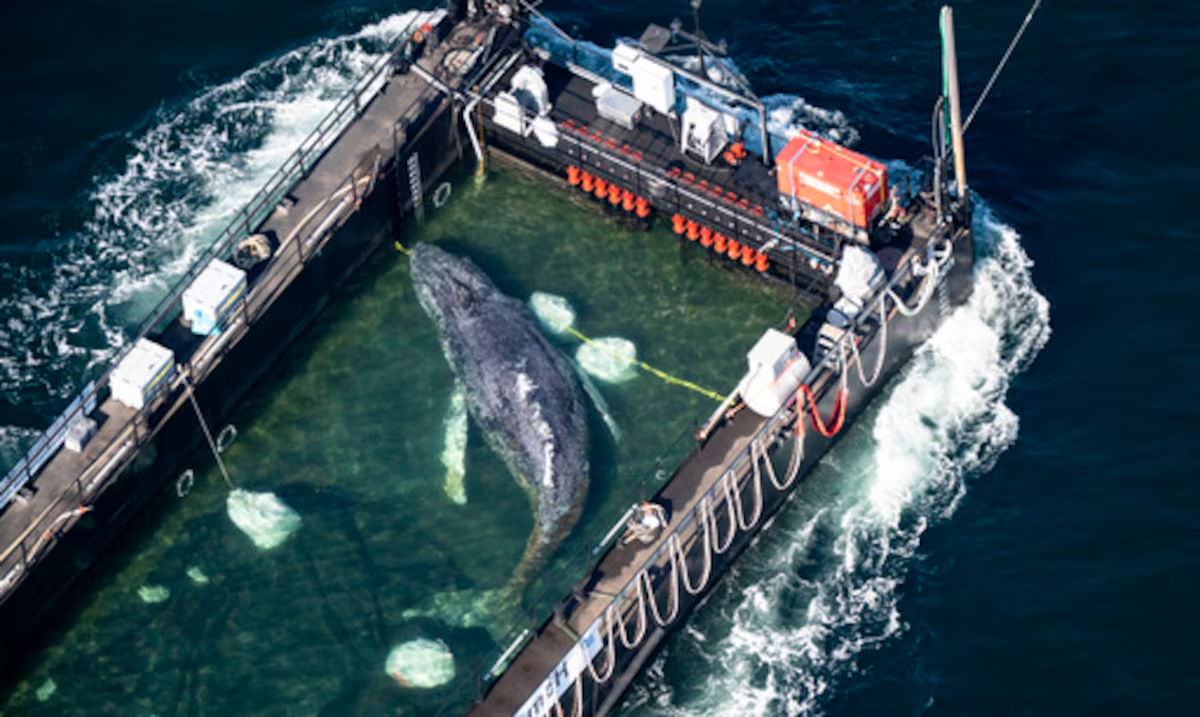
Berlin – A humpback whale found dead this week off a Danish island has been identified as the animal released two weeks ago in a spectacular and controversial rescue effort, after being repeatedly stranded off Germany’s Baltic Sea coast, authorities said Saturday.
The dead whale was stranded on Thursday off the small island of Anholt, in the Kattegat, the wide strait between Denmark and Sweden that connects the Baltic Sea with the North Sea.
The site is south of the town about 45 miles (70 kilometers) from Skagen, in the far north of Denmark, where the whale that earned the nicknames “Timmy” and “Hope” was released on May 2 after being transported to the North Sea on a barge.
A tracking device was recovered
“It can now be confirmed that the humpback whale stranded near Anholt is the same whale that previously stranded in Germany and was the subject of rescue attempts,” Jane Hansen, division head of the Danish Environmental Protection Agency, said in an emailed statement.
He added that conditions on Saturday allowed a Danish Nature Agency employee to locate and recover a tracking device that was still attached to the whale’s back, and “the position and appearance of the device confirm that it is the same whale that had been previously observed and handled in German waters.”
1 / 10 | This is how they try to rescue a humpback whale that is sick and stranded in the Baltic Sea. A stranded whale is doused with water after getting stuck on a sandbar in Kirchdorf on the island of Poel, Germany. – Michael Probst
The discovery brought a sad end to weeks of efforts to return the mammal to its natural habitat in the Atlantic Ocean.
a long drama
The whale was first spotted off the German coast on March 3. It is not clear why it entered the Baltic Sea, which is far from its habitat and for which it was not suitable, although some experts said it could have been lost while swimming after a school of herring or during migration.
At the end of March she was rescued from the shallow waters of Timmendorfer Strand, a tourist town in the German Baltic, with the help of an excavator, but soon had problems again nearby. Local media broadcast live throughout the day, and news websites alerted readers to any further developments in the whale’s situation.
In early April, experts said they had lost all hope for the whale and expected it to die in the inlet where it was stranded at the time.
But the deterioration of the whale’s condition sparked a controversy that attracted private rescuers, regional authorities and the scientific community. Activists organized protests calling for the animal’s rescue, while influencers debated the best way to help it.
Some scientists say rescue efforts would themselves cause serious stress to the sick and exhausted animal.
The regional government of the German state of Mecklenburg-Western Pomerania authorized a private rescue initiative to carry out the ambitious effort of lifting the whale onto a flooded barge.
The initiative confirmed that the numerical tracking device found on the dead animal corresponded to the one that had been attached to the whale, the German news agency dpa reported. He noted that it was not possible to conclusively state what the cause of the whale’s death had been.
Lessons to learn
Mecklenburg-Vorpommern Environment Minister Till Backhaus said Saturday that the effort had given the whale “one last chance to regain its freedom and health,” but that it had not been able to take advantage of it. He said it will be important to learn “the best possible lessons” from the episode.
Backhaus stressed in a statement that “consenting to the rescue attempt does not constitute a criticism of science” and added: “I believe it is absolutely human to take advantage of the slightest opportunity when a life is at stake.”
Authorities have not yet decided what will be done with the dead whale.
This story was translated from English to Spanish with an artificial intelligence tool and was reviewed by an editor before publication.