
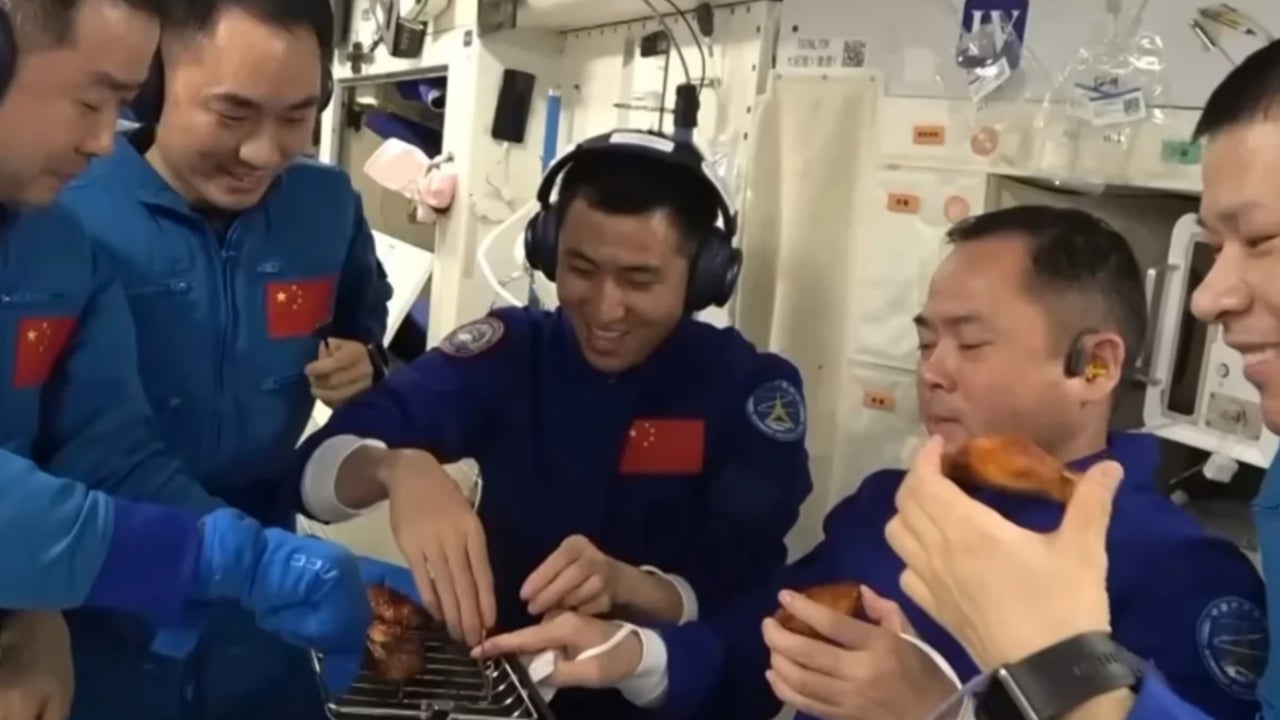
The image is as curious as it is strange to what we knew until now: the crew of China’s Tiangong Space Station orbital station They celebrate a crew change with chicken wings and beef steakscooked on board using a hot air oven specially designed for microgravity.
But beyond the anecdotal moment, This small “space banquet” represents technological, psychological and life support advances that have fundamental implications for human exploration.
The crew of the Shenzhou-20 and Shenzhou-21 missions used a new oven installed at the station, capable of reaching temperatures of about 190 °C and operate safely in microgravity, with a filtration system that prevents smoke and loose debris. The chicken wings took about 28 minutes to be ready. The oven is certified for up to 500 cycles.
The system was also designed to integrate with the station’s electrical circuit and its ventilation and purification systems. Why does this milestone matter? First, improving the quality of life in orbit. Eating is not just about nutrition: it is also a social, psychological and well-being act. On long-term missions (months or years), something as “earthly” as a decent meal can make a difference in morale, crew cohesion, and mental health.
Cooking in microgravity presents real challenges: no normal convection, no “up-down,” no gravity separating smoke or vapor toward the usual detectors. The development of furnaces, filters, fire safety and waste management is key to long life in space, whether on stations, the Moon or Mars.
If we ever want humans to live on the Moon or Mars, or in high orbit stations, having a menu beyond dehydrated or rehydrated food will be essential. This type of advance is a step towards that self-sufficiency.
That a nation implements “real” ovens and meals prepared in orbit too It conveys something about its spatial capabilities, not only scientific, but also infrastructure, logistics and permanence.
In the future we can expect that the menu will be expanded to include more varieties, fresher ingredients or those grown in orbit, that other cooking methods will be tested, more energy efficient or adapted to microgravity, and also, from a scientific point of view, that long-term effects on crew health (nutrition, microbiome, psychological well-being) are evaluated.