
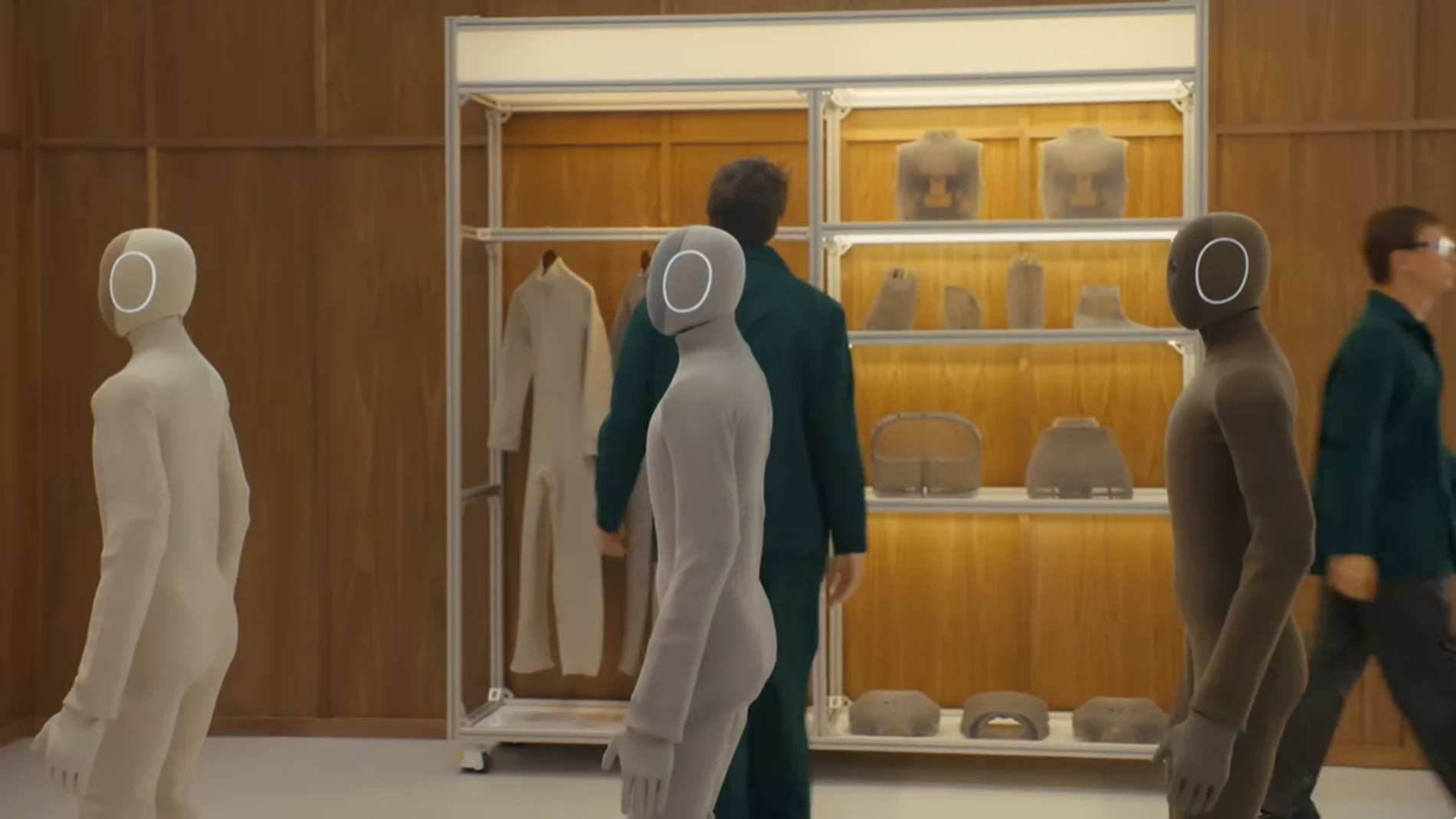
In a 58,000 square meter industrial warehouse in California, something that for decades belonged to science fiction has begun to take shape on an assembly line. It is not a car, nor a mobile phone, nor even a drone: they areartificial human bodies, designed to live with us.
The company 1X Technologies has launched the so-called “NEO Factory” in Hayward, a facility designed not to manufacture prototypes, but to produce humanoid robots on an industrial scale.
And therein lies the key to the announcement: it is no longer so much about what a robot does, but rather about how many can be made. For years, humanoid robots have been one-offs, expensive, delicate, and limited to laboratories or demonstrations. This move changes the logic. The new factory has initial capacity to produce about 10,000 robots a year, but the stated goal is exceed 100,000 before the end of the decade.
It is a conceptual leap: manufacturing ten robots is research, one hundred thousand is industry. To achieve this, 1X is committed to a “vertically integrated” model: many of the components (motors, sensors, batteries or structures) They are designed and assembled within the factory itself. This allows you to control costs, iterate quickly and adapt hardware to the pace at which artificial intelligence evolves.
The protagonist of this story is the NEO robot, a humanoid designed not for factories, but for homes. Its design responds to a simple but ambitious idea: if the world is made for humans, perhaps the most useful robot is the one that has a human form. That involves walking, grabbing objects, interacting with domestic spaces, and communicating with people.
NEO measures approximately 1.7 meters, has dozens of degrees of freedom in its joints and is equipped with cameras, microphones and AI systems that allow it to interpret its environment. It can perform basic tasks such as organizing, transporting objects or assisting in daily activities, although it is still far from completely replacing a person. In essence, it is not a specialized robot, rather a generalist one.
Making the body is only half the problem. The other half is teaching you how to use it. These robots are not programmed like a washing machine or an elevator. They need to learn. For this reason, much of their development occurs in virtual environments, where they can be trained through simulations before facing the real world. Each gesture, from picking up a glass, opening a door or putting on a washing machine, to avoiding an obstacle, involves solving physics, perception and decision-making problems in real time. And all of that must be done safely.
Because, unlike an industrial robot isolated in a factory, these humanoids are designed to coexist with people. The opening of this factory does not mean that tomorrow we will have robots at home. But it does indicate that something has changed: the industry has decided that the next step is not to improve the prototypes, but to mass produce them. Despite the “promise” of 1X, it is advisable to maintain a certain distance from the enthusiasm. Current developments themselves show that these robots still have important limitations: autonomy, precision, understanding of the environment or ability to handle unforeseen situations.
In many cases, they still rely on human supervision or controlled environments. But even with those limitations, the change is evident. For the first time, we are not seeing humanoid robots as technological curiosities, but as products on an assembly line. And perhaps that is the real headline: not that they exist, but that they are beginning to multiply.