
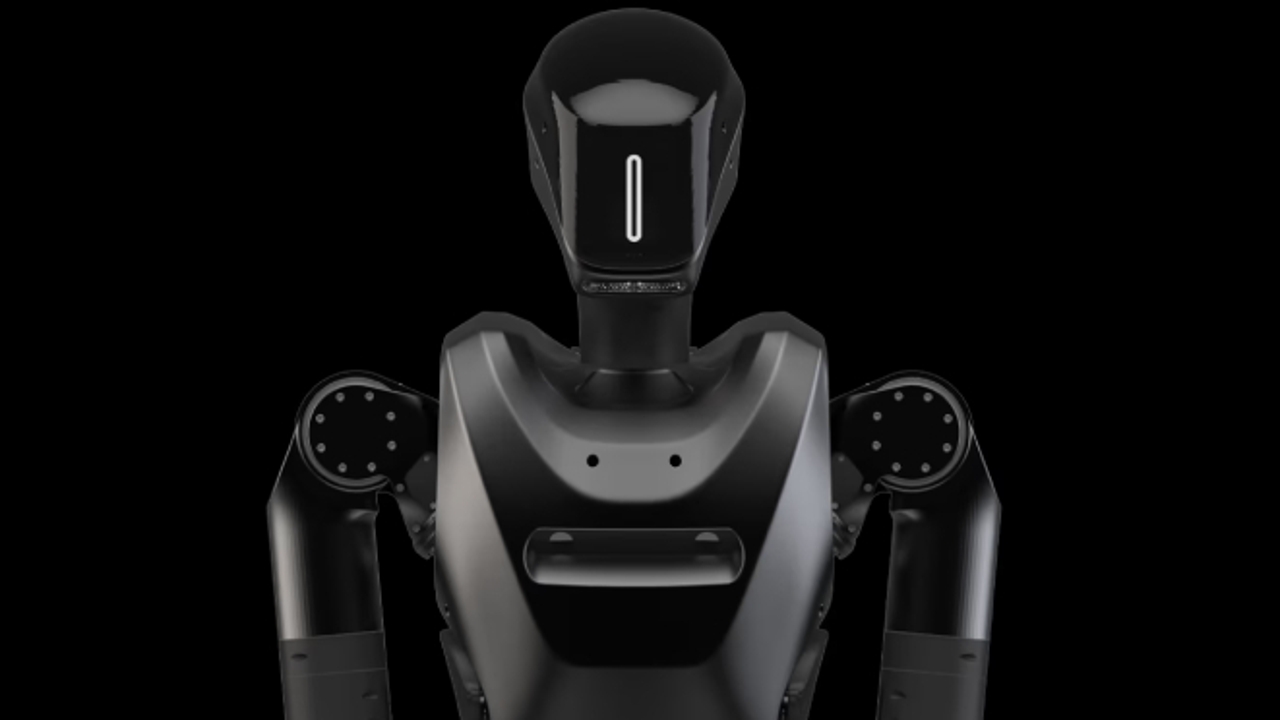
Companies like tesla They believe that in the near future humanoid robots They will be a revolution, but limited to civil life. Most robot manufacturers say they will not militarize their technology, but that is not the case. Foundation. The company, based in San Francisco, has developed what could be the world’s first humanoid robot designed expressly for war.
Is called Phantom MK-1measure 1.75 metersweighs about 80 kilosyou can load up to 20 kiloswalks at a speed of 6 kilometers per hour and, of course, artificial intelligence plays a key role in it.
Around the world, militaries are increasingly integrating AI into their defense systems. In the war between Russia and Ukrainelocally manufactured drones and unmanned systems already perform real-time target identification and precision attack support. As explained by the US congressman Pat Harrigandrones are causing 80% of Russian battlefield casualtiesin many cases assisted by artificial intelligence.
USA and Israel have gone a step further, using AI to track and generate target recommendations, while the Chinese People’s Liberation Army (PLA) invests in automated recognition systems based on satellite images and sensor data. In turn, countries like South Korea, India, Australia, United Kingdom, Saudi Arabia and United Arab Emirates They develop AI defense technologies, especially computer vision, which helps identify and classify targets in combat.
But Foundation’s approach takes a new dimension: bringing humanoid robots to military use. ‘The future of war is video games in real life‘, stated the CEO of the company, Sankaet Pathakin an interview with News Nation.
‘Air, land, sea… they will all be autonomous. In the next ten years, the most likely scenario is that we will see many active battlefields where The first body that enters will be a humanoid, and then, if necessary, humans‘, he pointed out.
ground defense unit

According to Pathak, the Phantom MK-1 is conceived as ground defense unitnot attack. It has been designed for reconnaissance and explosives disposal missionsthus reducing the risk to human soldiers in dangerous operations.
The CEO of Foundation has clarified that these robots They will not be completely autonomous. Explain that there will always be a human operator with the last word about whether a gun is fired or not, highlighting the company’s commitment to maintaining ‘the human in the loop‘ in critical decisions. The AI will take on tasks like trajectory tracking or robot motion calculationsbut human supervision will still be essential.
The manager describes the Phantom MK-1 as ‘Faster, stronger and armed to be more lethal‘, highlighting that its design prioritizes durability to operate in hostile environments. Foundation aspires to build ‘the toughest humanoid‘, capable of withstanding the physical demands of combat. The upper part of the robot integrates computing units, cameras, batteries and advanced sensors while the lower part is responsible for mobility and stability.
Unlike many modern humanoids, the Phantom MK-1 is based mainly on cameras and not on LiDAR sensors. In an interview with CNET, Pathak explains that the team intentionally reduced the number of sensors and cables on the robot to simplify data integration and improve reliability.
enjoyed hosting @CNET at @foundation_robo SFoffice. We discuss defense usecases, teleop, RL locomotion and more pic.twitter.com/LdTOx5tQRh
— Sankaet (@sankaet) October 15, 2025
Currently, the robot uses a mechanical hand with gloveswhich Foundation plans to replace with more advanced hardware in future versions. Their movements depend on patented cycloidal actuatorswhich allow you to move with softness, silence and notable strength.
Each joint can exert up to about 160 newton-meters of force –similar to that generated by a human arm lifting about 16 kg at 1 m distance-, but offers less than 1 newton-meter of resistance – the force necessary to turn a knob– if a person tries to bend your arm manually, so that it does not present rigid or sudden resistance. Although Pathak talks about its military use above all, Phantom MK-1 It also has industrial ones.
The company plans to manufacture 10,000 units next yearalthough so far it has only demonstrated the Phantom MK-1. On the web Humanoid.guidededicated to the humanoid robot industry, the model is listed by $100,000 per unitalthough without an availability date.