
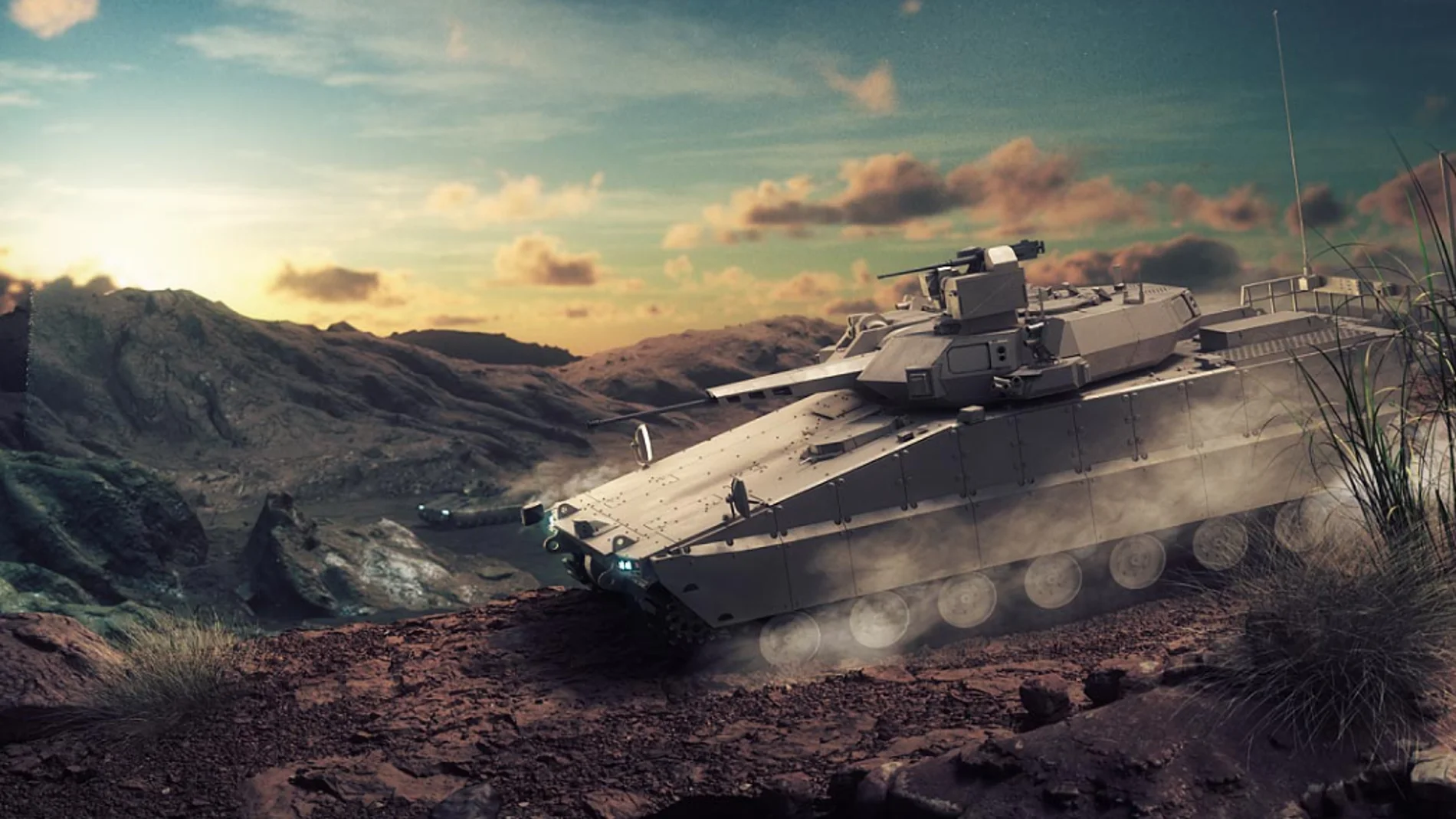
The battlefield has a new threat that comes from above and that does not always need a missile to destroy an armored vehicle. Drones can locate vehicles, transmit their coordinates, correct artillery fire or attack directly. Given this transformation, Lockheed Martin UK and Hanwha Aerospace (South Korea) have presented a new configuration of the AS21 Redbackan infantry fighting vehicle that incorporates a 40-millimeter turret and a command and control system designed, among other functions, to confront unmanned aircraft.
The presentation took place at the Defense Vehicle Dynamics (DVD) 2026 exhibition, held in Millbrook, United Kingdom. The proposal combines the Redback track chassis, developed by Hanwha, with a Lockheed Martin manned turret equipped with the CTA International 40mm cannon. It is, therefore, an adaptation of an existing platform, not an armored vehicle designed from scratch.
The companies present it as a modular option for NATO countries that want to incorporate new capabilities without developing a completely new vehicle. The most striking change is in the combination of the cannon with SkyKeeper, Lockheed Martin UK’s command and control system for air defense and counter-drone. It is the first time that the company integrates this system directly into a turret architecture. SkyKeeper can bring together information from different sensors and generate a common image of the airspaceso that the vehicle can receive information about a threat that it may not have even detected with its own sensors.
That changes the traditional role of an infantry fighting vehicle. Its primary mission is still to transport and support soldiers, but it can now be incorporated into a defense network against short-range aerial threats. The objective is not to convert each armored vehicle into an anti-aircraft battery, but add a layer of protection that can accompany mechanized units wherever they are.
The 40mm cannon also has a particular history. The turret developed by Lockheed Martin UK comes from previous British programs, including those aimed at modernizing the Warrior infantry vehicles and the Ajax reconnaissance vehicle. The Warrior modernization program was canceled, but left technology available that can now find a second life on the Redback chassis.
Hanwha highlights precisely the variety of ammunition available for the 40mm CTA cannon as one of the reasons for choosing it. That diversity allows the weapon to be used against different types of targets and provides greater flexibility than limiting the vehicle to a single function. Byunggil Lee, director of armored vehicles at Hanwha Aerospace, explained that The combination demonstrates the extent to which an existing platform can be reconfigured to quickly respond to the needs of a new customer.
The electronic architecture is as important as the turret. The vehicle uses the Generic Vehicle Architecture, a standard that allows different systems to be connected and makes it easier to incorporate new technologies during the operational life of the armored vehicle. In other words, It is not just about installing a cannon and a computer: the intention is to build a platform to which sensors, weapons and mission systems can be added without having to redesign the entire vehicle.
The Redback also already has experience outside of South Korea. Australia selected it in 2023 within its LAND 400 Phase 3 program and ordered 129 vehicles. But the Australian setup is different: It uses another turret, a 30 mm cannon and anti-tank missiles, among other systems. The version now presented in the United Kingdom responds to a different priority: combining the usual functions of an infantry fighting vehicle with a specific defense capability against drones.
That difference also explains why companies talk about a solution for NATO customers. They do not intend for all armies to adopt exactly the same Redback, but rather to demonstrate that the vehicle can be adapted to different national requirements. At the moment they have not announced a buyer for this specific configuration.
The proposal comes when drones are forcing us to rethink the protection of ground forces. An armored vehicle can remain very resistant against certain threats and yet be vulnerable if a small drone manages to locate it and transmit its position. The answer increasingly involves combining armor, sensors, electronic warfare, weapons and connected command systems.
In this scenario, the new Redback poses a simple idea: defense against drones does not always have to be behind the armored column; You can travel with her. Lockheed Martin UK and Hanwha They plan to carry out demonstrations with live fire in 2027, including in countries such as Canada and South Koreato show the capabilities of this new configuration.