
It may not be the most important question of science for some people, but it certainly occupies the podium: are we alone in the universe? Taking into account that there are about 700 trillion planets and that, at least, 300 million of them are in a habitable zone and meet the conditions for lifethe possibility that at least one of them has a biology is not crazy. But how to detect it? For their gases.
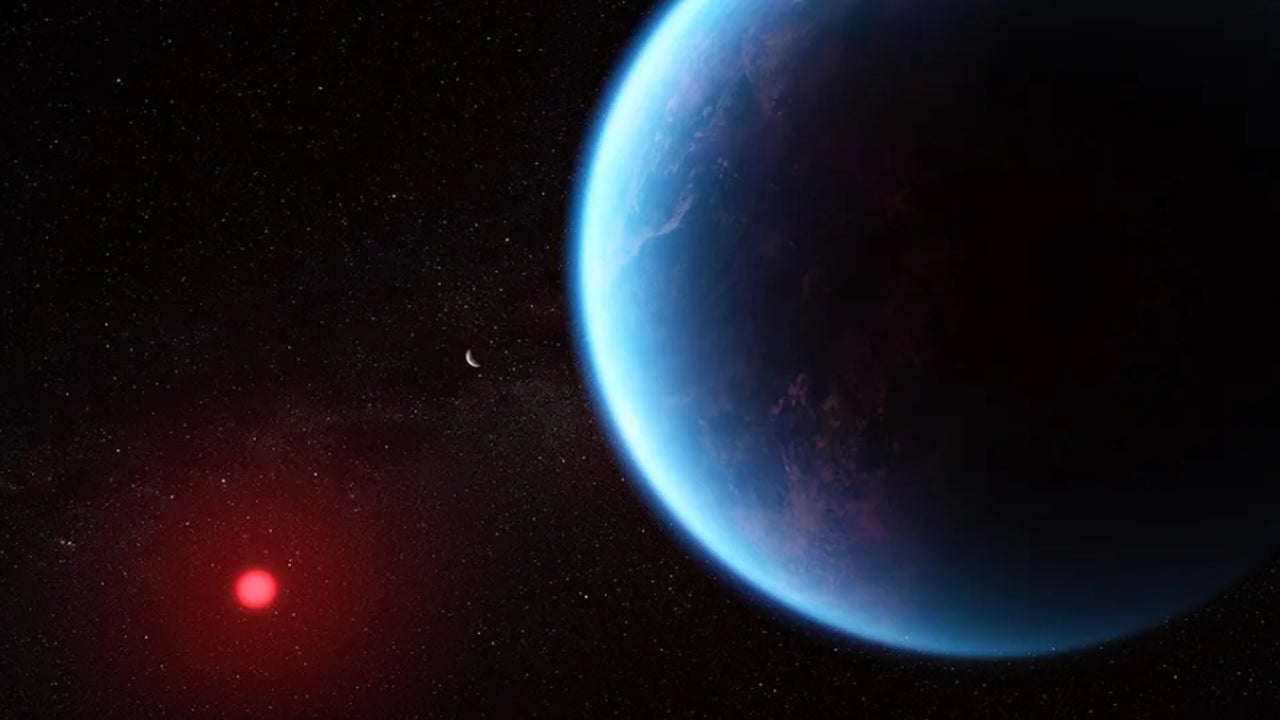
In this case, the protagonist is K2-18B, a planet at 120 light years that seems taken directly from the Interstellar movie and his marine world. K2-18B jumped to fame in 2023 when thanks to the James Webb space telescope (JWST) NASA was detected the presence of dimethyl sulfide (DMS).
On Earth, the DMS is mainly produced by life, especially by phytoplankton and other marine microbes, So the 2023 study was received with some enthusiasm.
However, enthusiasm was attenuated by the preliminary nature of the finding; JWST’s observations were consistent with the presence of DMSbut they did not confirm it. Therefore, the study team analyzed it again, but this time in a slightly different way.
The JWST can analyze exoplanet atmospheres when these worlds cross the surface of their host stars from the observatory’s perspective: The telescope detects certain molecules in the air based on the wavelengths of the stellar light they absorb.
These wavelengths act as fingerprints: each element has its own, so detecting a certain wave, is a reliable and reliable indicator of the presence of this element. Thus we know the elements of, for example, the planets in our solar system.
The team made the initial and tentative detection of DMS using the Niriss instruments (near -infrared and spectrograph without slit) and Nirspec (near -infrared spectrograph) of the JWST) of the JWST. However, for the new study, Posted in Astrophysical Letters Journall, Cambridge scientists used the middle infrared instrument (Miri) of the telescope, which Analyze different wavelengths of light. The results showed that Miri also detected the DMS footprint.
“This is an independent evidence, which uses an instrument different from the one we use before and a different light wavelength range, where there is no overlap with previous observations – explains Nikku Madhusudhan, leader of the study in A statement -. The signal was transmitted with force and clarity“
Based on its size and other characteristics, Madhusudhan’s team suspects that K2-18b could be a Hyceano world (combination of hydrogen and ocean), an exoplanet class proposed in 2021 that has a huge ocean of liquid water and an atmosphere rich in hydrogen.
In fact, the study confirms that K2-18b air is also rich in DMS. The authors They estimate concentrations of more than 10 parts per million in volume, compared to less than one part per billion for them here on Earth.
“Previous theoretical works had predicted that high levels of sulfur gases, such as DMS, are possible in the Hycean worlds -adds Madhusudhan -. And now we have observed it, according to the planned. Given everything we know about this planet, A Hyceano world with an ocean full of life is the scenario that best fits the available data. ”
It should be noted that The authors do not claim to have detected extraterrestrial lifewhat they support is that more research is needed to confirm and expand their findings. Other scientists think the same
Detecting signs of extraterrestrial life is a complex matter, and confirming them is even more, especially in a world like K2-18b, which we cannot closely investigate in the predictable future, if we ever do it. Therefore, it can be expected that the debate and data collection will continue.