
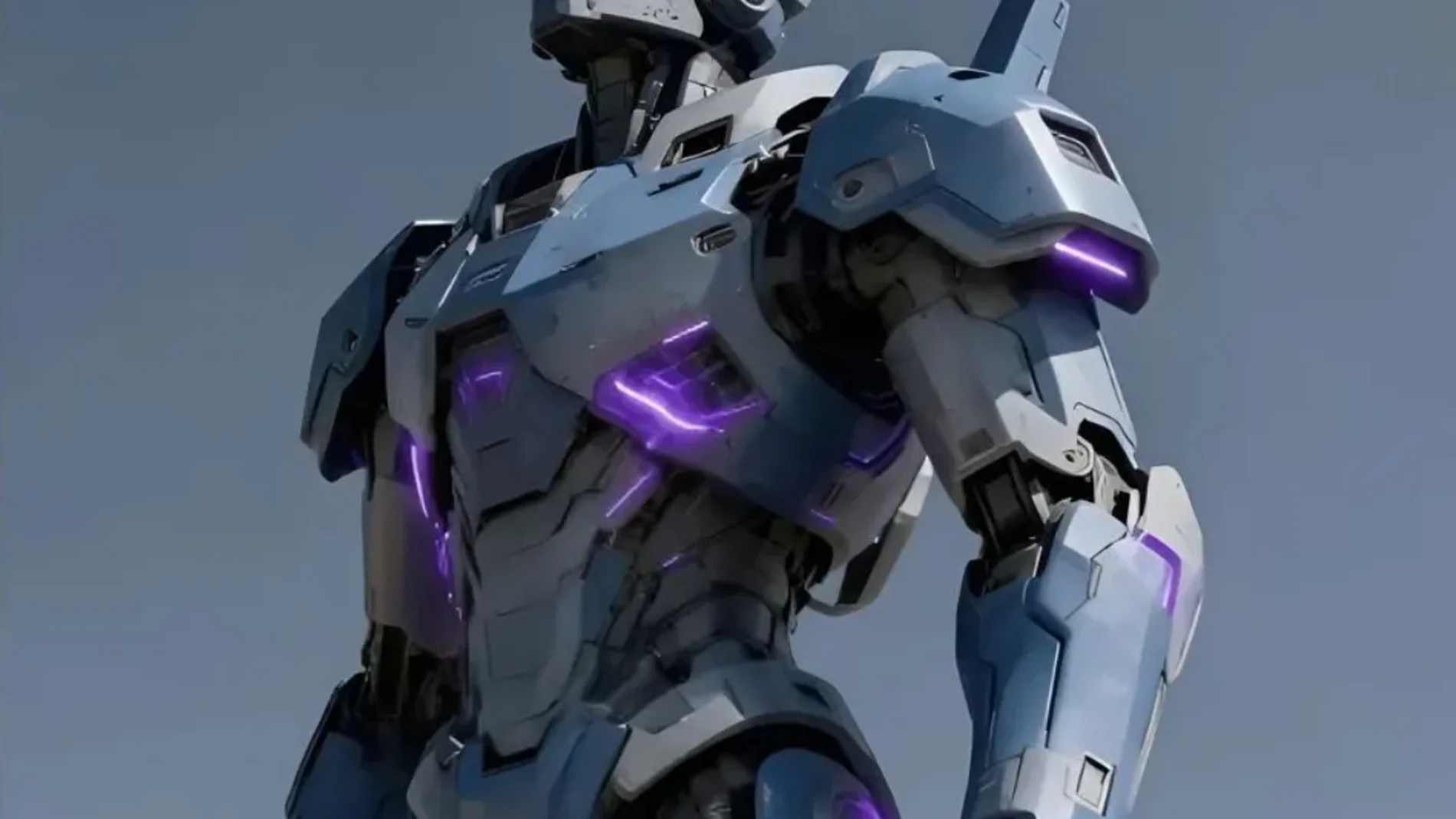
The first impression is, at least for those over 30 years old, Mazinger Z, the legendary Japanese robot from the 1980s. But the Neo1 is not that complex… although it could be just as legendary. A four-meter-tall robot capable of lifting half a ton looks like a machine designed for a science fiction movie. However, Neo1, presented by the Chinese company NeodraDynamics, pursues a much more specific purpose: moving humanoid robotics from laboratory demonstrations to some of the most demanding industrial jobs. Its secret is in a technological combination that recovers an old ally of engineering, hydraulics, and unites it with the precision control of electrical systems.
The company claims that Neo1 can handle a joint load of up to 500 kilos with its two arms. The figure does not mean that you can lift that weight in any posture, walk with it on any surface or hold it indefinitely: the effective capacity depends on the configuration of the arms, the distance of the load from the body and the operating conditions. But the data points to a clear ambition. Instead of competing with electric humanoids designed to carry light objects or perform service tasks, Neo1 seeks to operate where strength is the main obstacle.
The machine’s body has 41 active degrees of freedom, a measure of the number of independent movements it can perform. Thirty-nine joints use digital hydraulic actuators developed by the company, while The two remaining rotation movements, located on the forearms, use electrical drives. The hybrid architecture aims to combine the high force provided by hydraulics with the fine control of electric motors.
To understand the advantage you have to look inside an actuator. In a hydraulic system, a pump generates pressure in a fluid, usually oil, which transmits force to a piston or equivalent mechanism. The pressure applied on a surface produces a force: the larger that surface is for the same pressure, the greater the thrust can be.. This principle allows considerable forces to be developed with relatively compact components, a valuable feature when heavy loads have to be moved.
Electric motors can also generate high forces and offer very precise control, but increasing the capacity of a robot is not simply about installing more powerful motors. Consideration must be given to the weight of the actuators, energy consumption, heat generated, the structure that supports the loads, and the ability to maintain control during complex movements. Hydraulics offer a high force density, although they introduce their own problems: leaks, seal wear, fluid management, thermal dissipation and pressure regulation.
The word “digital” in Neo1 actuators points to a way of controlling the hydraulic system using electronically regulated drive elements. Without more detailed independent technical documentation, it is not possible to specify how the company solves each of these problems or how much performance improves over a conventional solution. The central idea, however, is clear: take advantage of the force of the fluid and regulate the movement with sufficient precision so that a machine capable of handling large loads can also carry out delicate operations.
NeodraDynamics claims a positioning repeatability of ±0.005 millimeters, equivalent to five microns. To put it in perspective, Five microns represent one twentieth of a tenth of a millimeter. It is an extraordinarily demanding specification for a system of this scale, but it is important to interpret the data correctly: repeatability indicates the extent to which the mechanism can return to a position when it repeats an operation, not that all positions are exact under any load, speed or environmental condition. The figure comes from the manufacturer and needs independent verification to assess its real performance in industrial applications.
The size and strength of Neo1 explain the environments it aspires to reach: heavy component assembly work, cargo handling in ports, mining, rescue operations and maintenance at nuclear facilities. It also targets underwater applications. In these scenarios, a machine could take on tasks that expose workers to loads, impacts, contamination, or hazardous conditions. Neo1 thus raises a relevant question for the future of robotics: Do humanoids have to be lightweight machines that replicate a person’s everyday movements, or can they become specialized platforms? that far exceed their physical capabilities? The Chinese proposal opts for the latter.