
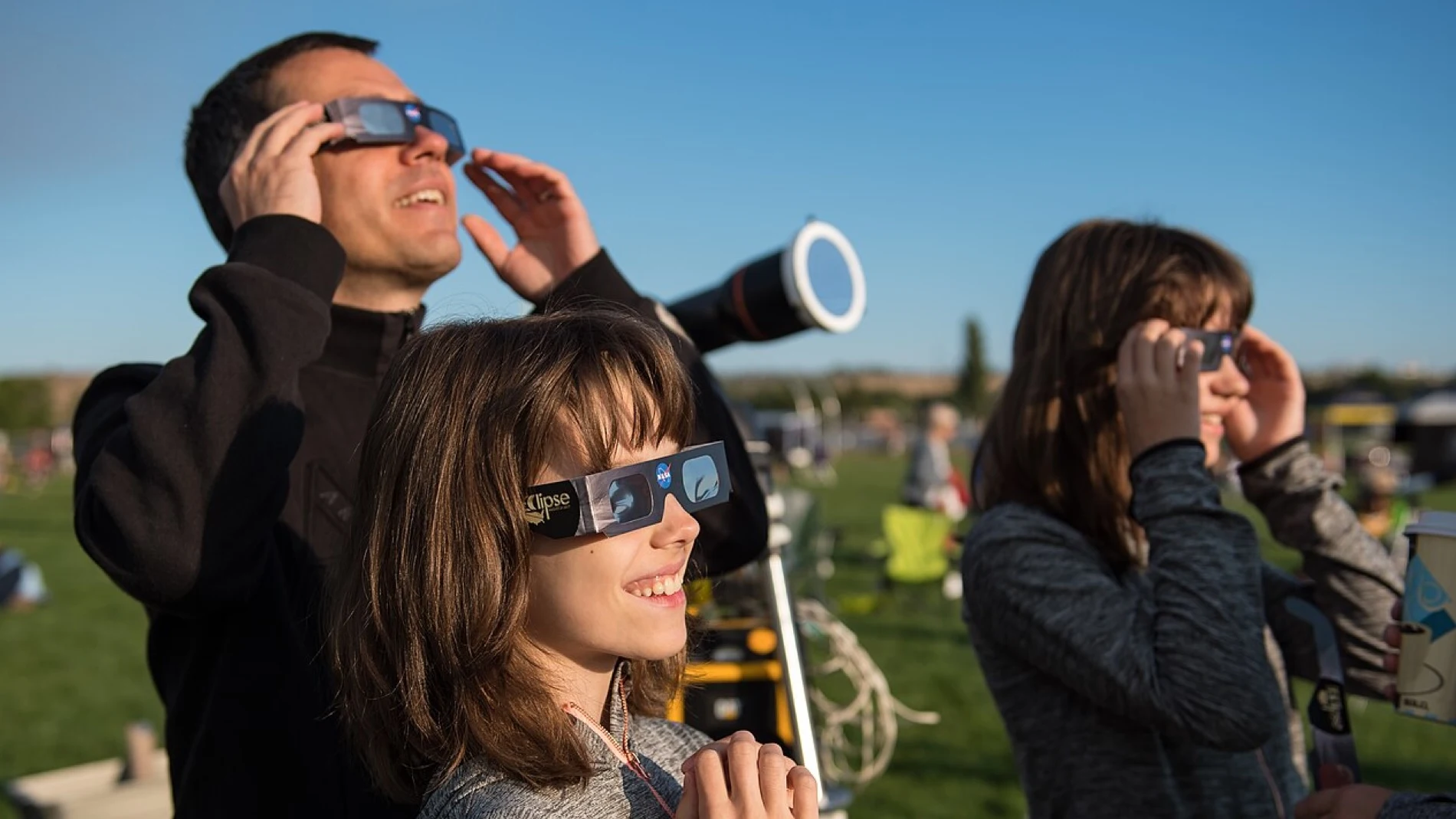
There is less and less time left for the long-awaited event to occur. total solar eclipse this coming August 12. As reported by the National Geographic Institute, this will be the first that can be seen from mainland Spain. since 1905. Therefore, most people are searching for the best point to fully enjoy this astronomical phenomenon.
The strip of totality of the eclipse It will cross the Iberian Peninsula from west to eastpassing through a large number of Spanish autonomous communities. In total, it will be visible in Galicia, Asturias, Castilla y León, Cantabria, Basque Country, La Rioja, Castilla-La Mancha, Aragón, Catalonia, Valencian Community and the Balearic Islands. While in other regions such as Madrid, it can be seen partially.
This phenomenon will begin next Wednesday, August 12 at 5:34 p.m. on the peninsulaand will reach its fullness, approximately, at 7:46 p.m., according to the National Geographic Institute. This schedule will depend on the territory in which you are located.being able to check when it will occur exactly on an interactive map available on the website of the Ministry of Transport and Sustainable Mobility in collaboration with the IGN.
This is the best area to observe the total solar eclipse on August 12
Although for many people this eclipse may coincide with their summer vacations and they may be in other autonomous communities, there is also a sector of the population that plans move only to find the best place to observe this phenomenon. For the latter, a user of the social network X (formerly Twitter) has revealed which is the best point to enjoy the totality of the eclipse.
According to José Salvador, the most suitable area to observe the next total solar eclipse would be the northern area of Castilla y León. Specifically, the map includes a perimeter between the provinces of Palencia and Burgos. Following this map, the best locations to see the phenomenon would be Carrión de los Condes, Frómista, Melgar de Fernamental, Herrera de Pisuerga and Osornoas well as those that are in its surroundings.
To make this recommendation, Salvador not only relied on the strip of totality of the eclipse, but also took into account other four parameters with which he was able to determine the best area to see it. These four parameters are: the duration, the weather forecast, the orientation to the west and, finally, the small population. Factors that, although they may seem unimportant, will greatly determine the experience of fans and observers.
In these locations, totality will last 1 minute and 46 seconds
Firstly, in terms of duration, in this area you can enjoy 1 minute and 46 seconds of complete darkness in which you can observe with complete peace of mind the different phases of the total eclipse, such as the one known as the diamond ring or the long-awaited solar corona. However, for this it will be essential that there is good weather and the sky is completely clear; Therefore, the second factor to take into account is the weather forecasts.
According to the AEMET, It is not expected that there will be cloudiness over Castilla y Leónalthough there are high temperatures, around 36 degrees maximum in Burgos and Palencia, with minimums of between 16 and 17 degrees. The eclipse will occur at sunset, so the presence of low clouds may worsen its visibility. Likewise, the Sun sets towards the west, so Orientation towards this direction allows you to have a better view of the phenomenon.
The low population density makes it easy to find the best place to see the phenomenon
Lastly, another determining factor for the observation experience is the number of people who will be at the same point. In large cities, official spaces have been set up where, due to the large number of people planning to gather to watch the eclipse, they have established a maximum capacity of between approximately 1,000 and 4,000 people. However, this problem will not occur in localities with lower population density.
According to data offered by the National Institute of Statistics, in the year 2025, the aforementioned populations They do not exceed 2,000 inhabitantsthe largest being Carrión de los Condes with 1,997 regular residents and the smallest, Frómista with 727 residents. Thanks to this, according to José Salvador, “improves the probability of finding places without obstacles to the west“that can hinder or directly block vision.
In case you cannot travel to see the eclipse, the majority of Spanish cities where it can be seen both totally and partially have arranged different official points from which this phenomenon can be correctly observed. In addition, you can also go to any high point of the town wherever you are, as long as the view to the west is clear.