
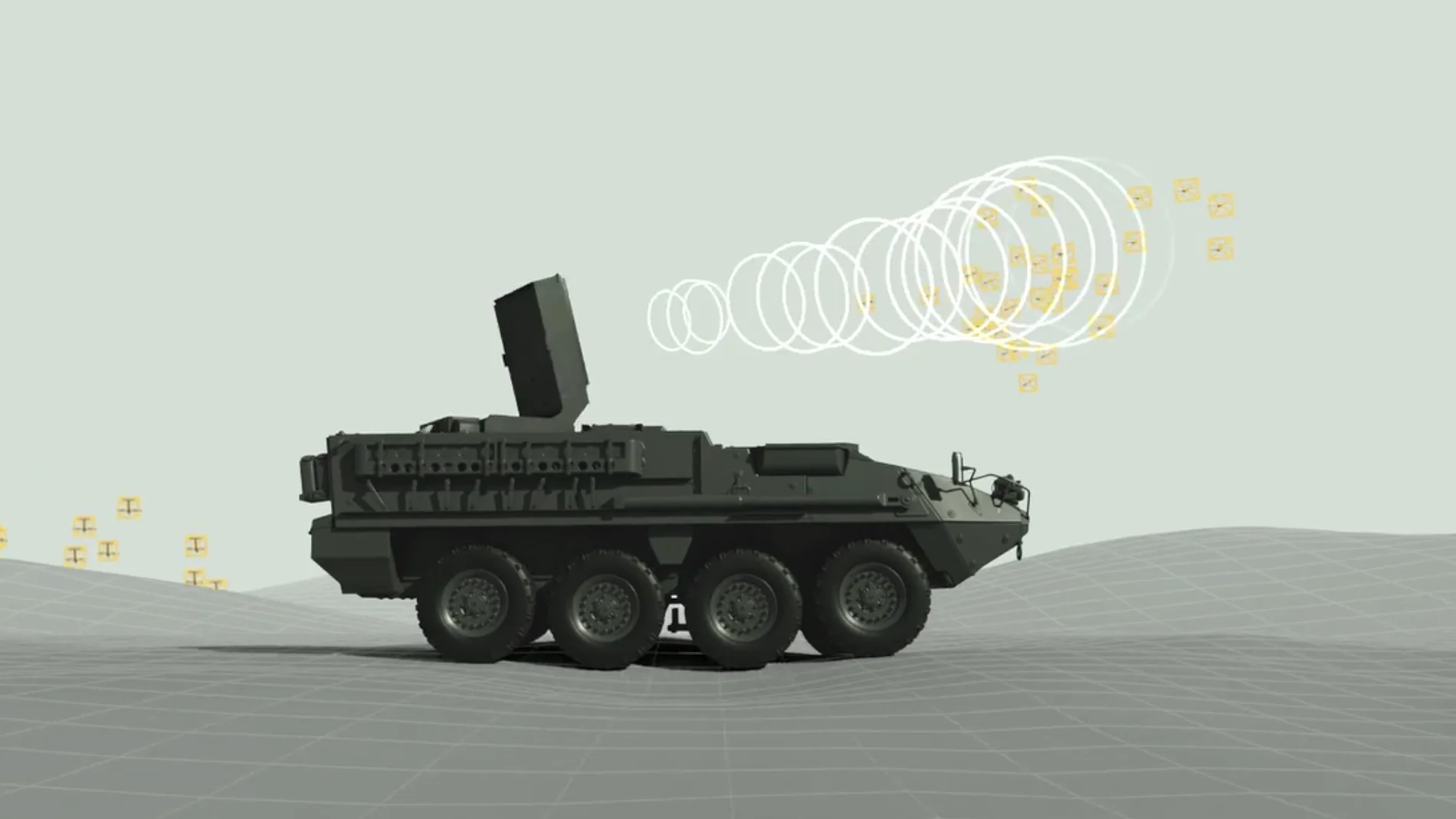
The scene is common in a war environment: dozens of drones advancing simultaneously towards a military position. There is no time to aim a missile at everyone. It doesn’t seem like a good idea either. spend an interceptor of hundreds of thousands or millions of euros to destroy a machine which may cost a fraction of that amount.
But there is an option: instead of firing, a military vehicle points at them and emits an invisible pulse – no projectile or explosion, just a burst of high-powered microwaves. And then several drones begin to lose control. That’s it the principle on which HAVOC (High Power Microwave Autonomous Vehicle Operational Capability) is based), the new anti-drone system that the United States Marine Corps has commissioned from the company Epirus. The contract, valued at $11 million, aims to bring a mobile and evolved version of its high-power microwave technology to the battlefield to confront individual drones and, above all, swarms.
And here the important word is not microwave, it is swarm, because the war has discovered a technological paradox. A small drone can be cheap, easy to manufacture and difficult to detect. But its greatest advantage appears when it stops being one and becomes tens. An attacker can simultaneously launch numerous devices and force the defender to decide how to spend their resources. If a missile is needed to destroy each drone, the economic exchange may be absurd.
And there is also a physical problem: a swarm can overwhelm a defense. It is not necessary for all drones to reach their objective. It is enough that some manage to break through the defenses. That is why defense against drones is evolving towards systems capable of producing a one against manya sort of technological tit-for-tat, and HAVOC aims to be precisely that.
Now, with microwaves, they are part of electromagnetic radiation, just like visible light, radio waves or infrared waves. What differentiates them is their frequency. A high-power microwave system concentrates an enormous amount of electromagnetic energy and directs it towards a certain area. When That energy reaches the electronics of a drone, it can induce currents and voltages capable of altering or damaging its circuits..
The objective is not to heat the device, but rather to attack its electronics. A drone can have perfectly functional motors, a charged battery, and an intact structure and yet become a useless object if it loses the functioning of the systems that control its flight. It is a particularly interesting form of warfare because you do not need to physically destroy the target, you just need to shut it down. Epirus calls this a capability one-to-manyone against many. Its Leonidas technology, from which HAVOC is derived, is designed precisely for that function.
And the company assures that in A demonstration carried out in 2025 managed to disable all 49 drones in a swarm. It is a result of the company and, therefore, it should be interpreted as an experimental demonstration, not as a guarantee that any swarm can be destroyed under any circumstances. The Marines had already received a prototype called ExDECS in April 2025, developed from Leonidas. That system was intended to experiment with high-power microwaves as defense against swarms and to evaluate its usefulness for short-range air defense. HAVOC is the next step.
The new system will be autonomous in certain functions, will have greater power and coverage and will have a universal mount that will allow it to be integrated into different manned and unmanned ground vehicles of the Marine Corps. The intention is that it can move with the forces and protect advanced positionsradars, communications equipment, resupply points and other important assets.
But microwaves are no magic wand and there’s a reason HAVOC is still in development. High-power microwaves have to overcome their own limitations. Effectiveness depends on factors such as distance, available power, attack geometry, electronic characteristics of the target, and the system’s ability to detect and track drones. Additionally, not all drones are the same. Some may have more protected electronics, others may be autonomous and not rely on a conventional radio link. And an adversary may try to combine drones of different characteristics to complicate the defense. That’s why HAVOC is not intended to replace all other current systems.