
The artificial intelligence (AI) It is no longer a conversation about the future in journalism. Today, it is part of daily routines in newsrooms like those of GFR Mean and the EFE Agencywhere it has become a tool to streamline tasks that previously consumed operational time.
From audio transcription to note translation, each medium has developed its own solutions, but with the same approach: use AI to gain efficiency without losing editorial control or journalistic judgment.
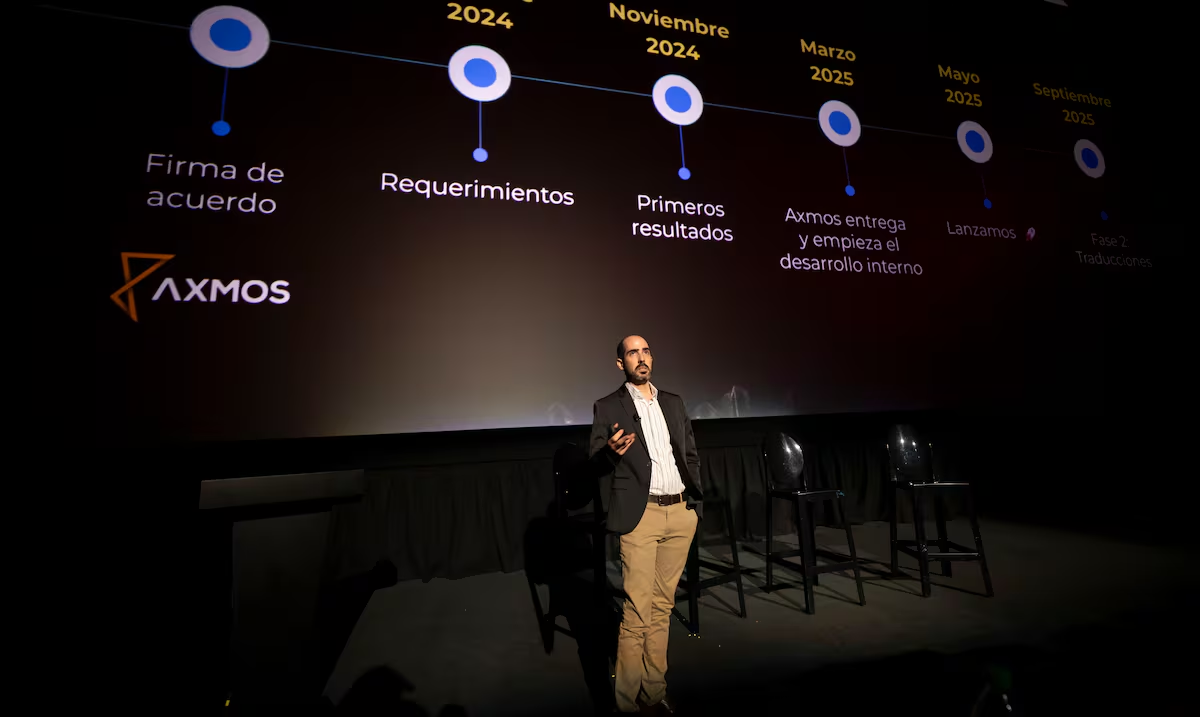
In the case of GFR Meanthe transformation has materialized with NewsBuddyan internal platform that is now one year old and that accelerates part of the process of publishing news from agencies.
As explained Carlos J. Martínez-Rivera, senior editor of digital strategy and subscriptions at GFR Mediathe tool was born from a very clear idea, which was to reduce mechanical work within the newsroom to free up editorial time.
“What we sought was to eliminate repetitive tasks that took time so that journalists could focus on what they come to do, journalism.”he explained.
NewsBuddy is a system that allows, for example, to translate “threads” (news from agencies) from Spanish to English, suggests headlines and downlines, and is even capable of classifying news content within the editorial system.
Once classified, the editor can send the note ready for publication to Arc Publishinginterface where content is written, edited and distributed. The advance eliminates the step of filling in metadata or optimization elements, inserting photos individually, among others.
The impact has been measurable. Since its implementation, the processing time of a story or “thread” went from about 15 minutes to about five, which represents an efficiency increase of around 67%.
For Martínez-Rivera, the real value is not only in speed, but in what it allows you to do with that time.
“If artificial intelligence helps us free up time, we can dedicate it to interviewing, contextualizing and doing better journalism,” he said.
The system started with content from The Associated Pressincluding photo galleries, and now also works with the internal notes of The New Day and First Hour. In the next phase, the EFE Agency notes would be available.
1 / 28 | “El Nuevo Día Speaker Series”: opportunities in artificial intelligence for key sectors in Puerto Rico. Artificial intelligence (AI) is no longer discussed as a future trend, but as a tool that is reconfiguring the economy and the operation of key sectors in Puerto Rico. – Carlos Rivera Giusti/Staff
In addition to Newsbuddy, GFR Media has integrated other tools within its editorial ecosystem such as Marfeelan analytics technology platform designed for web traffic.
Among other things, Marfeel has a shortcut that is placed next to the journalist’s story and recommends headline options, follow-up notes, tone of voice, basic style corrections and even scripts for videos on social networks.
Likewise, the database makes it easy to search for particular topics and quick access to hyperlinks that can be copied and pasted instantly.
The company is currently in the final stage of developing its ethical policy for the responsible use of artificial intelligence, which will establish clear limits on how this technology can be used within the newsroom.
“Artificial intelligence is a complement; it can never replace critical judgment or journalistic ethics,” said Martínez-Rivera.
In the case of the EFE Agency, the integration of AI has a broader trajectory. His deputy director of information, Evaristo Amado Fernandezdetailed in an interview with El Nuevo Día that the service began to incorporate tools long before the current rise of generative AI.
Among the first uses were the automatic transcription of interviews and the labeling of social media videos to improve their clarity and fluidity.
Over time, EFE, which generates over 3 million pieces of content annually, developed a more robust work environment that includes conversational assistants capable of consulting the journalistic archive, generating chronologies and summarizing information in minutes.
“It gives us enormous support in the writing process,” said Amado Fernández.
The system makes it possible to rescue the context of news events covered for more than a decade, such as a particular trial, through queries. This speeds up the work of writing complex events.
For the deputy director of information of EFE, the impact of artificial intelligence can be compared with other major technological changes in journalism, such as the arrival of the internet or the expansion of the mobile phone.
“It will allow information to be produced in an agile way, but it does not eliminate the responsibility of the journalist,” he noted.
The agency maintains a clear line in its execution, which is that no content can be published without human review. It should be noted that EFE has already introduced its guiding principles for the use of AI in its style book.
“AI is not responsible for the information that EFE publishes, those responsible are always people,” he noted.
This principle also applies to visual production. EFE does not allow the manipulation of photographs or the generation of images that can alter or reconstruct news events in an unverified manner.
Looking to the future, Amado Fernández believes that it would be interesting, for example, generate a system that, even if the “thread” has a typo, allows the note to be sent to all clients without that typo.
Both media agree that the biggest challenge is not technical, but ethical and editorial: it is how to integrate this technology without compromising the credibility of journalism.
In an environment where artificial intelligence also facilitates disinformation, the role of the journalist as fact-checker becomes even more relevant.
“Our most limited resource is time. So if AI helps us recover lost time on tasks that are repetitive and technical, it is better”summarized Martínez-Rivera.
Amado Fernández put it in a similar way: technology accelerates processes, but responsibility, verification and the last word remain human.
The biggest challenge, he assured, is financing.