
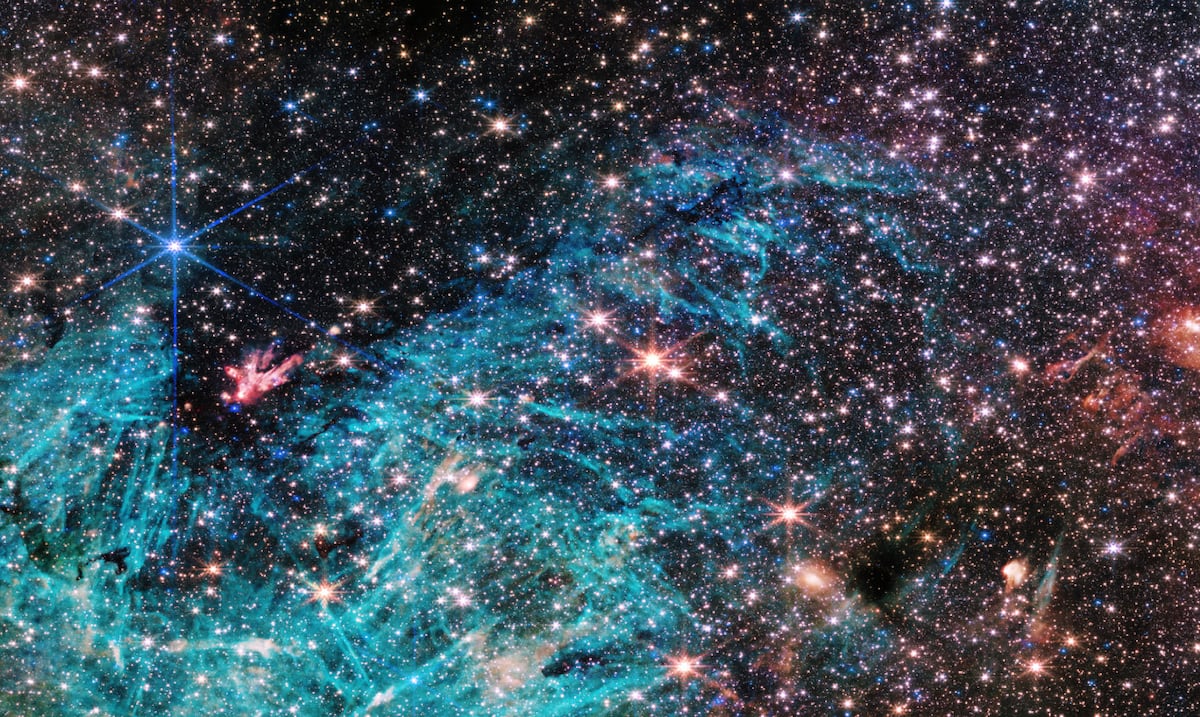
The space telescope James Webb He has revealed how stars are formed in one of the most extreme regions of the galaxy.
According to the Andalusian Institute of Astrophysics, based in Granada, in the south of Spainthe center of the galaxy is an extreme environment where intense cosmic phenomena transform space and matter.
In one of the regions of the galactic center, located about 200 light years from Sagittarius A* -The supermassive black hole in the center of the Milky Way- There is a huge and dense cloud of interstellar gas and dust.
Over millions of years, that cloud has collapsed over itself, giving rise to the formation of thousands of new stars. This region is known as Sagittarius C, the institute reports.
Now, two new works collided by the Institute of Astrophysics of Andalusia have used observations of the James Webb space telescope, built and operated together by the European Space Agency (ESA), the Canadian Space Agency (CSA) and the POTto study Sagittarius C with an unprecedented level of detail.
According to Rubén Fedriani, researcher at the Institute of Astrophysics of Andalusia and main supervisor of the project, The main objective of these observations was the study of stellar formation processes, especially mass stars, that is, those that have more than eight times the mass of the sun.
In their early formation stages, stars usually have jets of matter or jets: “In this work we have detected more than a hundred jets linked to low -dough proto -stages, similar to that of our star”Fedriani points out.
The jets associated with two massive stars have also been observed for the first time in infrared, about 20 times the mass of the sun.
Thanks to this activity of jets or jets, the study has also discovered a new stellar formation region. This discovery suggests that the formation of stars in this area follows processes similar to those of the rest of the galaxy, which shows that even in environments as extreme as the center of the Milky Way, new stars can be born.
The findings could also help solve a mystery about the most internal regions of the Milky Way, known as the Central Molecular Zone (CMZ), covered by Sagittarius C and other stellar formation regions.
This area is characterized by containing large amounts of dense molecular gas, which makes it one of the regions with the greatest potential for the formation of new stars in the galaxy.
However, despite its high gas density, the rate of new star formation in the central molecular area is less than what the models predict, which has led to numerous research to understand the physical processes that regulate this activity.
The works, collided by the University of Colorado Boulder, the University of Virginia and the Institute of Astrophysics of Andalusia, have observed evidence of magnetic field lines that are going through Sagittarius C, forming long and bright hot hydrogen gas filaments that remind of spaghetti’s noodles.
This phenomenon could cause the slowdown of stellar formation in surrounding gas.