
Drones have a problem that limits practically all their applications: the battery. Whether inspecting power lines, monitoring wildfires, or delivering packages, sooner or later everyone must return to land to recharge. Now, A team of Chinese scientists proposes an alternative that seems straight out of science fiction: transmit energy using a laser, without cables and while the device remains in the air.
The study, published in Matter & Lightdescribes a device capable of directly converting the energy of a laser beam into electricity to power a drone. Although this is still an experimental demonstration, the authors believe that This technology could open the door to much longer flights.
“Imagine a future in which drones that inspect forests, monitor disasters or deliver packages no longer have to constantly land to change the battery – says Jianhua Han, leader of the study -. As drones take on longer missions, autonomy has become one of the biggest barriers”.
At first glance, the device resembles a small solar panel. However, there is a fundamental difference. Conventional photovoltaic cells are designed to take advantage of the Sun’s white light, made up of a wide range of wavelengths. In this case the opposite happens: The energy source is a single beam of green light, perfectly defined and much more intense.
That is why Han’s team developed a specific photovoltaic cell based on perovskites, a material that in recent years has revolutionized the field of solar energy thanks to its high capacity to transform light into electricity. It could be imagined as a lock made for a specific key. While a traditional solar panel tries to take advantage of millions of different colors from the Sunthis cell is optimized to extract the maximum possible energy from a single color emitted by the laser.
Although we usually think of a laser as a tool for cutting metal or projecting a point of light, in reality it is an extremely concentrated flow of photons. Each photon carries a small amount of energy. When the beam hits the perovskite cell, that energy releases electrons within the material, exactly as happens in a solar panel. The movement of these electrons generates an electric current. capable of powering the drone’s motor or partially recharging its battery.
In other words, the laser does not transmit electricity directly. What it transmits is energy in the form of light, and it is the receiver who converts it back into electricity.. However, a problem arose that Han’s team had not fully anticipated: the higher the laser power, the hotter the device became.
“When we tested the system with a high-power laser, The thermal camera showed temperatures between 80 and 90 degrees Celsius – Han confirms -. “It was much more than we expected and made us realize that heat buildup was a much more serious problem than we had imagined.”
This increase in temperature reduces the efficiency of any photovoltaic cell. Some of the energy stops being transformed into electricity and is simply dissipated as heat. To solve this, the authors and the team incorporated nanocrystals capable of acting as a thermal barrier. These materials make it difficult for heat to pass through the device, maintaining a greater temperature difference between both sides of the receiver. And this difference is especially important because the system incorporates a second technology: a thermoelectric generator that takes advantage of precisely that thermal gradient to produce additional electricity.
That is, the device obtains energy through two different paths. On the one hand, it directly converts laser light into electricity and, on the other, it recovers part of the energy that would normally be lost as heat. Thanks to this combination, The system achieved an efficiency of 38.49%, one of the highest described so far for this type of devices operating under laser illumination.
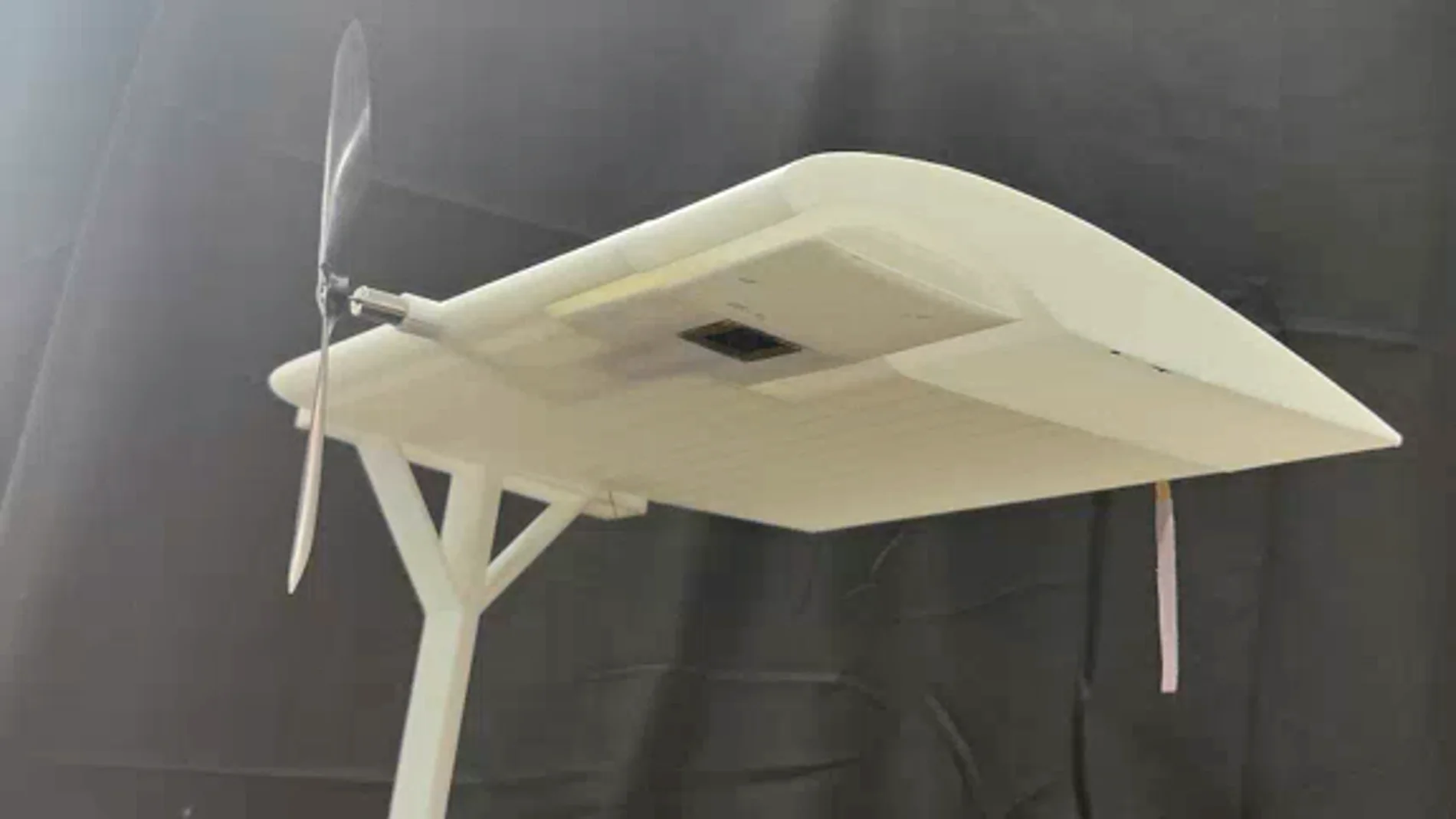
Finally, Han’s team also took advantage of another practical detail. Instead of placing the receiver anywhere on the drone, they installed it under one of the wings and designed small internal channels so that the movement of the air itself cools the back of the device during flight. The idea is reminiscent of the operation of a car radiator: the greater the air flow, the better the heat is evacuated and the greater the performance of the system.
“Previous advances had focused mainly on the materials or the device itself – concludes Han -. We wanted to go beyond the laboratory and think how to actually integrate the system into an aircraft, how to cool it during operation, and how to make it flight compatible. It’s not just a materials science problem; It is also engineering.
Despite the result, there is still a lot of development ahead. The next step will be to test the system on a light drone in real flight conditions. Later, much more complex problems will have to be solved, such as keep the laser pointed precisely at a moving device or ensure that a high-power beam can be used completely safely.