
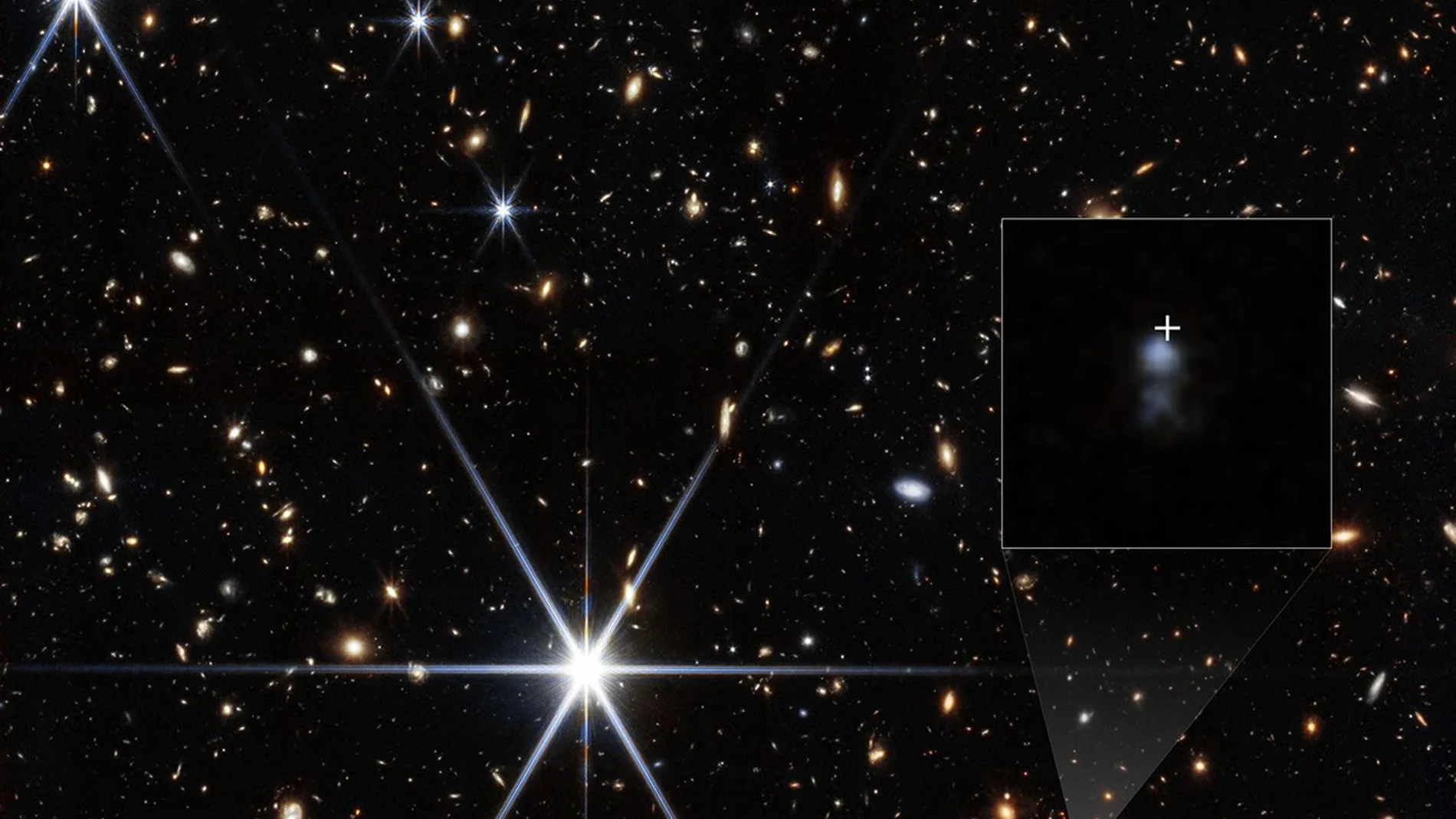
Fast radio bursts or FRBs are one of the most puzzling phenomena in the cosmos. They are pulses of radio waves that last just milliseconds, but can release an extraordinary amount of energy in that instant. We know that some are related to magnetars, neutron stars endowed with extreme magnetic fields, but there is still no single, population-wide explanation for these bursts. Now, A team of scientists from the University of Sydney did something especially difficult: they have not only detected an FRB, they have also identified where the signal came from. And that journey deserves a story.
For a fraction of a second, when the Universe was not yet 3 billion years old, something extremely energetic released a flash of radio waves. That signal traversed galaxies, gas clouds and vast regions of space for more than billions of years. On March 4, 2024, it finally reached Earth, where the MeerKAT radio telescope in South Africa captured it. According to a study, published in Science, we had found the most distant and oldest fast radio burst (FRB) located to date.
The signal has been named FRB 20240304B and comes from a redshift of 2.148. That means we watch it. just as it was when the Universe was approximately 3,000 million years old, at a time located about 10,000-11,000 million years ago. The finding practically doubles the redshift range of previously located FRBs. An important detail: FRBs, as we said, release an immense amount of energy and in this case, the one described in Science has produced the equivalent of the energy produced by the sun in a year and a half… only in a few seconds.
The study authors, led by Manisha Caleb and Themiya Nanayakkara, used the MeerKAT telescope first. This was responsible for the initial detection and location, but the galaxy responsible was too faint to be observed with ground-based telescopes. It was necessary to resort to the James Webb space telescope: infrared observations made it possible to locate a small galaxy located just a few tenths of an arc second from the position of the FRB and obtain its spectrum. Association with the galaxy has a probability of 97.5%.
And the galaxy turned out to be as interesting as the explosion itself. It is small, irregular and with a stellar mass of around 10 million solar masses. Its star formation rate is around 0.2 solar masses per year and its metal content is approximately 10-20% of the solar mass. It is, therefore, a young galaxy that is poor in heavy elements, but is actively making stars.
That detail may help resolve one of the big questions about FRBs: What kind of objects produce them. A small galaxy with intense star formation favors scenarios in which the responsible object appears shortly after the birth of massive stars. Among them are young magnetars, created when very massive stars die in supernova explosions. Instead, some alternative models require neutron star mergers, processes that may require much longer times.
But perhaps the most powerful part of the discovery is not in what caused the explosion, but in everything he found along the way. Radio waves from an FRB do not reach Earth exactly as they left. The plasma they pass through modifies their signal. The free electrons cause a dispersion that delays the low frequencies with respect to the high ones. By measuring that delay, astronomers can estimate how much ionized matter has passed through the pulse. It is as if the space left a mark on the signal.
That’s why this discovery is more than a race to set a new distance record. The oldest known FRB can become a flashlight to illuminate an otherwise virtually invisible Universe. Each new distant burst can reveal not only where and how the first generations of objects capable of producing them were born, but also what was between them and us. And there appears the next frontier. If these flashes can be detected when the Universe was only 3 billion years old, astronomers now want to look for them even further back, until they get closer to the time when the first stars appeared.