
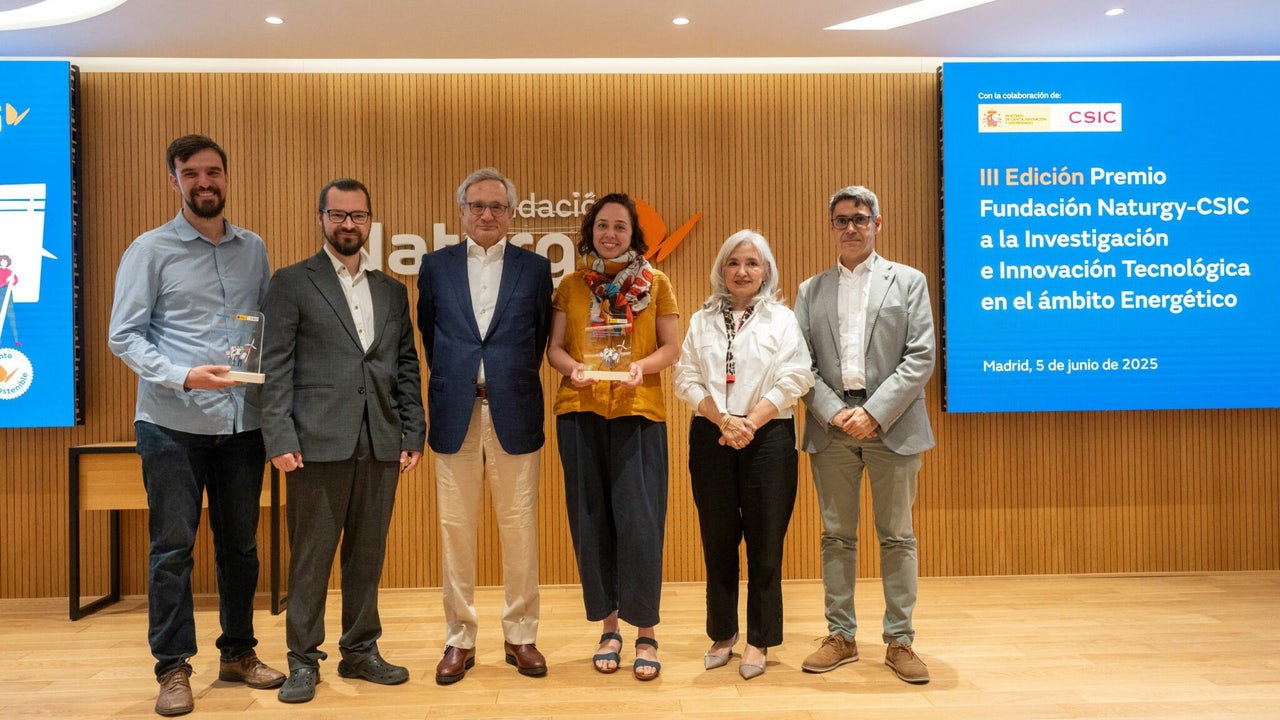
A Project born in Spain has a “great disruptive potential” To change everything in the photovoltaic industry. With these words, the jury pronounced granted by the Prize for Research and Technological Innovation in the energy field, in the third edition of the Naturgy Foundation and the Higher Council for Scientific Research (CSIC). The award -winning work, «Anomalous photovoltaic effects for 2-dimensional solar cells»(AP2SOL) proposes a concept test based on two -dimensional materials.
The proposal, developed by the Institute of Solar Energy of the Polytechnic University of Madrid and the Autonomous University of Madrid, is led by researchers Elisa Antolín Fernández and Juan José Palacios Burgos. Your approach, focused on the anomalous photovoltaic effect (APE), promises open a new horizon in the solar generationwith direct implications in future generations of more efficient, thin and versatile panels.
Endowed with 100,000 euros, the award will allow this team to advance In the maturity of his proposal during the next two years, with the support of a network of international collaborations. The jury has underlined its “unconventional and promising” character, as well as its potential impact on the academic field and the future technological transfer.
«The prize shows our commitment to Accelerate energy transition», Said Rafael Villaseca, president of the Naturgy Foundation. For its part, Eloísa del Pino, president of the CSIC and the jury, said that initiatives such as “support an economy in emissions and based on renewable production.”
What is the project? In broad strokes, it enters the fascinating land of APA, a rare phenomenon that allows generating electricity without the need for a union between materials of different types, as in conventional solar panels. AP2SOL arises what would happen if we could generate solar energy only with light and flat materialsalmost thin as an atom.
These 2D materials are ultrafine structures They have unique electrical properties. By exposing them to the light, they produce electric currents that we are still learning to handle. AP2SOL does not seek to manufacture solar panels tomorrow, but demonstrate that this principle works, and it could be the seed of a lighter, flexible and integrated photovoltaic technology on surfaces (for example, textiles) where today it would be unthinkable to place a panel.
In this edition, the award received 18 candidates from 14 entities from nine autonomous communities. The proposals covered from innovative batteries to smart platforms of energy management. The award, which has already recognized projects on CO₂ and Water Electrolyte’s capture, consolidates its IMPULSE TO SPANISH SCIENCE applied to sustainable energy.