
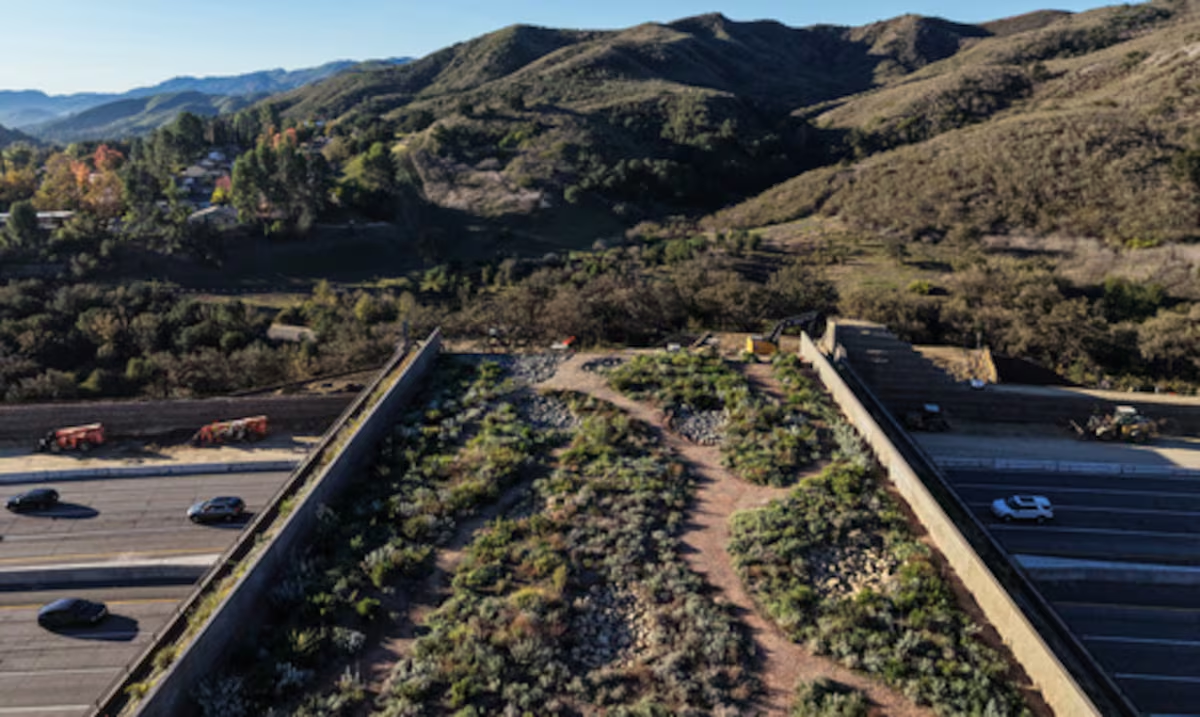
During her visit to the world’s largest wildlife pass, Beth Pratt carefully walked through the newly planted native vegetation and raised her hand for silence.
“Do you hear it? Right now we are listening to the birds singing, at the top of one of the busiest highways in the United States!” Pratt, one of those responsible for the project, said with enthusiasm and a broad smile. “That fills my heart with joy.”
The chirping was the latest sign that the bridge, which spans U.S. Highway 101 and an access road about 35 miles northwest of downtown Los Angeles, is already being used by animals ahead of the official opening ceremony, scheduled for Dec. 2.
Just two weeks earlier, motion-sensing cameras captured a lone coyote believed to be the first mammal to safely cross the bridge. Days after that momentous crossing, cameras caught three young coyotes playing in the brush beneath the 10-foot soundproofing walls that line the bridge.
“They don’t care about the inauguration ceremonies,” Pratt, president of the nonprofit organization, laughed. Wildlife Crossing Fund.
About 300,000 cars travel every day on that stretch of the 101 in Agoura Hills, a small city surrounded by a mosaic of protected natural spaces that the new animal crossing will connect. Fences along the highway direct animals toward the pass.
The bridge, whose landscape blends into the surrounding hillsides, spans 1,250 feet in two spans over roadways to offer animals, hemmed in by urban sprawl, safe passage to the nearby Santa Monica Mountains and beyond.
It is called “Wallis Annenberg Wildlife Crossing” in honor of the late philanthropist, whose foundation contributed 25 million dollars of the total budget of 114 million. The cost skyrocketed from the initial $92 million, and the money came from donations from 6,000 citizens, as well as grants from nonprofit organizations and state conservation funds. Leonardo DiCaprio was one of the first donors after launching a fundraising campaign a decade ago.
Waiting for the pumas
Pratt said that, for her, the real official inauguration will take place when a puma – a species classified as threatened in California— reach the overpass.
The star of the campaign to build the bridge was the puma – known as P-22 –, a Los Angeles celebrity in his own right who crossed the freeways and had made his home in a huge city park. P-22, which was euthanized in 2022 after probably being run over by a car, became a symbol of the decline in the genetic diversity of wild animals, which are practically trapped by urban expansion or risk being killed by vehicles. Thousands of people attended a memorial event in his honor.
Scientists tracking cougars equipped with GPS collars found, over several decades, that roads largely confined the animals to the mountains that stretch along the Malibu coast and through downtown Los Angeles to Griffith Park, where P-22 was based.
During last week’s guided tour, Pratt wore a T-shirt with an image of the beloved cougar. He hopes to eventually erect a statue of P-22 next to the new bridge.
Caged by concrete, run over by cars and poisoned by rat poison, isolated pumas are at risk of extinction due to inbreeding, according to scientists and state wildlife officials. A report released last week by the University of California, Davis found that at least 780 mountain lions — 18 percent of the state’s population — are killed by roadkill each year.
“P-22’s story was really moving,” said Mari Galloway, California program director for the nonprofit Wildlands Network. “We saw the danger of what had happened to that specific puma. It was a clear example of what these pumas are having to face in this area of the territory.”
Galloway’s group, which was not involved in the Annenberg crossing, hopes the new bridge will spur the construction of many others in California and across the country. The Wildlands Network is collaborating with state transportation officials in the early stages of planning a wildlife bridge on a stretch of highway in the Mojave Desert east of Los Angeles, where Rocky sheep live.
Wildlife passages – bridges and tunnels – are common in Western Europe and Canada. A very famous one, located in Banff National Park in Alberta, crosses the Trans-Canada Highway and is frequently used by bears, moose and deer.
A large overpass in Colorado over Interstate 25, along with other mitigation measures such as underpasses and fencing, has contributed to a 91% reduction in collisions with wildlife, the state’s parks and wildlife department announced in September.
Hummingbirds, bees and also spiders
Atop Annenberg Harbor, Anthony Deascentis, a field inspector for the California Department of Transportation, waved Pratt toward some brush. He pointed out a spherical web-weaving spider, the size of a silver dollar, that was weaving an elaborate circular web.
“There are also a good number of bees that enjoy the native plants,” Deascentis said. Additionally, there have been sightings of an oak tit, sparrows and hummingbirds, further evidence that wildlife is adapting to the new terrain, even as crews using heavy machinery continued to fill in the ground on the south side of the bridge.
Jeff Sikich, a National Park Service biologist who collars and tracks mountain lions and other wildlife, said the next step will be to deploy “biological recorders” that will allow scientists to also monitor physiological data such as heart rate, body temperature and activity levels. With that information, they will be able to determine if the animals are stressed when using the wildlife bridge or “if they are relaxed up there.”
Sikich stated that, in recent weeks, scientists have detected the presence of several mammals in the hills near the new section, including lynx, deer, gray foxes and a puma with two cubs.
This story was translated from English to Spanish with an artificial intelligence tool and was reviewed by an editor before publication.