
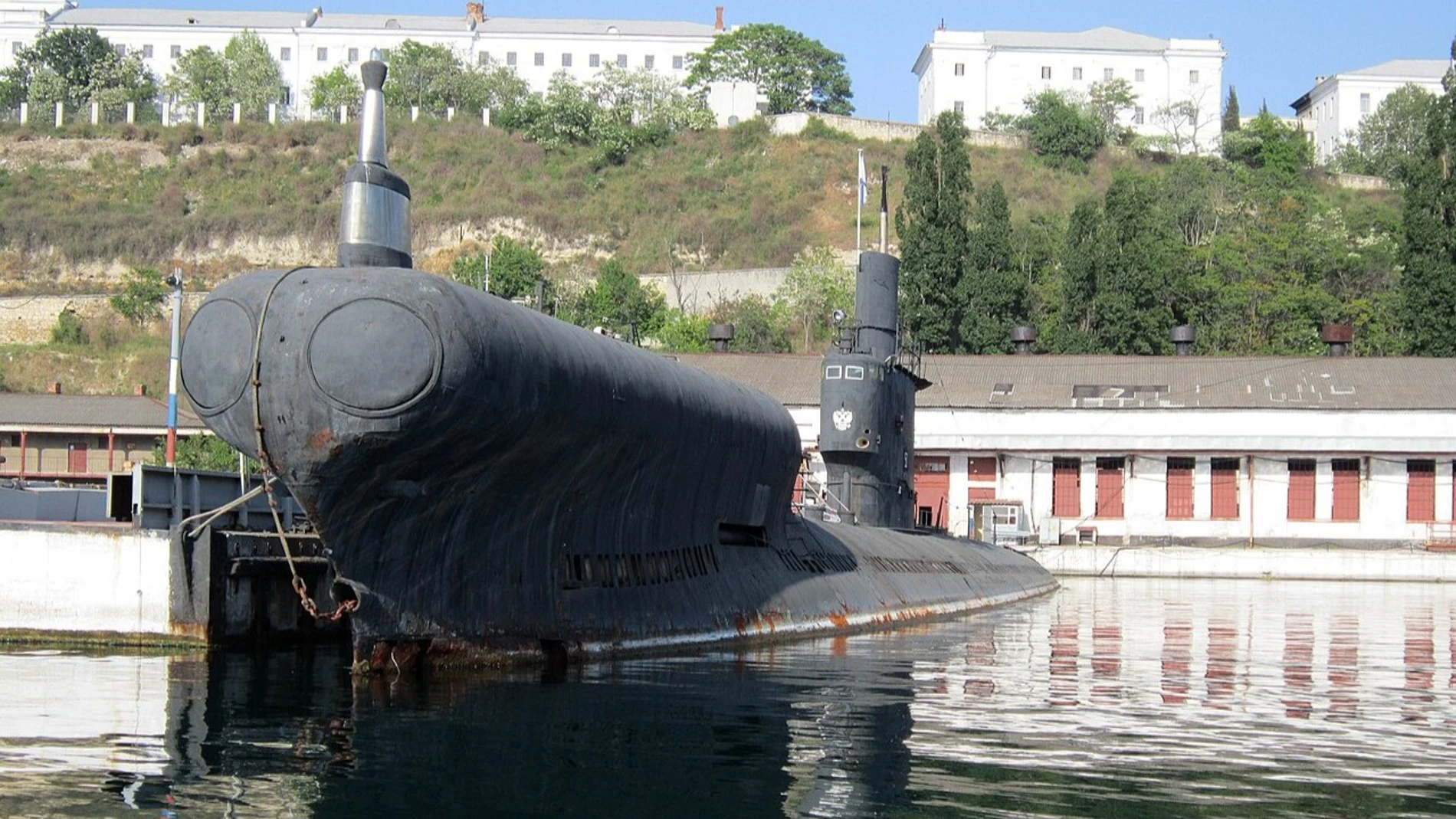
During its first decade in service in the second half of the 20th century, the Soviet submarine S-49 It seemed like another unit of the class Romeountil they settled on its bow two huge launch tubes. The addition of this structure with the appearance of double barrel It was not intended for combat, but to test a new generation of anti-submarine weapons during the Cold War before the appearance of American nuclear submarines.
Before undergoing this transformation, the S-49 had been a diesel-electric attack submarine of the Project 633. Her keel was laid in March 1961, she was launched in July and entered service in December. He served in the fleets of Black Sea and of Northin addition to participating in deployments by the Mediterranean.
OTD 1961: S-11, Project 633 ROMEO SS, was launched. Between 1970 & 1972 she and S-49 were converted to Project 633RV 65cm torpedo test sub. pic.twitter.com/cW0FgFRqhH
— AncientSubHunter 🇺🇦 🇮🇱🌻 (@AncientSubHunt) April 15, 2017
In your original configuration It measured 76.6 meters in length and displaced 1,330 tons on the surface and 1,729 when submerged. It reached 15.2 knots on the surface, about 28 km/h, and 13 knots underwater, about 24 km/h. It had 58 crew members, could remain on mission for up to 60 days and had an operational depth of 240 meters. Its armament included eight 533-millimeter torpedo tubes and up to 14 torpedoes.
The appearance of faster American nuclear submarines forced the Soviet Union to develop weapons with greater range. A conventional torpedo required getting quite close to the target and took longer to travel the distance. The new anti-submarine missiles allowed attack from a distant position and reduced response timesomething especially important in the face of a possible nuclear conflict.
These weapons They combined the functions of a missile and a torpedo. After being launched underwater, they traveled a short distance submerged, emerged and ignited a rocket motor. They would then fly toward the target area and release a guided torpedo or nuclear depth charge.
Przebudowa obejmowała dwie zmieniające wygląd okrętu masywne wyrzutnie 650 mm zamontowane na dziobie dla RPK-7 Weter i modyfikację 2 wyrzutni torpedowych 533 mm dla RPK-6 Vodopad.
Wycofany(2019r) S-49 ma zostać (jest?)wystawiony w podziemnym kompleksie muzealnym w Bałakławie 2/2 pic.twitter.com/iWCQfK93Ca— StaryOkręt (@Zbinnie87752240) July 2, 2023
He RPK-6 Vodopad used tubes 533 millimeters and reached about 37 kilometers. It could carry a homing torpedo or a nuclear charge. He RPK-7 Veter It was larger, it used tubes of 650 millimetersreached up to about 100 kilometers and only carried a nuclear depth charge.
To test both systems, the Soviets remodeled the S-49 between December 1971 and October 1972. The renovation increased its length to up to 78 meters and its submerged movement up to 1,810 tons. Its most visible feature was the two external 650 millimeter tubes installed on the bow because the Veter did not fit inside the hull. Two other 533 millimeter internal tubes were adapted for the Vodopad.
The work converted the front section into a complete underwater laboratory. Some of the torpedo storage was removed and equipment was installed to program the weapons, check them before launch and measure their performance. It also received new fire control, navigation and sonar systems, as well as special sealing and guidance devices.
During December 1972, S-49 carried out the first Soviet underwater launch of a Vodopad from 50 meters deep. Between 1973 and 1974 he completed 24 launches from depths to 150 meters. In 1975 he carried out other 22 shots and even threw a weapon from 240 meters.
Submarine activity continued after those initial tests. In 1977 he participated in the development of the cruise missile 3M10 Granatcomparable in function to Tomahawk American, and continued to support torpedo missile programs until 1985. After a review carried out between 1986 and 1991, it maintained tasks related to weapons until 1995.
At the end of that year, the old test bed was converted into the floating station PZS-50. Since then it was used to support the training of other submarines of the Black Sea Fleet. It remained in service until approximately 2019 and in May 2022 it became part of the underground museum complex of Balaclavain Crimea.