
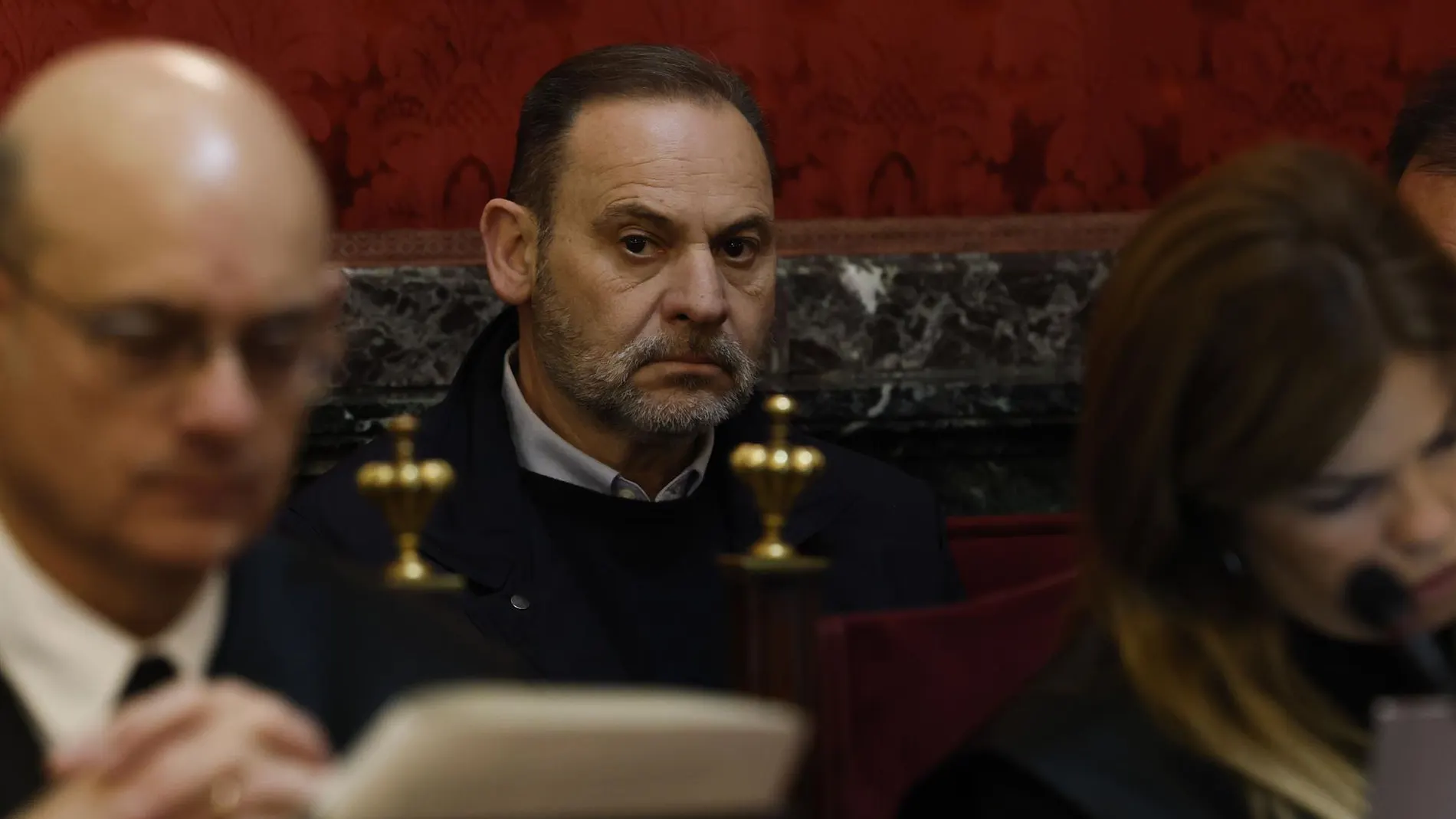
José Luis Ábalos will be released from prison today. It will not be, as the former minister wished, on provisional release, but to attend the opening session of the first trial of the “Koldo case” in the Supreme Court. He will do so in the police van that he wanted to avoid in order to fully face the ups and downs – procedural, and also emotional – of an oral hearing that will take place, many days in the morning and afternoon, until the next day 30. Whoever was Pedro Sánchez’s strong man in the PSOE will share the bench with his former advisor Koldo García – who to his relief ended up giving a name to this cause of corruption that is still alive in the National Court – and with the businessman Víctor de Aldama. The commissioner, whose revelations have been key to advancing the investigation, is the main threat to the former Secretary of Organization of the PSOE, along with the reports from the Central Operational Unit (UCO) of the Civil Guard that the defenses of the former minister and his former advisor have tried to destroy without success throughout the investigation.
The collaboration with the Aldama Justice has earned him a request for a more lenient sentence from the accusations – mitigating through -, seven years compared to the 24 years requested by the Anti-Corruption Prosecutor’s Office for Ábalos and 19 and a half for Koldo (which the popular accusation raises to 30).
Ábalos (and also Koldo) will therefore have to focus his defense on refuting Aldama’s revelations and the devastating conclusions of the UCO reports, with the trail of wasaps and the exhaustive analyzes of his assets that, according to the judge, reinforce the businessman’s words about that triumvirate that the three investigated would have launched to decide public awards, taking advantage of Ábalos’ status as minister (after “actively” contributing to Pedro Sánchez’s recovery of the reins of the PSOE in 2017) in exchange for commissions.
Main basis for the accusations
Judge Leopoldo Puente already made it clear in the resolution in which he prosecuted those investigated that most of the accusations are based on Aldama’s revelations.
The businessman recounted, for example, how the contracts for the purchase of masks during the pandemic were rigged in favor of Management Solutions, the company behind the “plot” (using two companies with economic muscle dependent on Transport, State Ports and Adif as the spearhead). And he told how in the case of State Ports, the initial order, for four million masks, was doubled 38 minutes later “by imposition” of the commission agent himself, finally endorsing the acquisition of eight million units of medical supplies.
He also alluded to the efforts (credited by other testimonies) before the ministries of Finance and Industry that were then directed by María Jesús Montero and Reyes Maroto.
Aldama also expanded on the payments of 10,000 euros per month in cash to Koldo between October 2019 and, at least, 2021, money that was supposedly shared with Ábalos and that he would have paid to him on some occasion in the presence of the then minister.
He also explained the deliveries in the Dominican Republic, where Koldo’s brother, Joseba García, went on several occasions, where an associate of Aldama delivered the money. Version ratified by two witnesses.
Aldama also told Anticorrupción that Ábalos signed a rental contract for an apartment on Paseo de la Castellana with a purchase option of 750,000 euros “much lower than its real market value.” And although he did not occupy the house or disburse any money, the Prosecutor’s Office considers this fact indicative that it was another gift.
The probative value of your testimony
The instructor has already pointed out that it should be at the trial when the probative value of “the incriminating statements of the co-accused” is “deepened.” But he stressed that his revelations “are in no way exculpatory,” since he admitted that he delivered the money to Koldo García assuming, the investigating judge stressed, “his own responsibility.”
But, at the same time, Puente emphasized that the businessman’s incriminating statements “appear indicatively corroborated by other results of the investigation.” And he expressly referred to the fact that the asset investigation of Ábalos and Koldo corroborated the existence of that “concerted pact” between the three investigated to rig public awards. And these UCO reports confirmed a “significant increase in cash income” in the accounts of Ábalos and Koldo between 2018 and 2022 to the same extent that cash withdrawals disappeared or experienced a sharp decrease, although expenses “remained constant.”
These UCO analyzes that the former minister is obliged to refute also prove the unusual and very close connection between the assets of one and the other. To the point that the Civil Guard indicated that Koldo was responsible for his boss’s expenses (such as child support for one of his children, for example), for which there is no evidence that they were reimbursed.
Payments in kind
The property investigation also revealed that between 2019 and 2021, Koldo Ábalos rented a home to Koldo in the Madrid neighborhood of La Latina, whose income was not declared to the Treasury. Or the acquisition of a home in Valencia by Ábalos and his then wife in July 2020 whose real sale price, according to Aldama, was greater than the declared 90,000 euros.
Caught between the UCO reports and Aldama’s words, the former socialist leader has confirmed how throughout the investigation various testimonies corroborated the businessman’s revelations, as in the case of the apartment where Jésica Rodríguez (then Ábalos’ partner) lived in Plaza de España, the rent of which was paid by an Aldama partner, Alberto Escolano, at a rate of 2,700 euros per month.
Something similar happens with other supposed payments in kind, such as the family enjoyment of a villa in Marbella or in the “La Alcaidesa” urbanization of La Línea de la Concepción (Cádiz). Or, also, with the “plugs” of Jésica Rodríguez (who admitted that she did not go to work a single day) at Ineco and Tragsatec, and of another friend of Ábalos, the former Miss Asturias Claudia Montes, at Logirail.
Víctor de Aldama also said that Transport provided him with various “safe passages” or mobility permits during the pandemic, at his request, despite the fact that the beneficiaries, who were supposed to meet at the Ábalos ministry, never held any meeting at the Transport headquarters.