
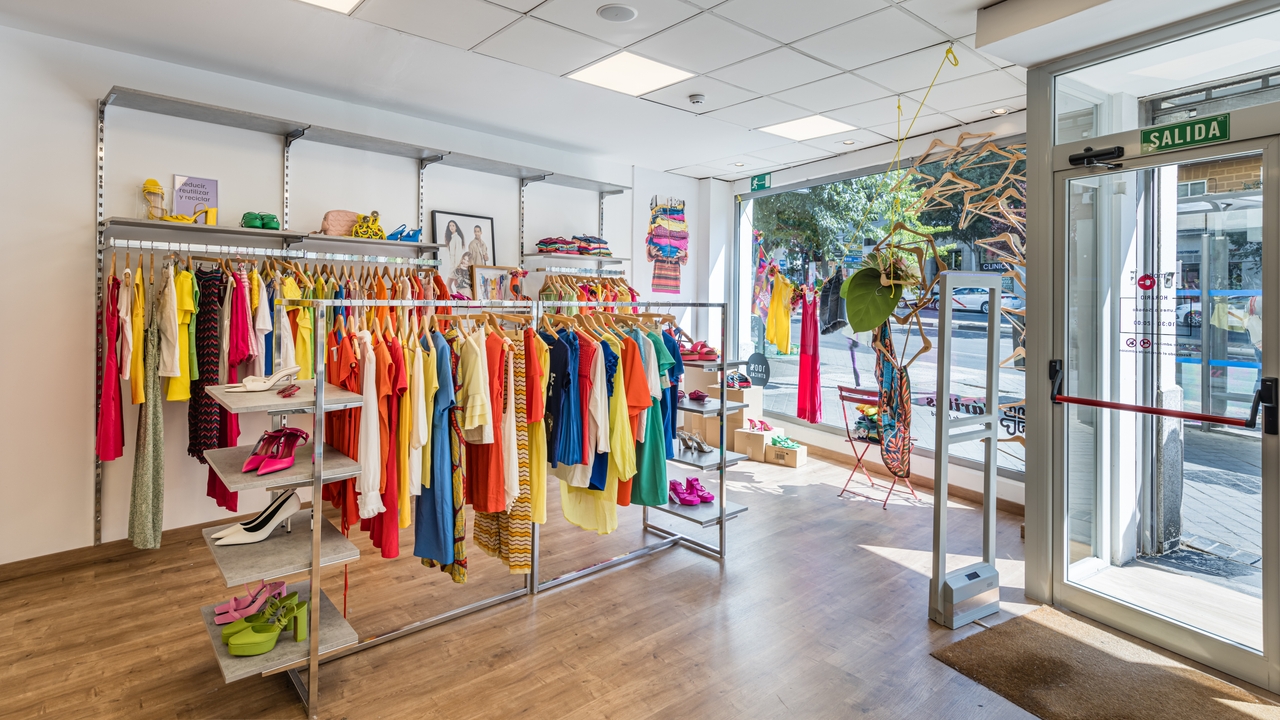
From collecting used clothing in parish offices to meet the needs of the many people who turned to them to dress with dignity, to being a social initiative cooperative, made up of 91 members, which has created a network of 170 clothing stores second-hand and employs more than 1,400 people, half of them at risk of social exclusion. What began as a purely social service done with more will than means, has been transformed into Moda Re, a Cáritas initiative that, without losing the social component, has advanced to make textile reuse and recycling a complete experience that has already constituted a circular economy model.
A work carried out for years and that this week has received recognition from the Mapfre Foundation, by being awarded one of the entity’s Social Awards, whose objective is to “recognize the people and institutions that have carried out outstanding actions for the benefit of society in the scientific, cultural and social fields”, according to the Foundation.
Fashion Re out
In its work abroad, which can be seen by anyone who passes in front of a Moda Re store, it consists of recovering, among the 44 million kilos of clothing that reach the more than 8,200 containers distributed throughout Spain. and then to the four classification plants, it is in optimal conditions of dignity to be used again and, once classified by seasons – summer, winter, etc. -, typologies – man, woman, children – and, once sanitized, prepared for reuse and sent to the stores, explains Alberto Almerich, director of Moda Re.
In the stores, which are not particularly distinguished from any other clothing store, “there is a lot of turnover, because we generate a lot of reusable clothing. Of the 44 million kilos that arrived last year, approximately half could be put up for sale. So we could feed the current network of stores three or four times more. For this reason, Almerich continues, if in 2020 we had 80, now we are already at 140 and 30 corners in Alcampo. And with the will to continue growing.
Not only in fixed points of sale, they have also created mobile points of sale, the Moda Re en route, “which are mobile stores that travel through markets or routes in small towns, to bring responsible consumption closer to populations in which, due to their size, , a fixed store would not be economically viable.
Professionalization
Although they have not always managed these figures, the truth is that “in some parishes, in the 80s, they already began to see that more and more clothes were arriving and, furthermore, in good condition. From there came the idea that it could be used to create jobs. But, as this volume did not stop growing, it was also seen that the treatments had to be professionalized to get these clothes onto the second-hand market. And between 2010 and 2014, the first three industrial classification and treatment plants were launched. Parallel to the volume of clothing managed, the volume of work has also been growing, enough for Moda Re to generate more than 1,400 jobs, more than half of them “with people at risk of social exclusion who participate in training and employment programs.” after which they can integrate into the labor market.
And logistical needs also grew. The organization now has four warehouses, “highly technological, so much so that at that time they are the most advanced in southern Europe in which this professional classification treatment for reuse and even preparation for recycling can be given.” The bags from the containers arrive at them, “which have been the first to be digitized with laser sensors to measure the actual filling level and be able to optimize collection.” Clothing is separated from footwear and what is going to go to stores or for export, more or less 50%, from what goes for recycling, 40%.
Re Fashion inside
In Europe, work is being done to change the part of the reality of the textile industry that involves the generation of huge amounts of waste. And Moda Re is being part of it and enters another dimension, that of being part of a textile industry “that is boiling”, which is translating into industrial R&D&I projects “on which we are working closely.” “the hand of the greats of the textile and chemical sector, and we are suppliers of raw materials for fibers.”
Thus, they have fiber identification systems that allow us to know “its composition at a speed of one garment per second.” Whether it is multifiber or not, and what specific fiber it is. They ask us, for example, for a ton of 80% polyamide or 90% cotton, etc. With all this, you can experiment with processes to treat these textiles and make fibers again.”
Albert Almerich cannot tell this part “due to confidentiality agreements. But there have been some that have been a real success and had a high level of impact. And they can also claim that their b-side is also highly useful for society.