
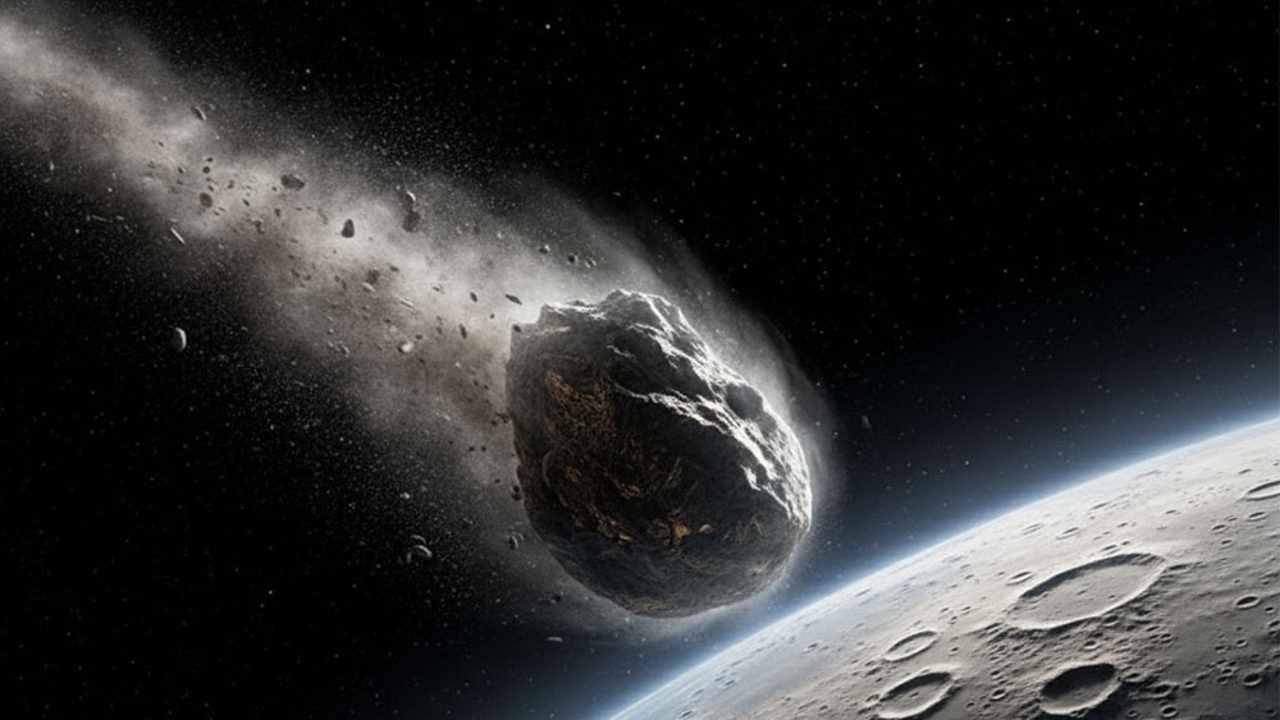
The time to decide whether to avoid an impact of the 2024 YR4 on the Moon it ends. This asteroid caused concern at the beginning of the year after being detected by the observatory ATLAS of Chile in December, quickly entered the list Sentry of the POT and led to the UN will activate the Planetary Security Protocol for the first timewhich made it possible to increase the resources allocated to studying it. Although the probability of impact with the Earth was once estimated at 3.1% by 2032 – the highest detected in an asteroid to date – later observations reduced it to make it practically non-existent (0.001%). But with the Moon exactly the opposite has happened and there is a possibility that it will increase up to above 30%after new observations from the telescope James Webb.
When it stopped being within reach of terrestrial instruments last spring – 2024 YR4 ‘visits’ us every four years – the probability that it would end up colliding with the Moon was 4%. It was not expected that new data could be collected until its next step in 2028, but James Webb will have the opportunity to study it again next February. This is possible because the orbit that the space telescope follows allows it to go where others cannot, although it will still be an extremely difficult observation due to how faint it will appear even to its ultrasensitive instruments. There will be two narrow observation windows on February 18 and 26.
According to Andrew Rivkinastronomer of the Johns Hopkins University from the US and research leader in the mission DARTwhich managed to divert the trajectory of the asteroid Dimorphos in 2022, it will be the last chance to decide on a possible diversion missionsince waiting until 2028 would mean being ‘very, very tight on time. Being able to do it at the beginning of 2026 would give us additional margin.’. The US planetary defense doctrine, in which NASA participates, contemplates the nuclear detonation in the vicinity of the asteroid as a last resort option to divert its orbit.
The possibilities are open: from 1% to more than 30%
Rivkin and his team have calculated how the position and speed of the asteroid could change following the new observations to be made by James Webb. According to their estimates, there is a 80% probability that the risk of impact with the Moon will be reduced to less than 1%but also a 5% of increasing above the 30%. The space telescope will have another chance at the end of 2027 to repeat the measurements, although that would leave very little room to decide on a possible mission, warns the astronomer.
‘Whether planetary defense should also extend to the Moon is an entirely new question, and different agencies may respond differently. If a company owns a large number of satellites, it may have a reason to press in a specific direction‘ Rivkin told New Scientist.
The impact of 2024 YR4 would not have direct consequences on Earth, but it would have consequences on its orbit full of satellites and withtwo space stations. An impact from this asteroid, which has an estimated size of between 53 and 67 meterson the Moon it would generate an energy equivalent to between 7 and 15 megatons, that is, between 470 and 1,000 times the power of the nuclear bomb that the United States dropped on Hiroshimaand would cause a crater of one kilometer in diameter. Impact debris projected beyond the lunar surface could endanger space infrastructure that orbit the Earth and, if the program Artemis meets its objectives, too the future human presence on the Moon.
Richard Moisslof the European Space Agency (ESA)has indicated to the media that there is currently no asteroid diversion or reconnaissance mission included in this year’s budget, but that, if the 2026 observations increase the probability of impact, available options will be evaluated. ‘We have definitely decided to wait until next year… to have time and evaluate the alternatives,’ says Moissl.