
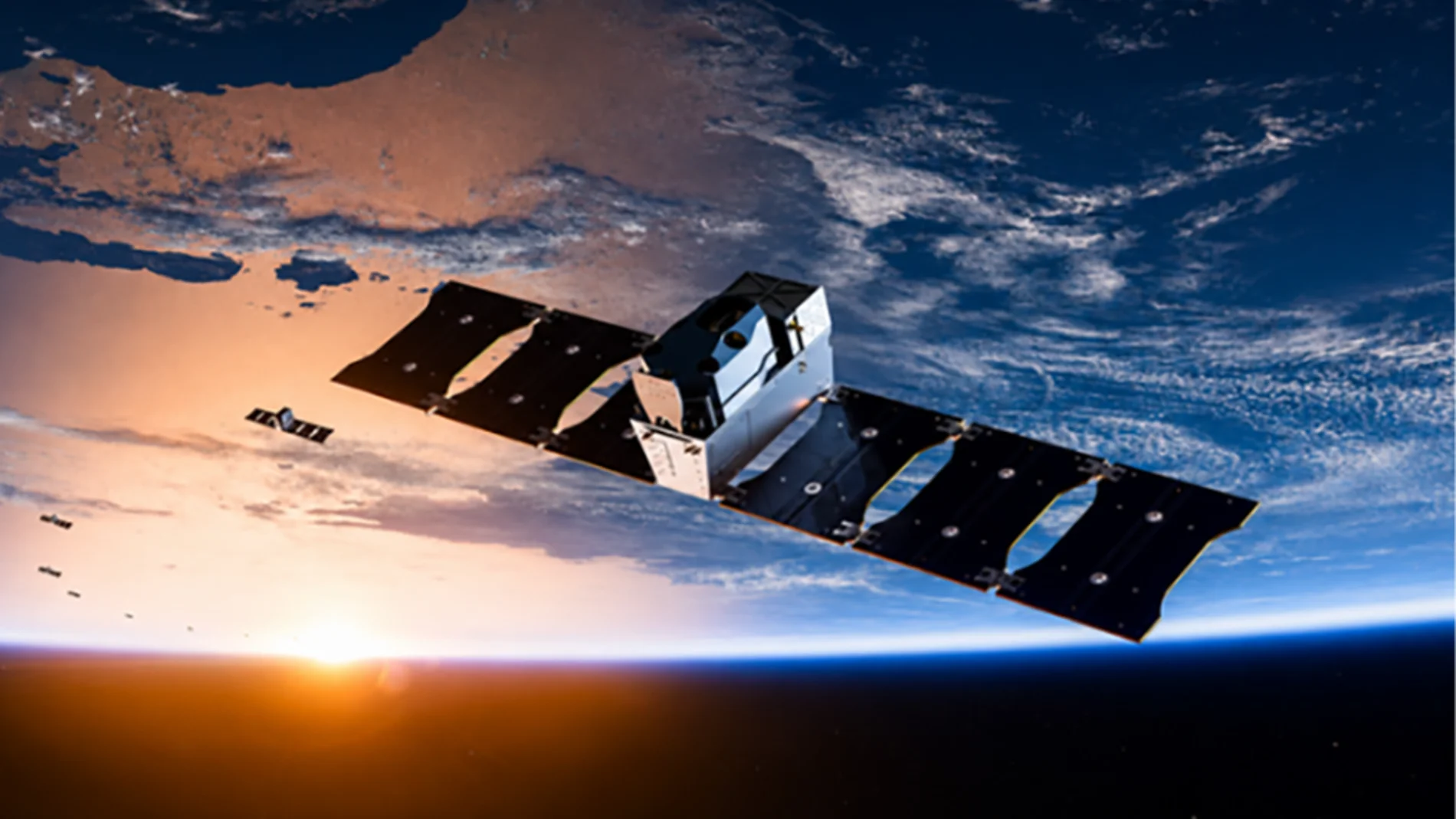
Until now, the border separating Earth from the Moon was mainly a stage for scientific exploration and space missions. But the Pentagon wants to start treating it as a new strategic domain. And to do it there is looking for satellites capable of carrying up to 2,000 kilos of payload each, although it has not explained what equipment it plans to place inside.
The initiative appears in a request for information addressed to the aerospace industry by the US Department of the Air Force. The document proposes developing up to five space vehicles that will have their “operation zone throughout cislunar space, including Earth-Moon transfers and libration point orbits.” The first launch capability should be available by the end of 2029, while the goal is to reach an initial operational capability in orbit during 2031.. It is not yet an award or a construction order: Washington is collecting proposals to decide how to develop the system and which companies could participate.
What draws attention is the required load capacity. Each vehicle must be able to accommodate government equipment of up to two tons, with maximum dimensions of three meters in length by one meter in height and one meter in width. You will also have to supply it with at least one kilowatt of electrical power, with three kilowatts as a goal. The document does not identify the nature of that equipment. It does require communications protected by the US National Security Agency’s (NSA) Type 1 level encryption systems, the agency’s highest encryption standard. This does not in itself prove that the instruments are secret, but it makes clear that the program contemplates integrating sensitive government systems.
Why take such infrastructure so far from our planet? To understand it you have to look beyond the lunar orbit. Cislunar space includes the gravitational environment formed by the Earth and the Moon, including the trajectories that connect both bodies, the lunar orbits and the so-called Lagrange points. The latter are regions in which gravitational forces and orbital motion allow a ship to maintain certain relative positions with reduced fuel consumption.
The US Space Force wants its vehicles to be able to move through all these regions, perform orbital transfers and maintain their positions for long periods. It is not a simple task. Unlike what happens in a good part of Earth’s orbits, here the gravitational influence of two bodies of great mass constantly conditions the trajectories. Besides, The volume of this space is approximately 1,728 times larger than that of the geostationary orbit.according to US Air Force documentation. Monitoring it and maintaining a continued presence requires capabilities that are still developing.
Although the Pentagon does not specify what instruments the satellites will carry, the priorities expressed by those responsible for the Space Force allow three possible functions to be identified: space surveillance, navigation and communications. The first, known as Space Domain Awarenessconsists of detecting, tracking and identifying objects that move through space. In an environment increasingly populated by satellites, probes and experimental vehicles, Knowing what is around you and how it moves can be as important as having the systems themselves.
The second function has to do with navigation. At the moment, Cislunar space lacks its own positioning, navigation and time synchronization infrastructure comparable to that provided by GPS systems around the Earth. Developing it would allow us to know more precisely the position of ships, calculate their trajectories and coordinate operations over long distances. The third priority is communication, essential to keep vehicles and ground stations connected.
There is another detail that deserves attention. In a separate request for information released Nov. 9, the Department of the Air Force asked industry for proposals on artificial intelligence and machine learning to control space vehicles in this environment. He The objective is that they can maintain their orbit, calculate maneuvers, detect anomalies and recognize objects without continually depending on instructions sent from Earth.. The document even contemplates artificial vision systems capable of identifying celestial bodies and objects manufactured by humans.
The reason is physical: the greater the distance, the longer a signal needs to travel between a ship and its control center. Autonomy stops being a convenience and becomes an operational necessity. The Pentagon wants, for example, the vehicles to be able to operate for at least 72 hours without outside intervention. The question, therefore, is not only what these satellites will carry. Is who will have the capacity to observe, navigate and maintain a continuous presence in a space that may be decisive for future scientific, commercial and military activities. The two tons remain an unknown. But the intention to occupy that territory is no longer.