
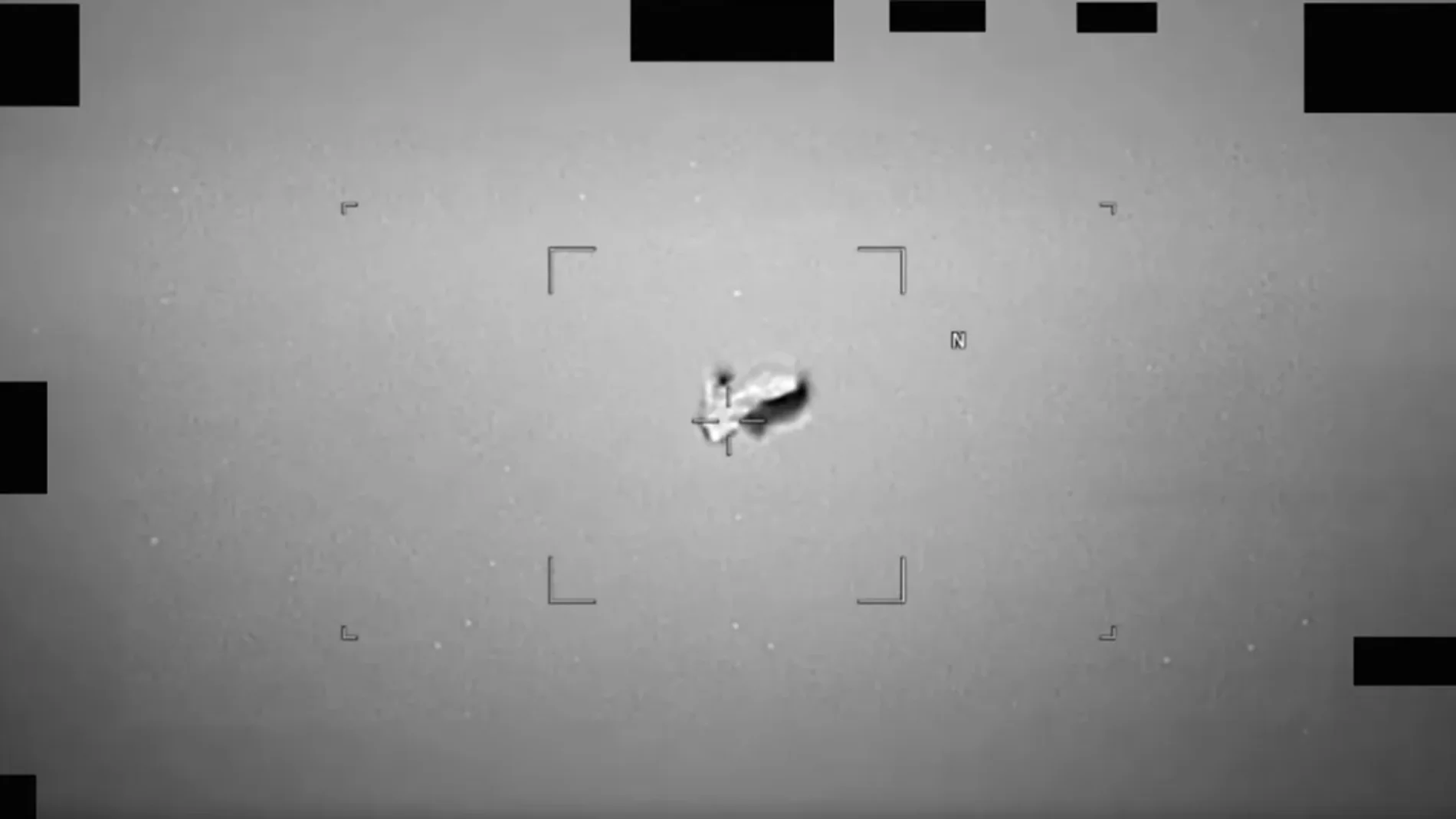
For decades, the Pentagon’s UFO files lived in a kind of limbo between conspiracy and bureaucratic secrecy. Blurry videos, partial reports, difficult to verify testimonies and a constant suspicion: that The United States Government knew more than it publicly admitted. Now, some of that material is beginning to officially come to light.
The US Department of Defense has published a new collection of videos and documents related to unidentified anomalous phenomena, the former UFOs, now renamed UAPs (Unidentified Anomalous Phenomena). Among them appear objects with shapes described as “soccer balls”, irregular luminous spheres or figures difficult to classify captured by advanced military sensors.
The publication is part of the work of the AARO office (acronym for All Domain Anomaly Resolution Office), created by the Pentagon to investigate strange aerial incidents observed by military pilots, radars and surveillance systems. What is relevant is not only the content of the videos, but the cultural change they represent. For much of the 20th century, publicly acknowledging this type of phenomenon could ruin military or scientific careers. Today, however, the Pentagon itself openly studies them.
And that modifies the problem. Because the question is no longer necessarily “is there extraterrestrial life?”, but something much more immediate: What exactly is the US military seeing in its own airspace?
Many of The objects analyzed end up having relatively mundane explanations: balloons, drones, optical reflections, sensor errors or unusual atmospheric phenomena. But other cases officially remain without conclusive explanation. Not because they defy the laws of physics, but because the available data is insufficient or contradictory.
That nuance is important. “Unidentified” does not automatically mean “alien”. It simply means that analysts have not been able to determine with certainty what that was.
However, The Pentagon’s interest does not arise from scientific curiosity or fascination with science fiction. It arises for national security. An object that appears near sensitive military installations, maneuvers unexpectedly, or evades conventional identification represents a problem, even if it ends up being a terrestrial one.
And there appears a less fantastic, but probably more disturbing, possibility: that Some of these phenomena correspond to advanced surveillance or recognition technologies developed by other countries.
The declassified videos also show another aspect of great interest: the extent to which we depend on automatic systems to interpret reality. Many of the images come from infrared sensors, radars or military cameras designed to detect threats in extreme conditions. The problem is that These systems do not “see” the world as a human being does. They interpret heat, motion, relative velocity and electromagnetic signatures. And sometimes, that information can be misleading even to experts.
A simple change in angle, an optical effect produced by the lens or the speed of the plane recording can make an object appear to move in an impossible way. At their core, these files also explain why the UFO phenomenon has survived for so many decades. Human beings tolerate gray areas poorly. And few things cause more discomfort than admit that something was observed, recorded and analyzed… but still without a definitive explanation.