
The old metaphor of “the light at the end of the tunnel” is about to take a 180º turn and become “the light is the beginning of the tunnel.” For decades, opening tunnels has been synonymous with brute force: steel discs, tons of pressure, constant wear. The tunnel boring machines bite into the rock, break it, crush it. It is a slow, expensive and, above all, mechanical process. That’s why The idea of replacing or at least complementing that effort with a laser sounds almost like science fiction. And yet, there are teams that are already working on it.
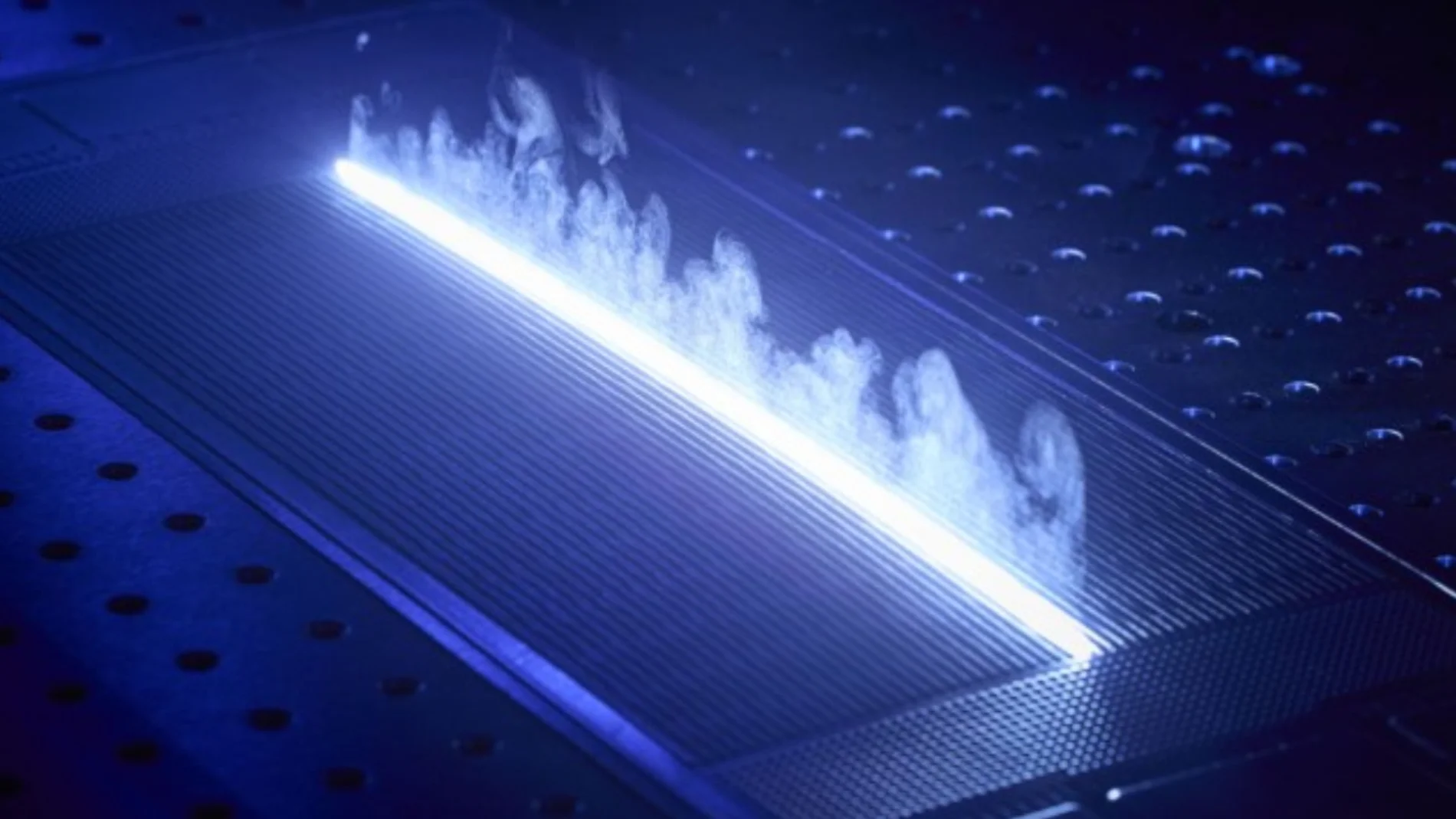
The proposal, a breakthrough by scientists at the Fraunhofer Institute of Laser Technology ILT (Germany), is based on a simple premise: instead of breaking the rock, why not transform it? A high power laser It does not “hit” the material, it heats it to an extreme point. Depending on the intensity, you can melt it or even vaporize it. That is, instead of fracturing the stone, it converts it into gas.
The recent system, based on lasers of around 100 kilowatts (the equivalent of turning on, in an instant, about 60 kitchen plates… but concentrating all that energy in just a few millimeters)has proven to be capable of cutting steel and drilling extremely hard materials, opening the door to its use in excavation and mining. But the real advance is not only in the power, but in how it is used.
Instead of a single beam, those responsible, led by Jochen Stollenwerk, are developing systems that split the laser into multiple smaller beams. This allows the energy to be distributed in a more controlled way over the rock surface. In practical terms, It means avoiding a classic problem: the material melting and forming a glassy layer that makes it difficult to continue drilling.
In patented designs, lasers are integrated directly into the TBM cutting head. They act as a kind of “softener” of the terrain: they heat the rock, generate internal tensions and make it easier for the mechanical discs to fragment it with less effort. So, The excavation stops being a head-on collision and becomes a combination of thermal and mechanical physics.
To understand why this works, you have to look closer at the rock itself. The rocks are not homogeneous. They have microfractures, minerals with different thermal properties, areas of accumulated tension. When a laser hits them, it not only heats them: it creates very abrupt temperature gradients (transitions). Some parts expand, others do not. This imbalance generates internal tensions that end up cracking the material from within.
In some systems, water is even added to intensify this effect. The laser heats the surface and suddenly the water quickly cools the area. This thermal contrast causes additional microfractures, making breakage even easier. It is, in a way, a way to “fatigue” the rock instead of hitting it.The potential advantages are enormous. Less tool wear means fewer interruptions and less costs. More controlled excavation could reduce vibrations, crucial in urban environments. AND laser precision opens the door to cleaner tunnels, with less excess material.
Plus, there’s a less obvious benefit: energy efficiency. Although a high-power laser consumes a lot of energy, reducing the resistance of the material can offset that expense. Some experiments already point to a significant decrease in the total energy needed to drill rock.
“In tunneling and deep shaft drilling, as well as in mining, high-power lasers could help fragment rock and greatly accelerate existing processes – explains Stollenwerk in a statement -. In shipbuilding and industrial plants, high average powers enable more efficient and precise drilling, cutting and joining processes for thick materials and high-strength steels. But where laser technology is reaching new dimensions is, for example, drilling 1,000 holes with a single shot, preparing square meters of metal and glass surfaces per minuteor precisely cutting and joining centimeter-thick steel.”