
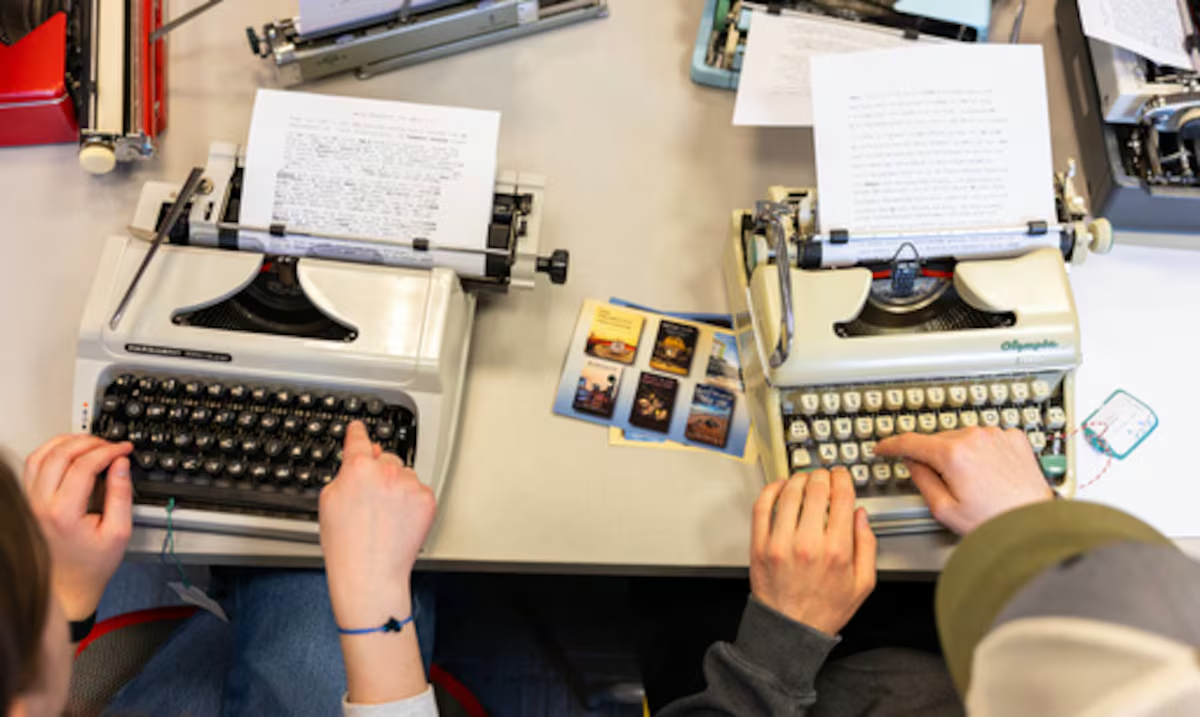
The scene is straight out of the 1950s, with students pecking away at manual typewriters, which beep at the end of each line.
Once a semester, Grit Matthias Phelps, a German professor at Cornell University, introduces his students to the raw sensation of typing without assistance online. No screens, online dictionaries, spell checkers or delete keys.
The exercise began in spring 2023, when Phelps became frustrated that students were using generative AI and online translation platforms to produce grammatically perfect work.
“What’s the point of me reading it if it’s already correct anyway and you didn’t write it? Could you produce it without your computer?” Phelps said.
I wanted students to understand what writing, thinking, and classrooms were like before everything went digital. So he found a few dozen old manual typewriters, at thrift stores and online markets, and created what his syllabus simply calls an “analog” assignment.
It may be premature to say that typewriters are making a comeback beyond Cornell’s campus. But the revival is part of a national trend toward old-school exam methods, such as pen-and-paper in-class exams and oral tests, to avoid using AI for assignments on laptops.
Typewriters bring the old-fashioned taste of doing one thing at a time
Students came to class on a recent analog day to find typewriters on their desks, some with German keyboards and others with QWERTY keyboards.
“I was very confused. I had no idea what was going on. I had seen typewriters in the movies, but they didn’t explain how they worked,” says Catherine Mong, 19, a freshman in Phelps’ Intro to German class. “I didn’t know there was a whole science to using a typewriter.”
Like a rotary phone, the manual typewriter looks simple, but it’s not intuitive for the smartphone generation. Phelps demonstrated how to feed the paper manually, hitting the keys hard but not so hard that the letters smudged. He explained that the ringing of the bell means the end of a line and the need to manually return the cart to start the next line. (“Oh,” said one student, “that’s why it’s called ‘return’”).
“Everything slows down. It’s like the old days, when you really did one thing at a time. And it was fun to do it,” says Phelps, who brings his two children, ages 7 and 9, to act as “tech support” and make sure no one’s phone is off.
Students appreciated having fewer distractions
The task involves lessons that go beyond how to use a typewriter, which is what it is about.
“I realized that the difference with typing on a typewriter is not just how you interact with the machine, but how you interact with the world around you,” says Ratchaphon Lertdamrongwong, a sophomore computer science student, whose class had to write a review of a German movie they had seen.
In the absence of screens, there are no notifications to distract him while he writes, and without all the answers at his fingertips, he asked his colleagues for help, something Phelps wholeheartedly encouraged.
“While writing the essay, I had to talk a lot more, socialize a lot more, which I guess was normal then,” Lertdamrongwong said, referring to the era of typewriters. “But it’s drastically different from how we interact in the classroom in modern times. People are always on the laptop, always on the phone.”
Without the delete key and the ability to correct every mistake, he stopped to think more intentionally about his writing.
“This may sound bad, but I was forced to really think about the problem on my own instead of deferring to AI or Google search,” he said.
Manual machines were a workout for the little fingers.
Most students realized that their pinkies weren’t strong enough to touch-type, so they typed more slowly, pecking at the keyboard with their index fingers.
Mong, a freshman, faced an added challenge with a recently broken wrist, which requires him to use only one hand. The self-described perfectionist was frustrated at first by how messy her page looked, with strange spaces between some letters and misspellings. (Phelps told students to go back and write Xs over their mistakes.)
“What I turned in had pencil marks all over it and certainly didn’t look clean or finished. But it’s part of the learning process that you’re going to make mistakes,” said Mong, who found the task of typing a poem “fun and challenging.”
He adopted odd spacing and played with the visual boundaries of the page to bleed and fragment lines in the style of poet EE Cummings. It took several sheets of paper and many mistakes, all of them saved by Mong.
“I’ll probably hang them on my wall,” Mong said. I am fascinated by typewriters. I have told all my friends: I took a German exam on a typewriter!“
This story was translated from English to Spanish with an artificial intelligence tool and was reviewed by an editor before publication.