
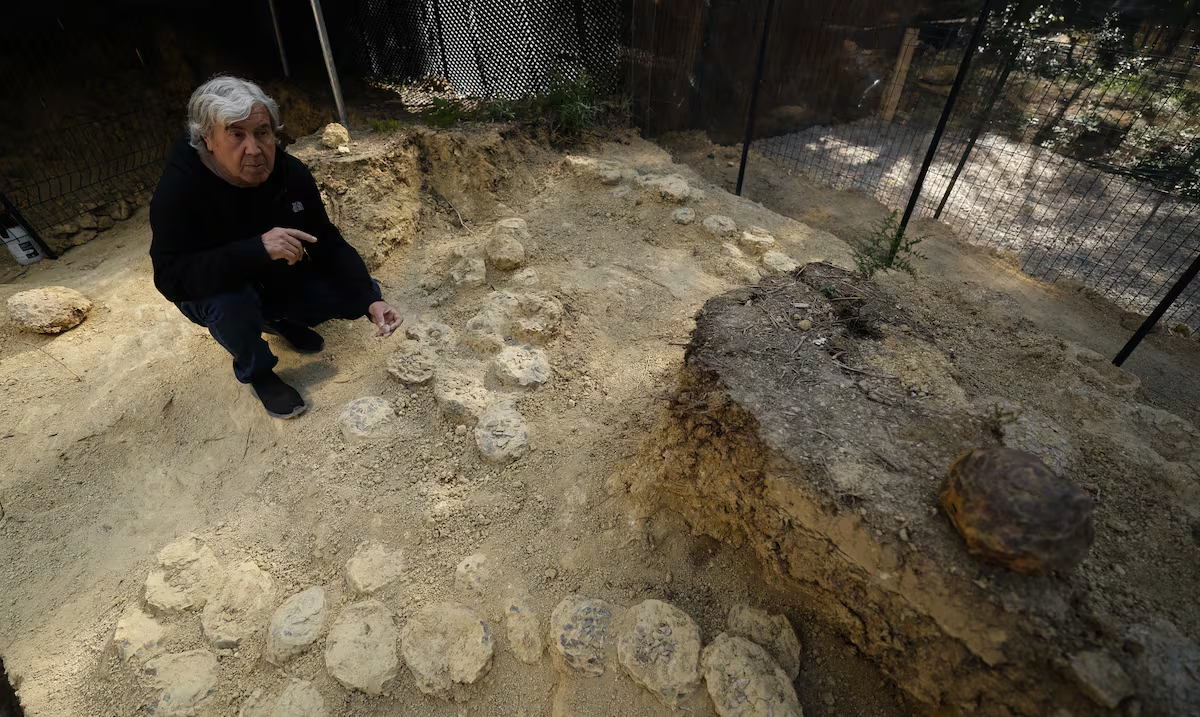
How can two nests of birds be related? dinosaur separated by an ocean? Alain Cabot, discoverer of dozens of fossil eggs in French territory, maintains that his findings belong to the lineage of Titanosaurus that inhabited Argentine Patagonia at least 70 million years ago.
“In October we started searching in a clay area and discovered the first eggs, in dozens, but there must have been hundreds buried”Cabot, a geologist by training and owner of a private park dedicated to dinosaurs in Mèze (about 30 kilometers from Montpellier), told EFE.
The discovery, which only required digging a few centimeters, has attracted the attention of the French press, although it is not something unprecedented. the south of France It is rich in paleontological sites. Cabot, 70, has played a key role in spreading them.
A first discovery of dinosaur eggs 30 years ago led the geologist to create, in the same area as that chance find, the Musée-Parc des Dinosaures de Mèze. In its 50 hectares open to the public, there are, in addition to giant reproductions of dinosaur skeletons, hidden paleontological treasures.
The most recent has a weight, a size and a shape: a kind of fossilized soccer ball weighing about 5 kilos and with a surface similar to the skin of an avocado peel.
“Everything is going to stay here, and anyone can come see them”said Cabot, who encourages universities and research centers – until now reluctant – to study his most recent discovery.
This discovery has a transatlantic connection. The owner of the museum asserted that these dinosaur egg fossils, based on studies carried out with a microscope, are comparable with those found in Argentina, specifically those from the Auca Mahuevo site (Argentine Patagonia).
This hypothesis is plausible. In the Cretaceous, the configuration of the continents still allowed certain biological exchanges.
In 1997, thousands of eggs from Titanosaurs – a family of sauropods (long-necked dinosaurs, the largest land animals that ever existed) – were found in Auca Mahuevo by an expedition led by paleontologists Rodolfo Coria and Luis Chiappe.
For the first time in history, dinosaur embryos were found with remains of fossilized skin, allowing scientists to see what the texture of a titanosaur’s skin was like before it was born (it was scaly and with geometric patterns).
However, the fossilized eggs found by Cabot lack this embryo because the chemical composition of the soils of southern France has probably dissolved them.
Even so, the geologist claimed his new discovery. “It is important that it be known in Argentina to be able to advance knowledge about dinosaurs, although we are far from reproducing a ‘Jurassic Park,’” the septuagenarian said categorically.
His enthusiasm has not found, for the moment, an echo in the academy. The main research center in France, the CNRS, is not involved in the studies of the new Mèze deposits.