
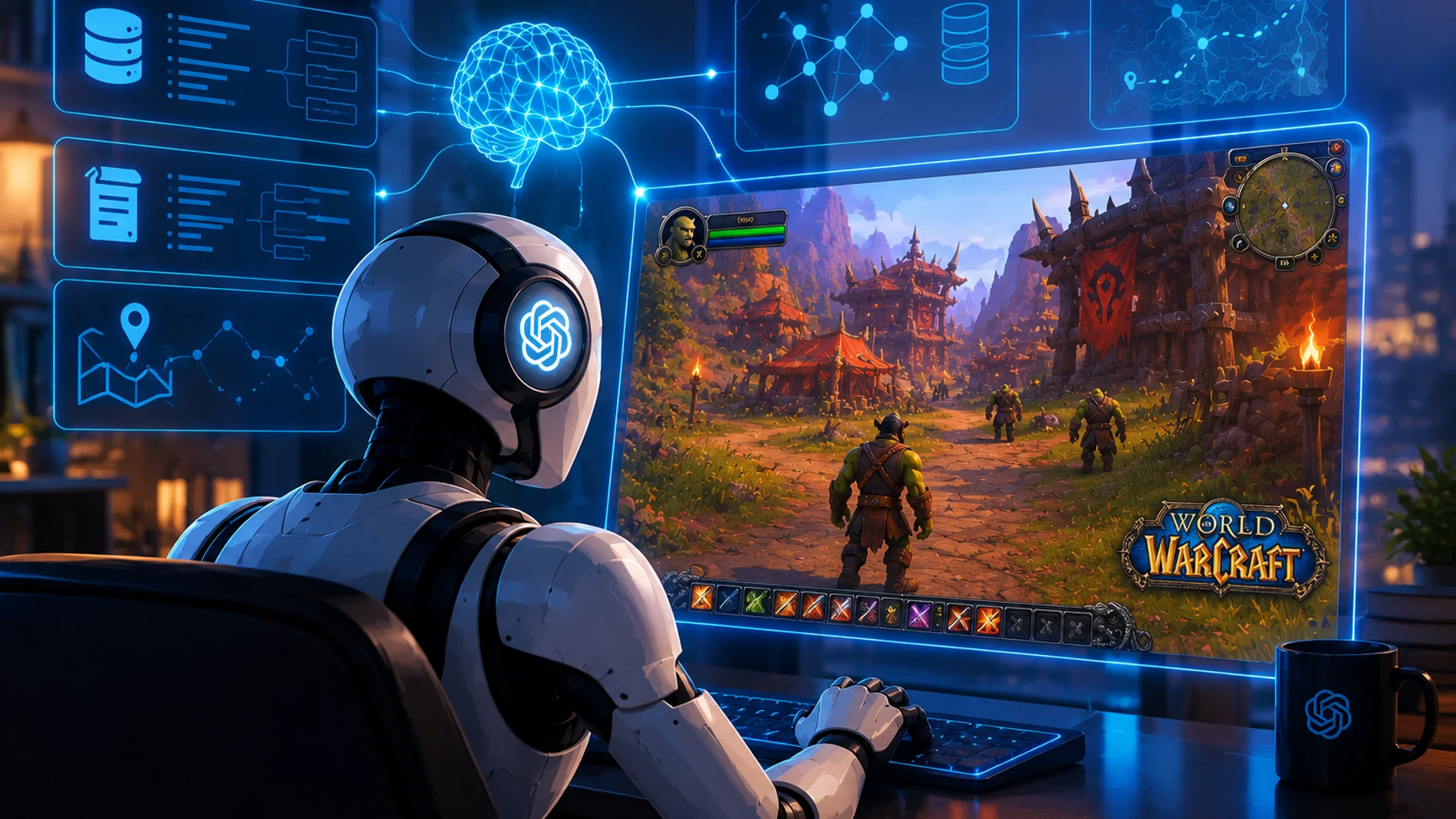
To play world of warcrafta human looks at the screen. You see an orc, a road, an enemy, a house, or a character who gives you a quest. GPT-6 Astra did something much stranger: it played without seeing any of it. According to the creator of agent-wowthe open source project that allows you to experiment with AI agents within world of warcraft, GPT-6 Astra completed all missions from the initial orc area in 40 minutes and without dying. But during the game he did not receive a single frame of the game. Instead of images, it pulled information directly from the bowels of the video game: messages sent by the server, mission data, and files used to calculate routes.
The difference is important. A human player constructs their representation of the world from sight, sound, and interaction. Astra was given a structured description of that same world and had to turn it into something she could use to decide what to do next.. And he did it in a time similar to that of average players. The experiment was performed with AzerothCore, an open source implementation of the world of warcraftand not with the official Blizzard servers. The system agent-wow It acts as a client so that artificial intelligence agents can communicate with that server using the game’s network protocol. Nor does it provide a complete system of movement, combat or interaction in advance: the idea is that the agent itself builds the tools it needs. And that is precisely what Astra did.
During the game, the model created a module capable of processing dozens of types of messages from the server and keeping that information in memory. A Python program used that data to build a representation of what was happening and send back the corresponding actions. He didn’t need to know that in front of him was an image of a character. The server could tell you, in another way, where that character was, what mission he was offering, or what was happening around him.
For the missions, the agent also used AzerothCore’s SQL files, which contain data on non-player characters, objectives, places where certain elements appear, and start and end points of the missions. With that information he was able to establish which tasks depended on others and organize a sequence to complete them. He also made practical decisions: selling items he no longer needed, equipping upgrades, and training new skills. That is, he did not simply execute a list of orders. He had to maintain a goal for a relatively long period and decide what intermediate actions brought him closer to it.
The problem of moving around the world required another solution. Astra generated a C++ program that used AzerothCore’s navigation maps, known as mmapsto calculate routes between different points. The program used the Detour library to convert these maps into a sequence of coordinates that the agent could follow. It is a radically different way of “seeing.” There is no image to interpret, but rather a kind of abstract map of the world that allows us to answer questions such as where I am, where I have to go and what path I can follow.
The result is interesting because it shows an increasingly important capacity in AI systems: not limiting themselves to reacting to what they receive, but building the necessary tools to act within an environment. In fact, the developer of agent-wow explains that he expected the agent to need a higher level implementationbut that in practice Astra was able to work directly at the protocol layer.
But it is advisable not to turn the game into something it is not. Astra didn’t learn to play world of warcraft from scratch as a human who sits in front of the game for the first time would do. He had access to a privileged representation of the environment: the server’s own data, its databases and its navigation maps. He even found some problems on the maps that he was able to take advantage of. Furthermore, he only completed the initial area of the game.
Therefore, the feat does not prove that an AI can autonomously play any video game without needing to see it. It demonstrates something more concrete, but perhaps more interesting: that A language model can transform structured data from a complex environment into an operational representation of the world and use it to plan actions over an extended period.