
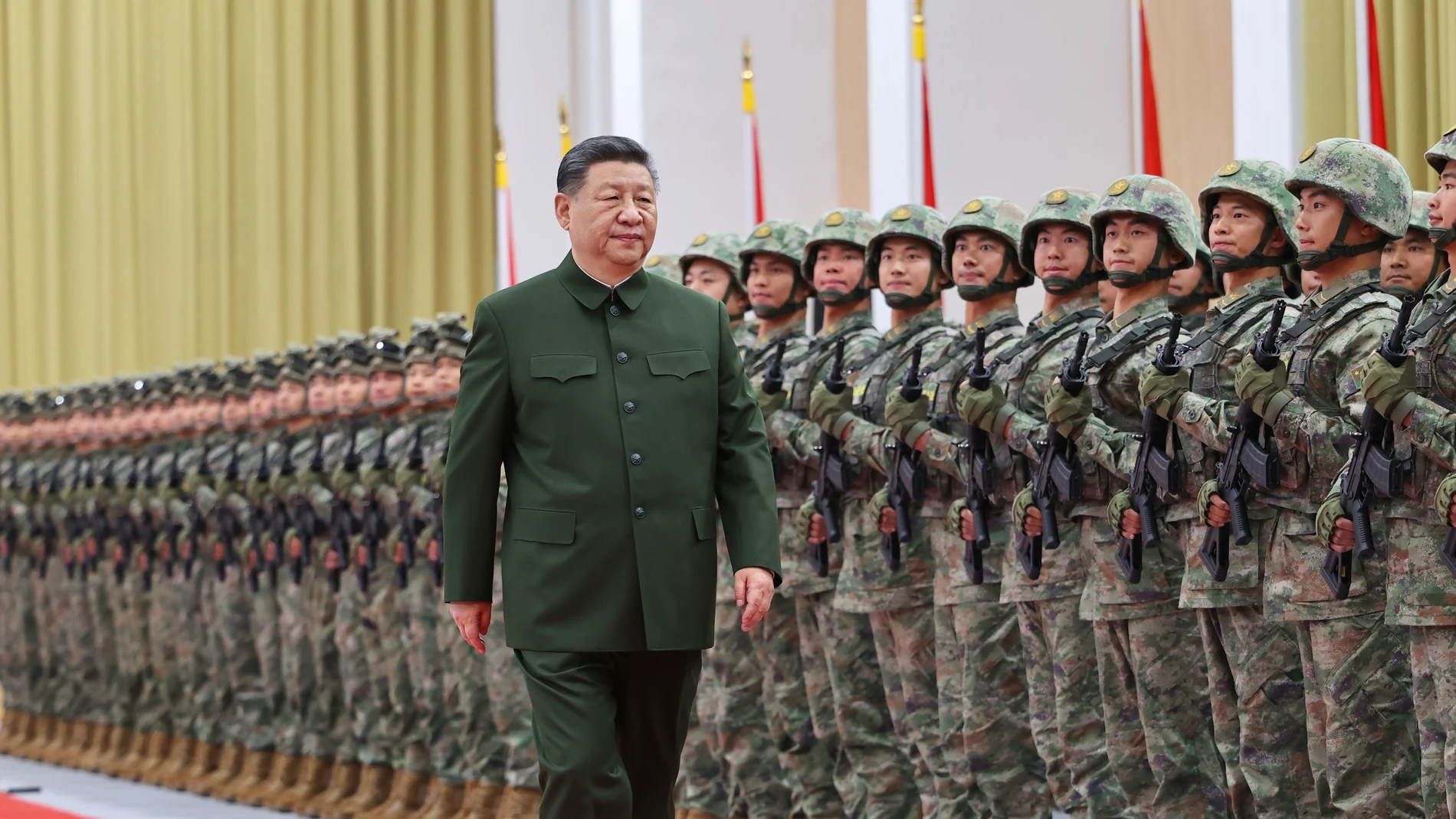
The Bohai coast is home to the enclave where historically the Chinese regime has charted its most radical turns. It was 300 kilometers from the capital, in Beidaihe, where Mao Zedong orchestrated the tragic Great Leap Forward and the bombing of Kinmen in 1958, and where Deng Xiaoping engineered his anti-crime campaign in 1983. Today, the villages of Qinhuangdao are a bunker guarded by military locks and facial biometrics. There, the communist leadership does not rest; opera a crisis cabinet surrounded by urgency. The priority is to quell panic in the face of an exhausted economic model, ensure technological sovereignty in the face of Washington’s interventionism and decapitate the dissident leadership. This entire apparatus responds to the mandate to settle the debate on the succession and shield the verticality of Xi Jinping facing the decisive 21st Congress in 2027.
September will test Chinese resilience. Xi will land in the United States to confront Donald Trump in the midst of an escalation of containment, with bans on the export of advanced chips, a blockade on the joint development of AI and a tariff war. Aligning party veterans with the hard core to articulate trade retaliation against their adversaries monopolizes the agenda of this key isolation.
Extinction of the clans and septuagenarian tsar
Historically, the informality of the Beidaihe retreat gave retired political elites the necessary leeway to scrutinize the decisions of the supreme leader and balance the shares of influence. That corridor diplomacy has been annihilated. Under a relentless campaign against political interference, the voice of retired leaders has been exterminated. To shield his hyper-leadership, Xi has abolished the statutory rule of communist orthodoxy that required the retirement of the elite upon crossing the seventy-year mark.
The president has handed over operational control of the State to a small guard of veterans unconditional. In this logic of entrenchment the figure of Cai Qi emerges. His appointment as president of the influential Central School of the Party places him at the head of the academy that molds future leaders, while the supreme leader dashes any expectations about the preparation of a successor in the short term.
Cai belongs to the forged hard core in Fujian and Zhejiang provinces. Despite ranking fifth on the Standing Committee, his vast accumulation of power stifles Premier Li Qiang’s theoretical authority. He directs the propaganda machinery, serves as director of the General Office of the Central Committee and holds the vice presidency of the strategic National Security Commission. At his side are consolidated figures who are over the aforementioned age and do not have a seat on the Central Committee, such as Song Tao, in charge of policy towards Taiwan, or Xia Baolong, supreme supervisor of Hong Kong. Longevity in office is no longer an anomaly to be the valid loyalty filter in Beijing.
Rust of traditional industry and fear of stagnation
With the political apparatus under absolute control, the conclave has turned towards the management of the economy and avoid social fracture. The law of silence of Chinese propaganda was blown up at the end of July when Zhang Enhui, head of the party in Changchun – a city of nine million inhabitants in the ‘rust belt’ and engine of the national automotive industry – broke the script to publicly warn about the “unprecedented challenges” that suffocate their region. The censorship deleted the panic message within hours, but confirmed the diagnosis that terrifies the Politburo. The world’s second largest economy suffers from a severe sectoral gap. While high-tech exports resist the global pulse, household consumption is dying and the real estate collapse continues to devour municipal finances.
Faced with the Western suggestion of execute a massive brick rescue and stimulate consumption, Beijing is castled. The Government has imposed a doctrine of minimums based on intervening only what is strictly necessary to save the annual growth quotas, avoiding at all costs the over-indebtedness of the central State.
The survival of the regime relies all its capital on achieving a extreme technological sovereignty. The only official leak from the hermetic summit confirms this bet. At the beginning of August, the powerful leader Cai Qi gathered the country’s scientific elite to urgently solidify the foundations of the fifteenth Five-Year Plan for the period 2026-2030. Beijing assumes that the trade clash with the United States cannot be reversed and concentrates its forces on dominating the global supply chains of the future.
The strategic risk is imminent. A recent report by the Chinese firm Galaxy Securities warns that the risk of ‘desinization’ of the market will skyrocket over the next five years. Experts demand that the Government solve your technology bottlenecks and forge fully independent supply chains in critical areas such as semiconductors, basic software, advanced materials or heavy machinery. The final mandate requires redoubling investment in basic research and strengthening emerging sectors to guarantee a blockade-proof economy of resistance.
Military guillotine and retroactive corruption
This reengineering of the State requires blind obedience. In the civilian sphere, repression has caused the unusual rotation of nine ministerial portfolios in the first half of the year alone. But it is in the People’s Liberation Army where the shaking has reached epic proportions. The civilian command has beheaded military personnel who enjoyed immense political protection and influence over the troops, striking down the vice president of the Central Military Commission, the veteran general Zhang Youxia, and the powerful general Liu Zhenli. To protect operations and avoid mutinies, Beijing has emergency promoted General Zhang Shuguang as the new head of the military disciplinary inspection and has handed over the command of the Air Force to Wang Gang.
The internal hunt falls on the shoulders of Li Xi, director of the Central Commission for Discipline Inspection. Until the month of July, this feared court formalized investigations against 36 senior state officials. The list includes seven vice ministers and, breaking an unspoken rule of immunity at the top, Ma Xingrui, a full member of the all-powerful Politburo.
To perpetuate bureaucratic terror and dismantle the old clientelist networks woven over decades, the judicial system has established the disruptive doctrine of retroactive corruption. A court in Sichuan province recently sentenced Zhang Jianhua, former deputy director of the State Administration for National Defense, to ten years in prison after proving he collected multimillion-dollar bribes. The fact that has frozen the blood of the hierarchy is that the prosecution demonstrated that a third of that illicit fortune was amassed through influence peddling between 2021 and 2025, years after officially retiring. Political withdrawal is no longer a criminal firewall.
The historic coastal retreat has lost its function as a consensus forum for the Chinese leadership. Today it is the headquarters where Xi liquidates the biological clock of his succession, forcibly shields a divergent economy, purges the military high command and shields his mandate.