
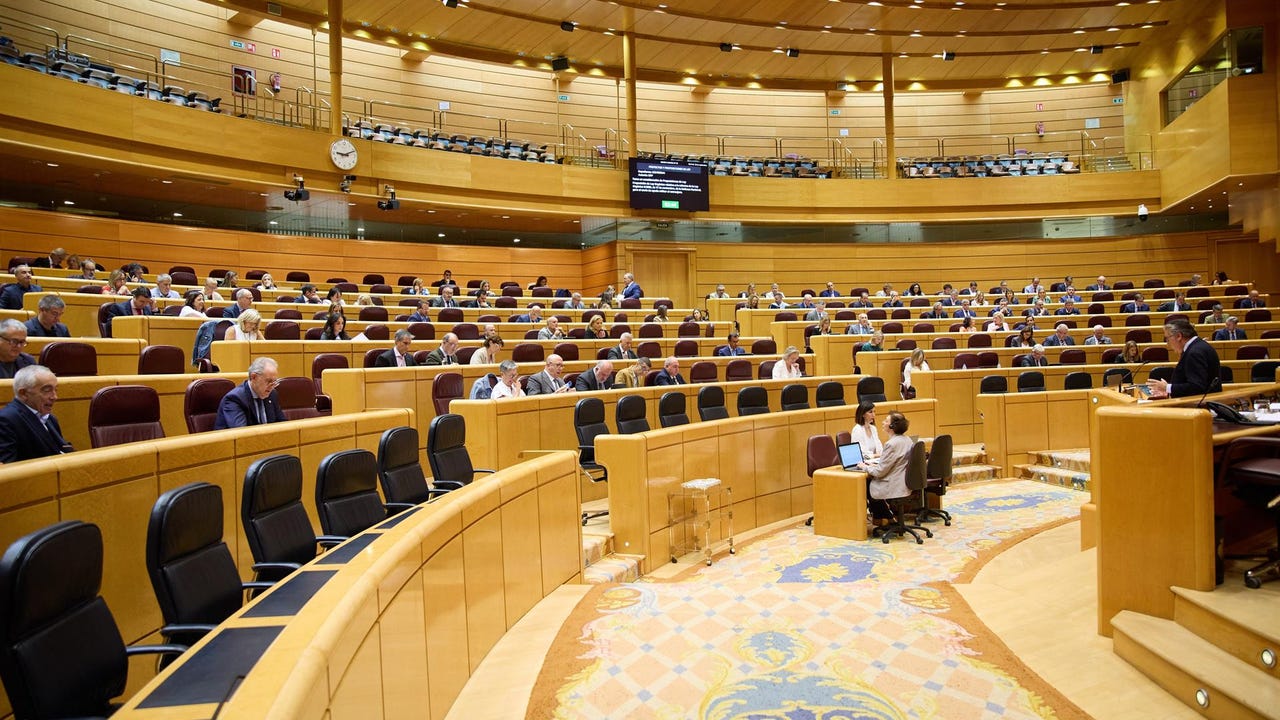
The PP achieved an absolute majority in the Senate in the elections on July 23 and Pedro Sánchez has not liked that at all from the first moment. The socialist leader has ignored the Upper House like never before to avoid the opposition of Alberto Núñez Feijóo’s party and has only attended the control session once in an entire year. His ministers seem to be following in his wake: in 17 plenary sessions, they have recorded 109 absences, which comes to an average of more than six per session. Of those 108 absences, 33 are unjustified, which is equivalent to 30.2%, since during those days nothing appeared on the ministers’ official agenda.
The truth is that these unjustified absences have increased and have reached their peak with the start of the new political course: during the month of September, 18 absences have been recorded, of which there were eight (almost half) unjustified. . In a way, this dynamic occurs in a context of greater weakness for the Government, with a new blow due to Congress’ rejection of the deficit objectives (previous step to the Budgets) and María Jesús Montero forced to appear to give explanations for the unique financing agreement for Catalonia.
The rejection of the Senate is the way that the Government has found to despise the absolute majority of the PP in the Upper House, a parliamentary force that has allowed the popular party to fail the ministers four times (Félix Bolaños, Óscar Puente and twice Fernando Grande-Marlaska); overthrow the deficit objectives for 2024, which prevented the Executive from presenting the Budgets; e, promote up to 14 laws, of which, eleven have received the “collaboration” of Junts, so they could move forward in Congress if the PSOE stopped blocking them.
Specifically, of the 108 absences, the minister with the highest number is José Manuel Albares, with eleven: in this sense, his own portfolio makes him travel a lot and that prevents him from being present at many control sessions. However, there have been three absences in which no type of event was included in their official agenda. On the other hand, in contrast to Albares is the Minister of Defense, Margarita Robles, who also holds a portfolio that requires her to be away from Spain for a few weeks and has been absent from the control sessions seven times, but all of them have been justified (always has had an official agenda).
Also, with seven absences, are Teresa Ribera and Óscar Puente. And, also, both have stood up to the Senate without justification: specifically, the former vice president has done so on four occasions while the Minister of Transport has done so on two occasions. From there, those who have most evaded the control sessions without justification are: María Jesús Montero (3), Carlos Cuerpo (3), Isabel Rodríguez (3), Sira Rego (2), Félix Bolaños (2), Diana Morant (2), Luis Planas (2), Pilar Alegría (2), Ángel Víctor Torres (1), Pablo Bustinduy (1), Ernest Urtasun (1) and Ana Redondo (1).
For next week’s Plenary Session, nine absences from the control session have already been reported and it remains to be seen who ends up justifying it and who does not. With these nine absences, the total balance will rise to 117 in 18 control sessions. In this sense, the PP has already announced its intention to introduce a reform to force all ministers to justify their absences to avoid what has happened until now because in Feijóo’s party they have the feeling that the Government wants to “decaffeinate” the Senate control sessions to weaken the parliamentary force that achieved its formation on June 23.
In fact, there are ministers with burning issues who have accentuated their absences as their departments became more in focus: the most obvious example has been Montero, who has been absent in three of the last four plenary sessions when during the first months of the legislature almost never failed. This has coincided with a very delicate moment, with the singular financing pact for Catalonia in the middle of the negotiation of the 2025 Budgets, so the vice president avoids as much as she can comment on a topic on which she has a lot to say while she has Junts on the lookout. Montero, with regional financing, has to maintain many balances.
In addition to the unjustified sit-ins, the Government has already introduced a legislative reform to reduce the powers of the Senate and, specifically, to withdraw its power to overthrow the deficit objectives. This legislative reform was made through the Parity Law, a movement that lawyers considered to be unconstitutional.