
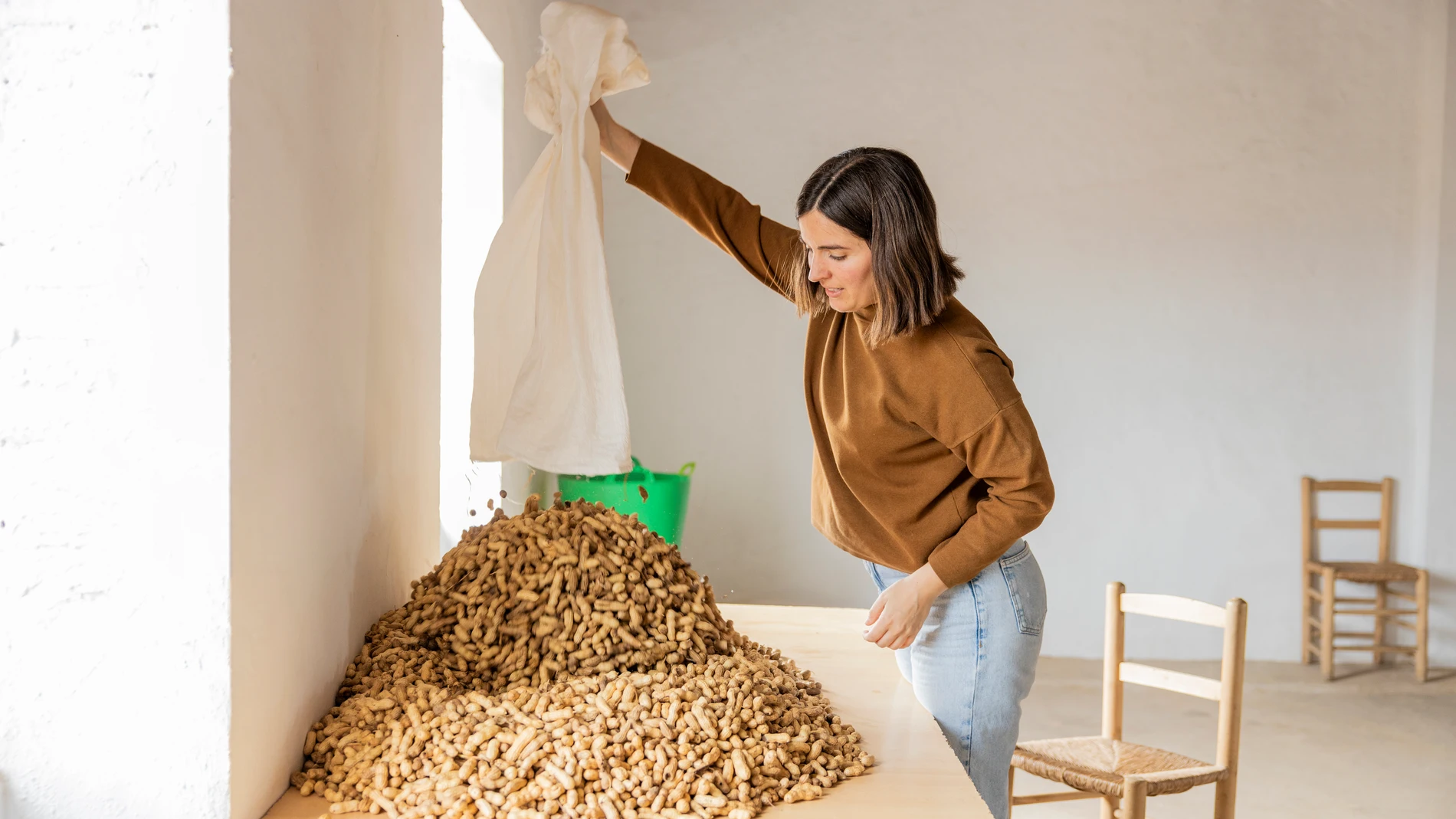
La Granja de la Costera, a town of 300 inhabitants in the interior of Valencia, has become something like the Gallic peanut-growing village. In 2021, CA Climent, Ana Climent’s project, began to recover three traditional Valencian varieties: Collaret, Cacaua and Morú. They grow, roast and package their own peanuts in a workshop, “to guarantee the economic stability of the project and to be able to set sales prices,” explains Ana Climent. They sell them directly online and also distribute them to specialized stores and restaurants.
For Ana Climent, peanut cultivation is part of her family history. His parents already cultivated it, although the family’s main agricultural activity was citrus. «Oranges were the most important crop in this area. At times vegetables and even tobacco were also planted, but this legume was mainly for self-consumption, to have at home.
The seeds came to Ana through her father, who had inherited them from his grandfather and he, in turn, from his great-grandfather. A tradition of more than a hundred years that ended up becoming the seed of their project. «We took the plunge because we thought that, if we didn’t, those seeds would end up being lost. They were already in the hands of very few people and almost everyone kept them for self-consumption. With this commitment we want more people to be able to enjoy the flavor and properties of this plant and that other farmers are encouraged to plant them. The more hands keep those seeds, the more protected they will be,” he says, alluding to the fact that 60% of the world’s peanut seeds are in the hands of four large companies.
To recover this local agricultural heritage, they have gathered around 30 seeds from Valencian farmers and have received varieties from the Catalog of Traditional Valencian Varieties of the Carcaixent Agrarian Experimental Station. From a few seeds extracted from family pockets, they have become an exploitation that obtains a thousand kilos of peanuts per year on about seven “puffs” of land (it is the Valencian term for hanegada). “We are not big producers,” he acknowledges.
Traditional cultivation
Valencia was one of the first places in Europe where peanuts, a plant native to America, were grown. In the Botanical Garden of Puçol, experiments were carried out to verify its viability given the climatic conditions and characteristics of the Valencian terrain and planting began in the 17th century.
The crop became an important economic engine in the area, but it progressively disappeared during the seventies due to the impossibility of compete with imports from Argentina, China and the United States, the three countries that still dominate the international market today. «They developed machinery that allowed them to work large areas and create a larger industry, while here the farmers worked artisanally and on small plots. Little by little they abandoned peanuts and replaced it with other more profitable crops, until reaching the current situation, in which practically no one produces it,” Climent clarifies. However, one of the local varieties, Collaret, has such a high content of healthy oils and fats that its name is used, even today, to market imported peanuts that do not belong to this variety.
Here it is still cultivated in a traditional way; Abandoned fields are taken advantage of and peanuts are used for crop rotation. And like other legumes it contributes to fixing nitrogen. These local varieties have also spent generations adapting to weather conditions and soil. Being a local product, It also avoids 95% of transportation emissions compared to those in America.
Nothing is wasted about peanuts. The bushes are used for animal feed and the husks find new applications. The Sirope Lab study used to develop biomaterials; The APU’A design studio transforms them into lamps and the Alboraia ceramist Patricia Varea Milan uses their ashes to create pieces intended to preserve the seeds of future harvests.
The legume has also found its place in haute cuisine. These products are served in the kitchens of Begoña Rodrigo, recognized as Best Vegetable Chef in Europe in 2024, or Álex Vidal. Without forgetting that they sell raw or roasted peanuts, in shell, without shell and without skin. This latest presentation is one of the novelties of the season, made possible thanks to the financial support of Cervezas 1906.