
We are halfway through the year, but this could become the news that makes all the headlines when we talk about the scientific news of the year in December. For decades, astronomers have scanned the sky looking for planets first and then hunting and capturing those rocky bodies that could have an atmosphere compatible with life as we know it. We already know giant worlds larger than Jupiterlava oceans, frost giants and even planets where it rains iron. But there is a much simpler and, at the same time, much more elusive question: Can an Earth-like planet retain an atmosphere for billions of years?
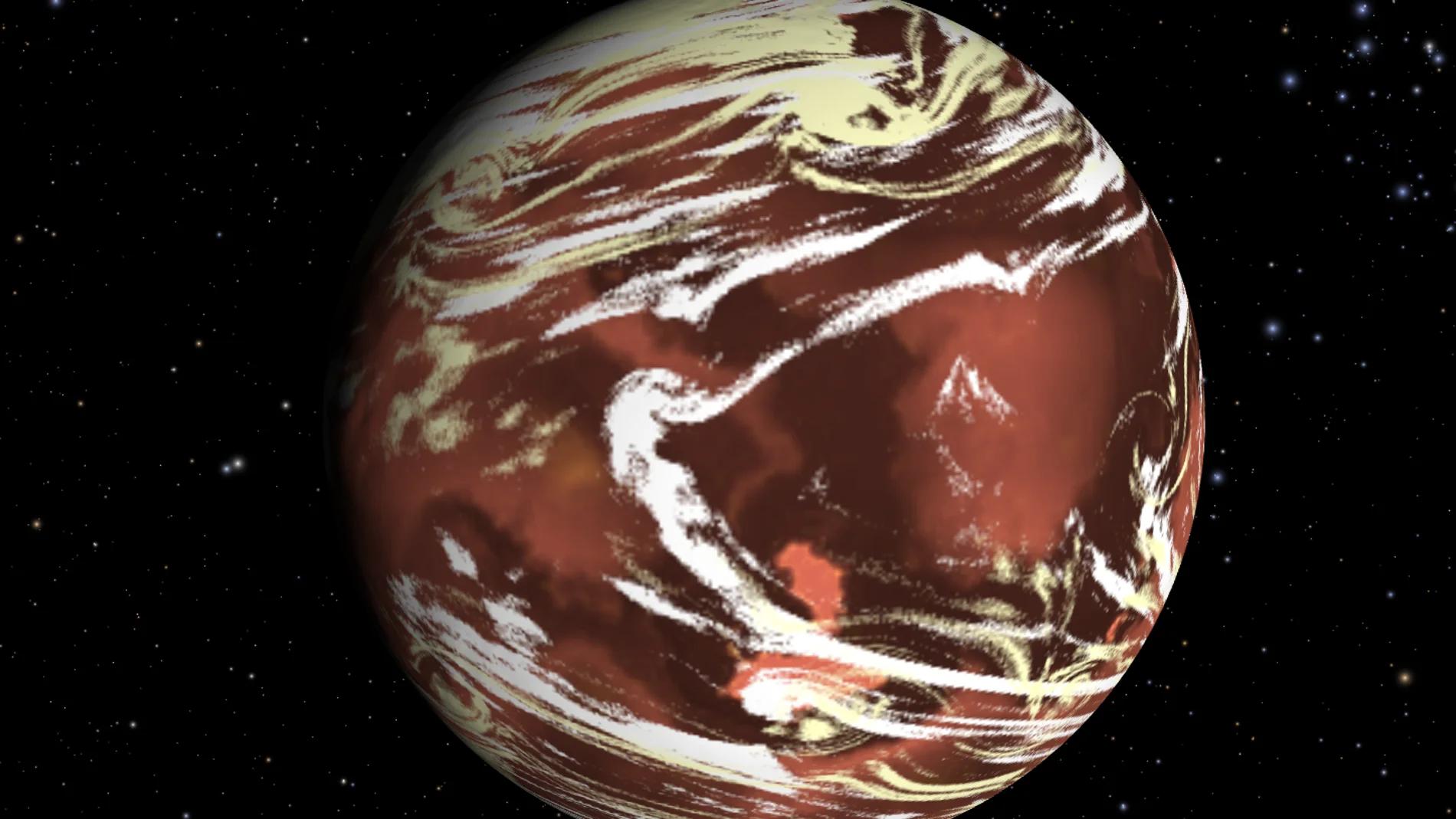
Now, a study published in Science offers the best clue to fill this gap. The authors, led by Jason Dittmann of the University of Florida, believe they have found evidence that LHS 1140b, a rocky planet located about 40 light years from Earth, could still be surrounded by a stable atmosphere. If confirmed, it would be the first time we observe something similar in a world of these characteristics. Why is this detection so important? When we think of an atmosphere we usually simply imagine the air we breathe. But, from the point of view of physics, an atmosphere is much more. It is an immense envelope of gases that completely modifies the behavior of a planet.
It regulates the temperature through the greenhouse effect, distributes heat between day and night, protects the surface against part of the stellar radiation and constitutes the stage where all the chemistry develops. necessary to form clouds, rain and climate cycles. Without it, the surface of a planet can become an extremely hostile place.
Mars offers a good example. Although it once had rivers and lakes, it lost most of its atmosphere billions of years ago. Today it barely preserves a very tenuous gas envelope incapable of maintaining liquid water stably on the surface. Finding an atmosphere around a rocky planet therefore means finding a world that may have managed to maintain relatively stable conditions for billions of years. It does not prove that life exists. But it does remove one of the biggest obstacles to its existence.
Detecting an atmosphere is much more complicated than discovering a planet. Exoplanets are usually located when they pass in front of their star and block a tiny part of its light. However, the atmosphere only adds a tiny transparent layer around the planet. Its thickness represents a tiny fraction of the total diameter.
From dozens of light years away, distinguishing that thin envelope is comparable to trying to detect the transparent edge of a soap bubble by observing it from thousands of kilometers. That’s why the vast majority of atmospheres confirmed so far belong to gas giantswhere the atmospheric layers are huge and much easier to study. Rocky planets, however, present a completely different challenge. Dittman’s team decided to look for one of the easiest gases to detect: helium. And to understand this it is convenient to go back to the past. More than 150 years ago.
In 1868, during a total solar eclipse observed from India, the French astronomer Jules Janssen and, independently, the British Norman Lockyer studied the light coming from the solar chromosphere using a spectroscope (basically a device that measures the trace left by each element when light passes through it). They both hoped to find the characteristic lines of sodium. However, A yellow line appeared that did not match any known element.
Lockyer proposed an extraordinary idea for the time: that signal belonged to a chemical element that did not yet exist in the Earth’s tables. He named it helium, from the Greek Heliosthe god of the Sun. Almost thirty years later, in 1895, the chemist William Ramsay managed to isolate the same element in terrestrial minerals, confirming that Astronomers had discovered an element in a star before chemists on our own planet.
Today we continue to use exactly the same principle and that is what Dittman’s team has done. When a planet passes in front of its star, a tiny part of the light passes through its atmosphere before reaching our telescopes. Each gas absorbs certain wavelengths, leaving a kind of luminous barcode. Enough compare this pattern with those obtained in the laboratory to know what elements and molecules are present. And the signature that has been detected in LHS 1140b is that of helium. And that would be very strange since the helium should not still be there.
The planet, whose mass is 5 times that of Earth, is several billion years old. If it were only losing helium since its formation, it would have exhausted its reserves a long time ago. However, he continues to escape. That requires an explanation. The only reasonable way to continually replenish that helium is for there to be an atmosphere that continues to release it into the upper layers. It is a very similar reasoning to finding smoke coming out of a chimney: we do not see the fire directly, but it is the best explanation for the existence of smoke. Over the next few years, the James Webb Space Telescope will look for other, much more revealing molecules, including water vapor and carbon dioxide. But, although the study invites us to dream of other planets capable of harboring life, it also points out the window of caution.
“The exciting thing about this study – concludes Dittman – is that it is the first time we see a rocky planet, similar to Earth, that could still have an atmosphere. Given that there is helium there, and that it is escaping, the question is: Is it a bare rock with no atmosphere that occasionally spews out gases that then escape immediately, or is there a stable atmosphere that releases substances from time to time, like the Earth does? Data from the James Webb Space Telescope (JWST) over the next four or five years will be looking for water, and if there is water in the atmosphere, then it is probably a stable atmosphere that will persist.” Just like our fantasy of a new world.