
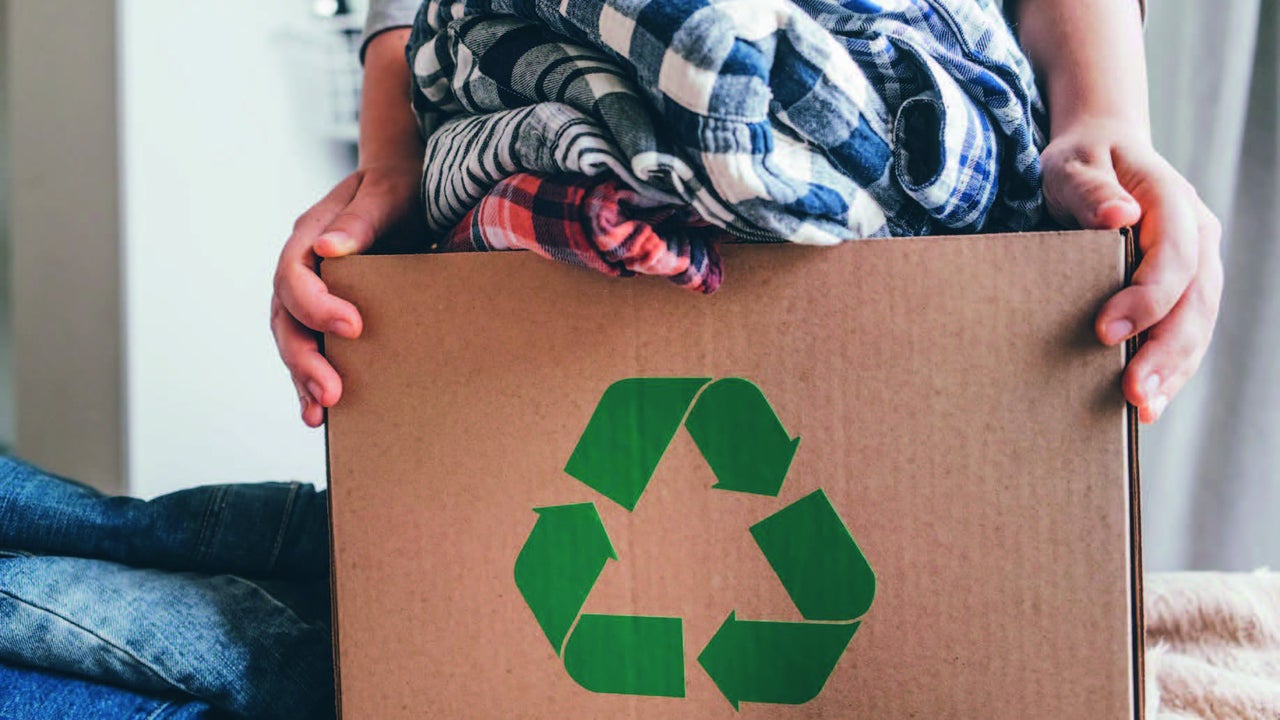
Circularity has become the great hope of fashion, An industry that produces clothes at a frantic pace and discarded it With the same speed, without time or ability to digest it. Every year 100,000 million garments are made in the world and, according to figures from the latest report prepared by the Global Fashion Agenda, 92 million textile tons end up groading the landfills. A problem that neither recycling nor second hand are able to mitigate – because only 13% end up recycling. Neither does the maximum of “buying less and better.”
The solution involves challenging the linear form in which the garments are manufactured and we interact with them, rethinking all the elements of the chain, to promote a rational use of resources, extend the life of the garments and turn what we now call waste into a new useful material. Too ambitious? Let’s say that implementing it is not easybut neither is a utopia.
On the contrary: in Spain, it is already a legal requirement. Law 7/2022 on contaminated waste and soils for a circular economy expressly prohibits the destruction of unveiled textile surpluses. In addition, it establishes that as of January 2025, these remains must have established a system of recycling, reuse or valorization. For this, collective systems of expanded responsibility of the producer (SCRAP) must be developed. That implies that All textile producing companies are already responsible for waste management that generate.
In this context of normative and environmental urgency, AIMPLAS, the Technological Institute of Plastic, is positioned as one of the key actors of the transformation in the country. It does so through leading projects such as “Textended”, an initiative financed by the European Union, to demonstrate that textile circularity is technically and economically viable. In its second phase, will be tested in a real environmentin which both citizens and industry will participate. The goal? Show your potential to reduce textile waste by 80%.
“This comprehensive approach will allow AIMPLAS to advance significantly in the sustainability of textile and plastic materials,” says the entity. Moving innovative solutions for recycling outside the laboratory. We believe that these will strengthen competitiveness and resilience through sustainability and digitalization, while generating new businesses, ”says Nacho Montesinos, a chemical recycling researcher in AIMPLAS.
To achieve this, they work with avant -garde technologies: optical sensors, RGB cameras and hyperspectral allow to identify and classify textiles according to their composition. In addition, the Institute will develop electrostatic and triboelectric methods to separate non -textile parts – cloaks, labels, buttons – as well as air classification techniques to differentiate types of garments. Everything, on a pilot scale, like advance of possible industrialization.
Innovation does not stop there. AIMPLAS also investigates the dissolution of PVC in textile waste, with the aim of facilitating the separation of materials for later recycling. In parallel, it advances in the chemical recycling of polyurethane foams, an omnipresent material in fashion (from soles to padded), for Recover reusable polyes in new formulations. These solutions seek to close the circle of the residue, transforming what was previously a logistics and environmental problem into a raw material.
But the Textended project is not limited to laboratories. It will last four years and its impact extends to urban environments Through a demonstrator that will operate on a real scale in European countries, including Spain, France, Portugal, Switzerland and Finland. Through citizen participation – preclassification actions, return of used textiles and workshops – it is sought not only to validate technologies, but also create a new culture of textile use and reuse.
In parallel, AIMPLAS has promoted the “Innorap” project, focused on the creation of SCRAP models, for textiles and fishing networks. This work, in the case of textiles, has contributed to the creation of Re-Viste, a national scrap driven by large manufacturers of the textile and footwear sector. All this marks a clear direction: the textile of the future will not burn or bury. It will be redesigned, separated and regenerated. Because the true textile revolution begins long before the garment reaches the closet.