
Vektrex is a precision guided munition that the American company General Atomics presented in 2023 as Long Range Maneuvering Projectile (LRMP) or long-range maneuverable projectile. It is designed to be fired from 155mm howitzers and, although it lacks an engine, deploys wings after launch that allow it to glide towards fixed or moving targets.
According to the company’s estimates, its reach exceeds 120 kilometers from a howitzer with a tube 39 calibers and the 200 km from another of 52 caliberswhose greater length favors reach. For reference, American howitzers of the first type reach about 40 kilometers with guided projectiles Excalibur.
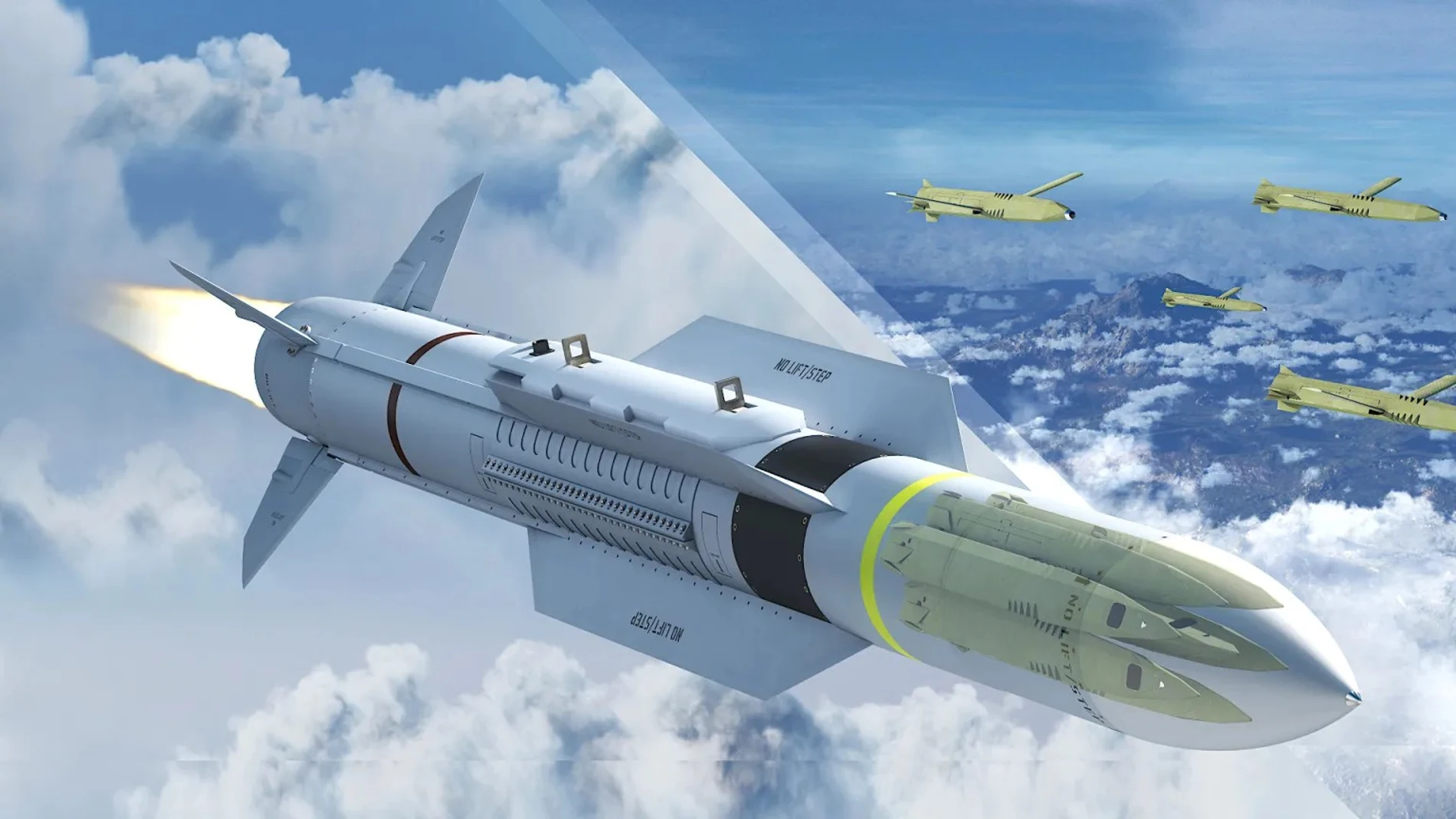
Now, General Atomics wants to adapt this technology so that it is a missile that carries several similar munitions and releases them during flight. ‘The missile-carried submunitions concept envisions a larger missile carrying and releasing several maneuverable Vektrex-derived projectiles.has explained Mike Ruckervice president of Armament Programs of the company, to The War Zone.
The proposal presented in Euronaval 2026 proposes hosting seven smaller Vektrex-derived submunitions in the front of an AIM-174B. This missile, also known as Gunslinger and officially presented by the US Navy in 2024, it is launched from aircraft to attack air targets, it is air-air.
The AIM-174B is derived from the SM-6which is launched from the surface, mainly from ships, to intercept aerial threats, although it can also attack surface targets. The proposed adaptation takes advantage of that kinship to give the AIM-174B a different function, carrying munitions that, once separated, can be directed towards seven different ground or naval targets, turning it into an air-to-surface weapon.
The range of this combination has not yet been established, but the SM-6 greatly exceeds 322 kilometers and TWZ considers it reasonable to place that of the AIM-174B in several hundred kilometers. The latter takes advantage of the speed and altitude of the aircraft that fires it, while the SM-6 requires an auxiliary booster for launch from the surface.
The submunitions could add tens of kilometers of glide from release pointbut it must be taken into account that The 120 and 200 kilometers planned for the artillery Vektrex cannot be automatically transferred to this reduced versionwhose performance would require its own evaluation.
This approach allows attacking targets deeper in enemy territory or several ships far from each other, keeping the launching aircraft at a greater distance from the defenses. A F/A-18E/F Super Hornet with two of these missiles it would take 14 submunitions and, with four, he would reach 28multiplying the objectives that could be attacked in an outing.
The main challenge is safely release those munitions from a missile traveling at high speedsubjecting them to mechanical and thermal stresses that their sensors and guidance systems must also withstand. The original Vektrex design should already withstand the forces of a shell shot, but adaptation would require additional validations and could require maneuvering of the missile to reduce its speed before separation.
For now, it is about a conceptual proposalwithout an acquisition program behind it. ‘We are internally exploring the concept of air-launched submunitions and He currently does not have a client to finance him.Rucker acknowledges. Meanwhile, General Atomics’ immediate priority remains moving the artillery version toward procurement.