
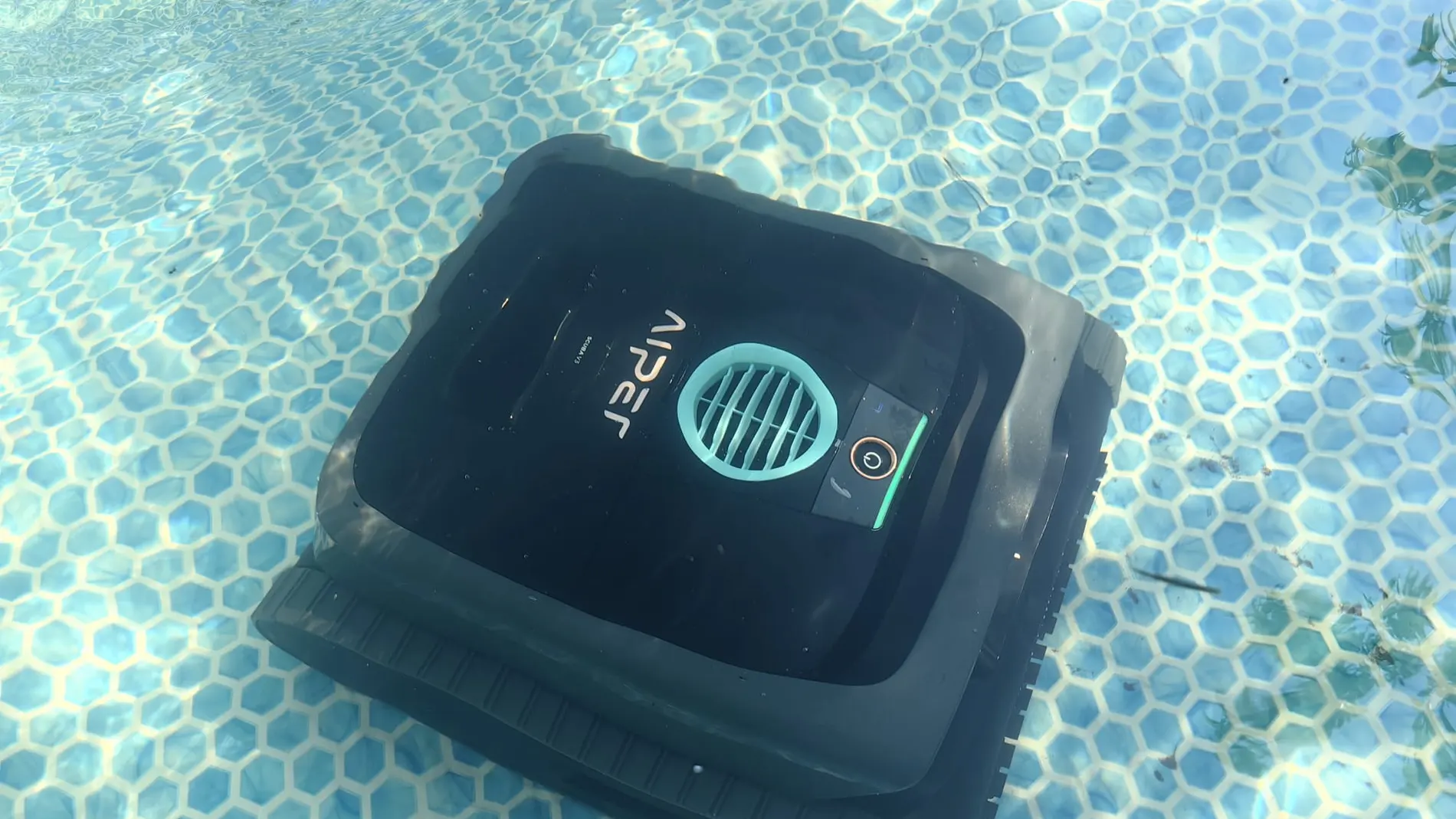
I’ve been using the Aiper Scuba V3 for almost a month and I confess that it is one of the gadgets that makes reviews a fun job: watching it sink into the pool and suppressing the instinct to pull a robot out of a submerged environmentknowing that everything is going to be fine, is something new.
For years, pool cleaner robots have had a fairly simple mission: enter the pool, move around it and vacuum up everything in their path. The problem is that a swimming pool is not empty ground. There are leaves, sand, hair, algae, obstacles, corners and areas that the robot has already cleaned. Knowing where the dirt is can be almost as important as having enough power to vacuum it up.
Aiper’s idea with the Scuba V3 is to solve precisely that problem. Its main novelty is not in how much it aspires, but in how it decides where to go to avoid turning 10 times in the same place and wasting battery in one square meter. A camera, dToF sensors and artificial intelligence algorithms allow the robot to recognize its environment, locate debris and modify its trajectory based on what it finds. It is, in a way, going from a robot that goes around a pool to one that tries to understand it. And that difference is noticeable. But let’s go separately.
A dToF (direct time of flight) sensor is a technology that measures exact distance by calculating the time it takes for a pulse of laser light to travel from the emitter to an object and return to the receiver. If the next question has to do with how he does this underwater, it’s a good question. Aiper has worked on this by using a green laser instead of the usual red and adding speed compensation algorithms: the robot’s microprocessor is programmed with the refractive index of water. In a nutshellknows that the speed of light there is lower and recalculates for a much more precise measurement.
Now, let’s get to the navigation. Between us, I would have liked that, Taking advantage of the camera, I could see underwater with the appjust as we can see with the camera of robot vacuum cleaners. It is not yet the case.
Aiper has called its route planning system VisionPath, which combines a camera with dToF sensors to build a perception of the environment. But despite not being able to feel like Cousteau, The camera is not there simply to record images. The AI system is trained to recognize more than 20 types of debris and distinguish them from obstacles and, most importantly, actively search for them. And this is one of the big differences with a robot vacuum cleaner: it doesn’t just go around following an established circuit, it looks for waste.
Let’s go with the app. The first thing is that, once in full operation (underwater), the information is minimal; We only know that it is working: there is no data on the battery, nor on the percentage of surface covered… It is logical, underwater it has no signal and it is controlled by AI and its sensors and camera. Aiper also offers a mode called AI Patrol Cleaning, designed to locate waste autonomously. AND Cognitive AI Navium mode can create cleaning plans taking into account factors such as pool sizeweather conditions and cleaning history. We can program the frequency and even the cleaning time and time of each routine. Whether from the bottom, the walls or the waterline.
Another of the most banal attractions is seeing the Scuba V3 use its tracks to move along the bottom and climb the walls. Of course, once the routine is finished, you have to pick it up and take it to its charging station; He doesn’t go alone. The upside is that when it’s done, it approaches the waterline, sends a notification, and starts draining itself.so that when we lift it, it is not so heavy. This detail is very well thought out.
Fundamental topic: battery. It is close to three hours of work (depending on the routine we program, it can be enough for different types of pool). Personal recommendation: Do it by sectors, first the background and then the walls, and create routines. This has to do with its charge: it needs 5 hours to reach 100%. It is better, therefore, to know what to invest in each time.
Finally, one last unmissable experience. The Scuba V3 It incorporates two LED lights along with the vision system. Its function is not only to illuminate the path, but also to allow the camera to continue detecting debris when light conditions are poor. This means that, at night, the pool emits a light that touches on ET cinematic moments and gives the garden a look that enchants. It is worth not saying anything so that the rest of the household is surprised.
Verdict: The Scuba V3 makes a lot of sense for a pool starting at 7,000 liters. Cleaning most of the surfaces available on the market, even many removable ones, makes it a summer facilitator. It saves a lot of time and does it efficiently.