
The position of Congressman Mario Díaz-Balart regarding Ceuta and Melilla is not an isolated fact, a bad translation or a simple terminological confusion. Nor can it be reduced, as it has crudely attempted to do, to a purely geographical observation. In an interview with “ABC”, Díaz-Balart stated: “Just look at a map. Just as the Rock of Gibraltar is located on the Iberian Peninsula, Ceuta and Melilla are located in North Africa. That’s a fact. It is not a political question; “It’s a geographical question.”
His explanation to get by, far from correcting the problem, aggravates it. As my grandmother says: “Ignorance is bold; even more so when it is shown off. The declaration reveals a flagrant ignorance of the historical, legal and geopolitical principles that regulate the sovereignty of States. It is hard to believe that such reasoning comes from someone with a degree in Political Science. Geography does not determine sovereignty. Hawaii is a state of the Union located in the Pacific; Alaska; separated from the 48 continental states by Canada; and Puerto Rico are American territories far from the continental territory, and countless in world geography. None of these territories cease to belong to their respective State due to their geographical location.
I wonder if, applying his peculiar cartographic doctrine, the congressman plans to start a global crusade to question the sovereignty of territories belonging to NATO member states. Or does your geographical obsession only activate when the harmed country is Spain?
But, as I said at the beginning, this is not the first time that Díaz-Balart adopts positions contrary to Spanish territorial integrity. The registry of foreign agents, regulated by the Foreign Agents Registration Act (FARA), constitutes a huge source of information on the activities carried out in the USA by foreign governments, organizations and pressure groups.
Among its documents I found the registration of the Delegation of Catalonia to the United States, registered with number 6220 and then domiciled at 360 Lexington Avenue, suite 1801, New York. The entity declared that it acted on behalf of the Government of Catalonia and carried out political pressure activities.
A semi-annual report from the Department of Justice described its activity: “The registrant met with US officials regarding the political situation in Catalonia.” The document also recorded $125,286.53 during the semester ending on 11-30-2015. It should be noted that the registrant was the Delegation, not a natural person. It would be convenient for the Court of Auditors and the other competent supervisory bodies to determine precisely the budgetary origin, justification and destination of that amount.
He must rectify Ceuta, Melilla and Catalan separatism
It all officially began on September 9, 2015, when Roger Albinyana, then Secretary of Foreign Affairs of the Generalitat, met in the US Congress with Mario Díaz-Balart and other congressmen. On September 26, 2015, “El País” expressly included Díaz-Balart among “the three United States congressmen who defend the right to decide” and presented him as one of the allies of the Generalitat in Washington. The newspaper pointed out that, despite being co-president of the Friends of Spain caucus, he disagreed with the position held by the main Spanish parties and with the Spanish constitutional framework regarding Catalan separatism.
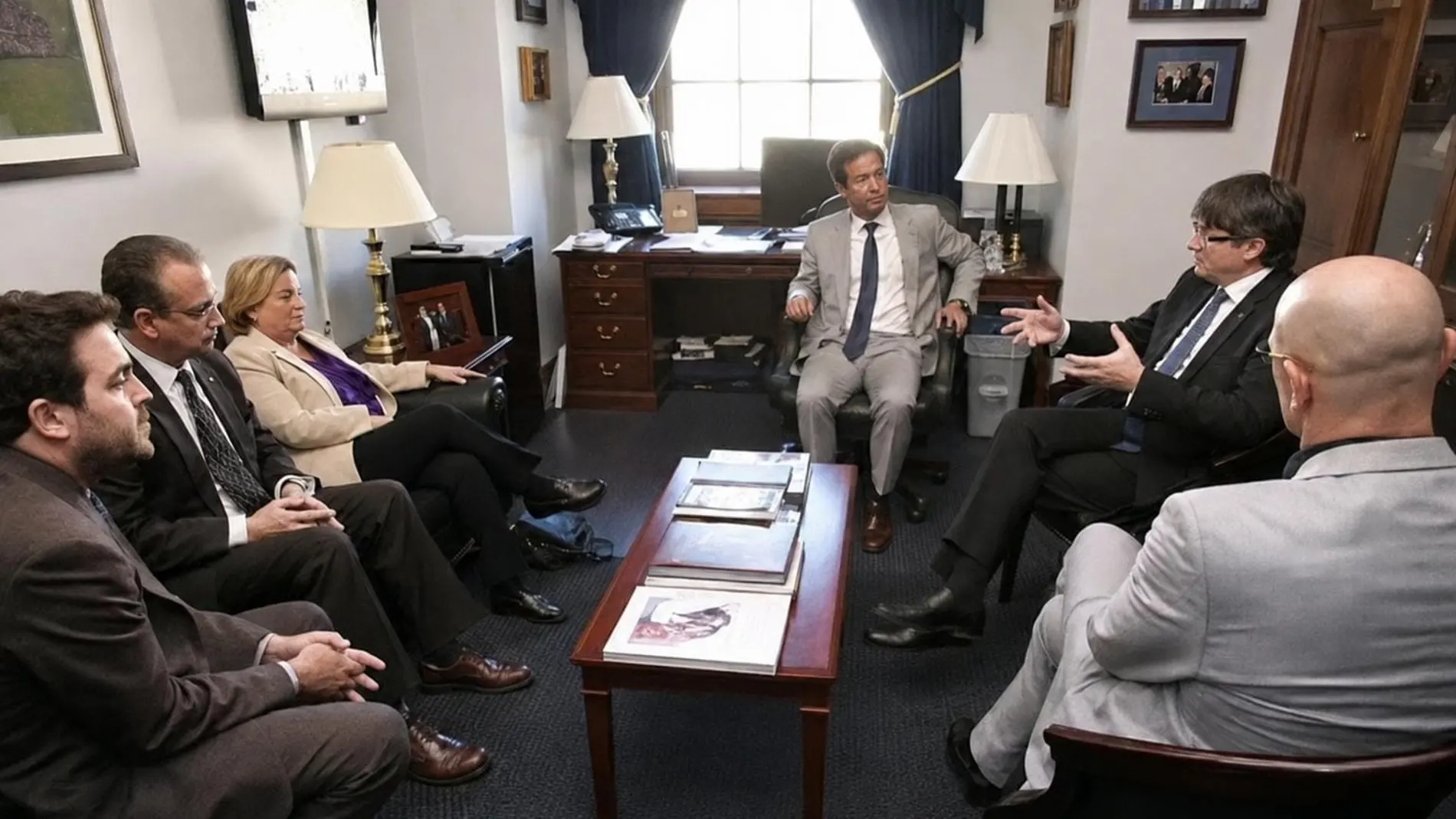
On March 29, 2017, Díaz-Balart received Carles Puigdemont and Raül Romeva at the Capitol, along with Ileana Ros-Lehtinen and Carlos Curbelo. According to Puigdemont, the three congressmen maintained a “position clearly committed to the right to self-determination.” “El Confidencial” even referred to Díaz-Balart as “the new American friend of Catalonia.”
It is legitimate to wonder to what extent Díaz-Balart really knew about the project to which he was giving political support. How could he support a cause around which many leaders and propagandists had come to formulate arguments about genetic singularity, cultural superiority and collective identity with National Socialist resonances? I do not believe that Díaz-Balart shared such approaches, but he did contribute to legitimizing a movement in which this rhetoric circulated, protected under the democratic guise of the so-called “right to decide.”
Months later, the “Washington Examiner” reported that the Generalitat had been maintaining contacts in Washington for years specifically related to the separatist project. Andrew Davis, delegate of the Catalan Government in the USA, acknowledged that he discreetly kept his interlocutors informed and that the legislators considered favorable were perfectly aware. The media also recalled the meetings held since 2015 between representatives of the Generalitat, Díaz-Balart and other congressmen.
On November 15, 2018, coinciding with the reopening of the Generalitat Delegation in Washington, Díaz-Balart met again with Ernest Maragall, then Minister of Foreign Action, and with the delegate Victoria Alsina. In the documentation presented to FARA, the Delegation itself defined, on paper, its activities using a formula apparently respectful of Spanish law: “facilitate relations, within the scope and powers of the Government of Catalonia, with the United States.”
However, the statements made that same day by Maragall deny that the purpose was solely administrative, cultural or economic. The counselor announced that they would work so that Catalonia obtained “explicit recognition of its condition as a country, of its condition as a nation that has a life of its own,” proclaimed that “we will win our right to exist as a nation, as a people” and confirmed that the situation of the imprisoned separatist leaders would be present in the activities of the Delegation. The contradiction is evident and forces us to wonder if the reference to respect for autonomous powers was nothing more than a formal cover intended to appear to comply with the law, while the office continued to be used to internationalize the separatist project. Despite all this, Díaz-Balart once again served as the Generalitat’s political interlocutor in Washington.
By then, Puigdemont was already on the run from Spanish justice and the Supreme Court had opened an oral trial against the main leaders of the separatist process for the events related to the illegal referendum and the unilateral declaration of independence.
The most striking thing is that on that occasion he also acted contrary to the official US position. On September 26, 2017, President Donald Trump had been blunt: “Spain is a great country and must remain united.” Following the unilateral declaration of independence, the State Department reiterated that Catalonia was an integral part of Spain and supported the constitutional measures adopted to keep the country “strong and united.” However, Díaz-Balart continued to receive separatist representatives and helped them present an internal Spanish conflict in Washington, as if it were an international controversy.
If Díaz-Balart defends the “right to decide” so much, would he accept the fragmentation of the United States with equal enthusiasm? Hardly: its constitutional doctrine considers the Union indestructible and denies unilateral secession. Apparently, this right only seems legitimate when the threatened nation is Spain.
For the “right to decide”
While many Cubans, including the writer of these lines, defended the constitutional unity of Spain in the streets of Barcelona, Díaz-Balart supported the so-called “right to decide”, a process that would end up burning Catalonia, destroying public and private property and leaving police officers disabled.
It is especially paradoxical that a congressman whose career has been built around the fight against communism ended up supporting a separatist demand also supported by the Cuban Communist Party and its political networks in Spain. Even the separatist agitation groups adopted the acronym CDR, identical to those of the Cuban Committees for the Defense of the Revolution. A coincidence full of irony. It seems that Don Mario’s agendas got crossed.
At this point, the congressman must offer a public apology to the Spanish people and rectify his positions on Ceuta, Melilla and Catalan separatism. A foreign official who has repeatedly questioned the sovereignty and territorial integrity of an allied state must be held accountable.
We will continue investigating. Who knows if Díaz-Balart’s commitment to the “right to decide” was limited to Catalan separatism or if it also reached Basque separatism, Corsican separatism in France, Padania in northern Italy, Bavarian secessionism in Germany or any other project aimed at fragmenting allied states.
The congressman likes to talk in Congress about the sovereignty of allied states and with issues that, given what he has seen, he does not understand and that, of course, he has no capacity to solve. However, it can confuse them considerably and generate unnecessary problems for American diplomats. All this while clashing head-on with the doctrine of perpetual Union defended by Abraham Lincoln.
Sayde Chaling-Chong García He is president of the Ibero-American and European Association Against Communism (AIECC)