
The arrival of quantum computers provides a much greater computational power than traditional computers for certain problems. This is due to Its enormous capacity to solve problems in a much smaller time and with greater power. Basically, quantum computers do not operate with the binary bits system (zeros and some), but with qbits, capable of being zeros and some at the same time thanks to the properties of the quantum world.
But this, which is positive for research, also opens a door to break the security of communications, since current encryptions can be deciphered in seconds. Therefore, it is fundamental The development of a system that allows to send information with the necessary guarantees in government communications (civil and military) environments, Critical infrastructure management and applications and services of economic, environmental or technological interest, as well as large corporations.
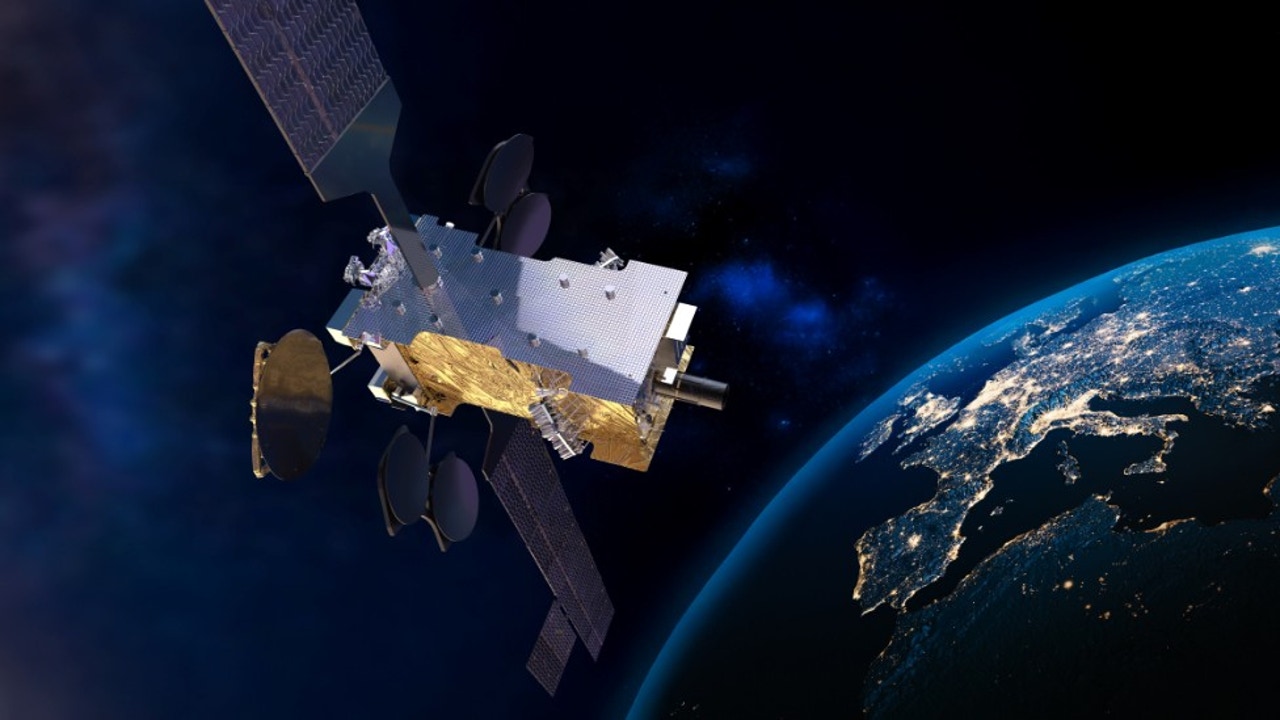
How to protect yourself then? An option is to develop a satellite capable of creating a shield, in the form of an indecipherable key, that neither the most powerful quantum computers can cross. This is the objective of the QKD-Geo mission, The most advanced civil project in this regard. Distributing keys impossible to hack, It will act as a barrier that may not cross even the most advanced quantum computers.
The QKD-Geo mission is the most advanced civil project in this regard. Distributing keys impossible to hack, it will act as a barrier that they will not be able to cross even the most advanced quantum computers.
The quantum key distribution (QKD) works basically transmitting many light particles, or photons, through fiber optic cables between the parts. Each photon has a random quantum state and, collectively, the envied photons form a current and quantum zeros (the aforementioned QBits). When a photon reaches its receiver end, it travels through a divisor that forces photon to randomly take a path or another to a photon collector. The receiver responds to the sender with data on the sequence of the photons sent and the sender then compares them with the issuer, which each photon would have sent.
“Incorrect” photons are discarded and what remains is a specific sequence of QBits that It can be used as a key to encrypt data. Any error and data leakage are deleted during a error correction phase.
The shield is being developed by Thales Alenia Space and Hispasat, the operator and provider of redeia satellite services and will become, next year, in The first geostationary system for Spanish quantum distribution.
An advantage of this satellite shield is that the fiber optic -based terrestrial networks can only preserve the integrity of the system in distances below hundreds of kilometers, since from that figure they suffer signal losses. Instead, The use of the satellite for the sending of quantum keys allows to cover any distance.
The QKD-Geo project will be launched in 2026 and To date there is no quantum key distribution system from geostationary orbit. As for its configuration, the geostationary payload is made up of a high precision telescope with an integrated point and electronic mechanism, a quantum generator of random numbers, a source of polarized photographs, a laser beacon and a processor in charge of generating the keys and implement the communication protocol.
At the same time there will be A land test that will be formed by a telescope for the reception of the photographs sent from space and recover the keys and of an operations center, which organizes and controls all the activities of the system, both of the spatial segment and of the users.
The project also includes the realization of Field tests with an atmospheric link of 140 km between the Palma and Tenerife Islands, which will allow the functional validation of the land segment and of the payload in fully representative contour conditions, as a prior step to its implementation in an operational mission in orbit.