
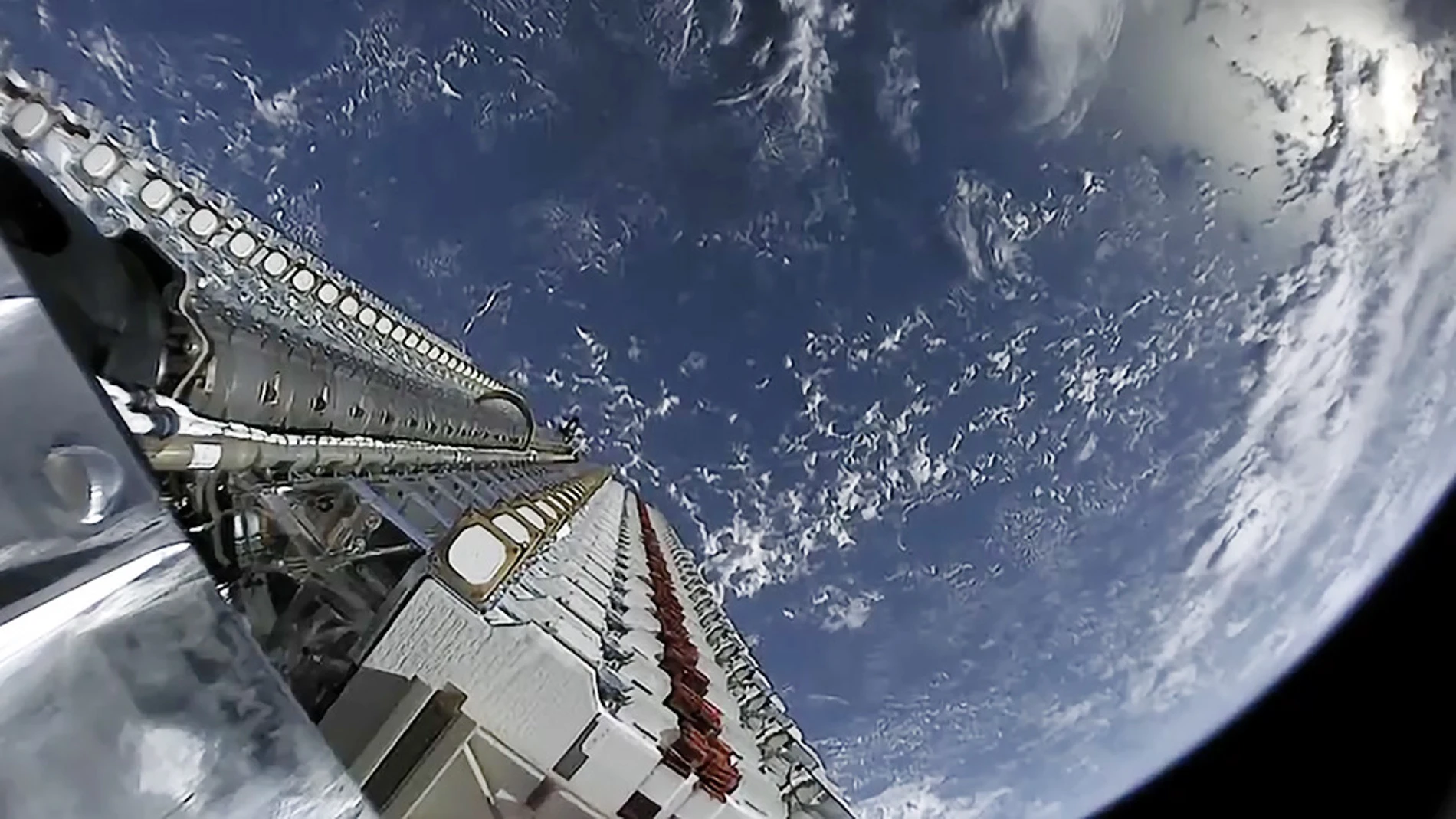
It is known that the Earth’s orbit is increasingly crowded, but the risks that this implies are not so much. These are given numbers in the reports that SpaceXthe company with the largest number of satellites in space, presents every six months to the United States Federal Communications CommissionFCC for its acronym in English. According to the last two, between June 1, 2025 and May 31, 2026, the constellation Starlink carried out no more and no less than around 355,000 maneuvers to avoid collisions.
The most recent document includes 207,152 evasive maneuvers between December 2025 and May 2026. In the previous six months, other 148,696. Together, each satellite in the constellation that provides broadband internet corrected its trajectory more than 40 times on average during that period, which is equivalent to almost one maneuver per week to avoid a possible accident.
The volume of movements has skyrocketed as Starlink has expanded its presence in low Earth orbit. The SpaceX network went from having around 6,000 satellites in 2024 to exceed 10,000 in June 2026. During those two years, the total number of operational ships around Earth also increased. from about 10,000 to about 16,000.
The company’s satellites Elon Musk They orbit at altitudes of between 480 and 550 kilometers and they have an autonomous collision avoidance system. It modifies its trajectory when it calculates that the probability of impact exceeds three in ten million. The company has also chosen to make its satellites automatically move out of the way when they receive an approach alertwithout waiting to coordinate the maneuver with the operator of the other object.
Space.com has spoken with several experts in sustainability and orbital safety, who recognize SpaceX’s efforts, but warn that the growth of constellations can make that the problem becomes increasingly difficult to control.
‘I think we are heading towards a situation where there will be a collision involving an operational satellite in the constellation. And it will not be for lack of attempts to avoid it. It will happen despite all those maneuvers‘, he stated to the media Hugh Lewisprofessor of astronautics at the University of Birmingham.
Lewis believes that SpaceX is making ‘an excellent job’ in orbital traffic management. The problem, as he explains, is that even a very low risk can become significant when the same operation is repeated hundreds of thousands of times.
‘Avoidance maneuvers reduce the probability of collision to about one in a million, a figure so small as to be insignificant. The problem is that if you make a million maneuvers and maintain a residual probability of one in a million, you end up with added risk across the entire constellation that you cannot eliminate.‘, he points out.
Starlink could reach one million maneuvers accumulated since the beginning of the constellation in June 2027. By 2030, this could make more than a million each year. SpaceX has also requested permission from the FCC to expand its network. up to 100,000 satellitesa figure that would greatly increase the number of approaches that must be monitored.
Tommaso Sgobbadirector of the International Association for the Advancement of Space Securitymaintains that ‘the more satellites you introduce into an orbital slot, the more pairs of satellites there are whose trajectories could intersect. Adding satellites does not increase the risk one by one, but rather multiplies the number of possible pairings. If you double the satellites in an orbital slot, you approximately quadruple the number of pairs that need to be monitored‘.
Sgobba also warns that trajectory predictions continue to have a considerable margin of error. Atmospheric drag changes with solar activity and space weather, making it difficult to accurately calculate the future position of each object. As a consequence, ‘Satellites frequently avoid ghosts, consuming fuel and shortening their operational life in the process’.
The problem is not limited to Starlink. amazon is unfolding its constellation Amazon LEOwhile China works in Thousand Sailsalso known as Qianfan. The latter could occupy orbital regions similar to those used by SpaceX. Added to these are several space data center projects that also aim to operate in specific areas of low Earth orbit.
Lewis proposes separate constellations by altitudes to prevent their paths from crossing. This solution would, however, open a debate on the available capacity and the advantage of companies that arrive first in an orbital region.
Sgobba calls for greater intervention from regulators. In his opinion, companies should present before each authorization an estimate of the annual number of maneuvers required and demonstrate that their satellites have sufficient fuel and automatic systems to execute them.
‘Orbit saturation is not an accident waiting to happen. It is a predictable and manageable engineering workload, and regulators should treat it that way, requesting these figures beforehand rather than reacting afterwards to headlines about dangerous approaches‘, he concludes.